The Herculean Task of Being a Woman

La Colonna dell’Immacolata c. 1880. Via

Today, in Italy, is the Feast of the Immaculate Conception. It celebrates “the sinless life of the Blessed Virgin” and officially begins the Christmas season.

In Piazza di Spagna, there’s a tall column with a statue of Mary on top. This morning a fireman will be lifted with a crane so that he can place a wreath of flowers on the statue’s head. Later in the day, after various processions, the Pope will arrive to honor Mary, too.

Knowing that the area would be crowded with people, we walked towards the Pantheon instead. For years there was no entrance fee and the Pantheon was always fairly empty. But now that you must pay to get in, there’s always a line. Aren’t people funny?

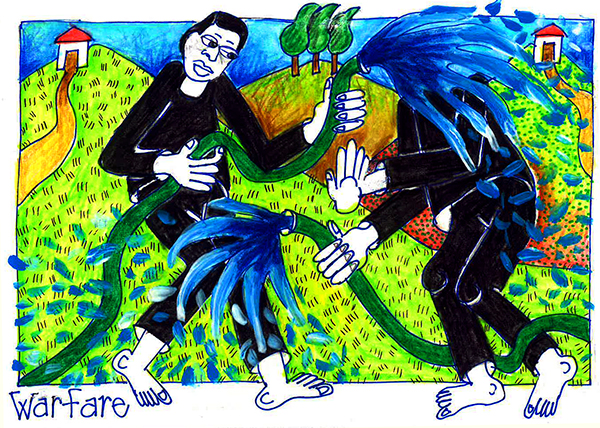
We walked towards Piazza Navona and its side streets where there are many boutiques and antique shops. It was great fun window shopping. Or at least it was until I saw a bust of Hera next to a statue of Hercules. How could this be possible? Everyone knows that Hera and Hercules couldn’t stand one another. So why force them to share the same limited space?

Hera’s husband, Zeus, was a real womanizer totally lacking in decorum. The first time he saw the beautiful mortal, Alcmene, Zeus’ biorhythms went into tilt. He was so aroused that he disguised himself as Alcmene’s husband so that she would not object to having sex with him. But later that night, Alcmene’s real husband came home and wanted sex, too. This led to Alcmene’s double impregnation (known as hetero-paternal superfecundation) and the subsequent birth of twins who had different fathers.

When Hera learned that Alcmene was pregnant with her husband’s baby, she went berserk. Hera, despite being the protectress of women during childbirth, was ready to have Alcmene’s baby slaughtered. But Alcmene, aware of the danger her child was in, took her Zeus sired baby, Hercules, to Athena for help. Hera later showed up at Athena’s and, not recognizing the baby as that of Alcmene and Zeus, felt sorry for the skinny little baby and nursed him. But the baby sucked so hard that Hera pushed him away causing her milk to spray across the sky thus creating the Milky Way. But what milk baby Hercules had managed to drink had given him supernatural powers. Hercules became very strong and, even as a baby, was not afraid of anything.

Because of his strength, he earned quite a reputation for himself and even managed to marry the daughter of a king. Pity that every time Hera saw Hercules, it reminded her of her husband’s betrayal. One day her wrath overpowered her. She put a spell on Hercules that made him go crazy and kill his family. Once he had realized what he had done, Hercules fled to Delphi to seek advice. For atonement, the Oracle gave Hercules a series of tasks to complete.

Although Hercules finished the 12 Labors assigned to him, he just couldn’t stay out of trouble. In a rage, once again, he threw his friend Iphitos, over the city wall. This time the Oracle decided that, as punishment, Hercules should be sold as a slave to the recently widowed Omphale, Queen of Lydia.

Omphale was thrilled. Finally, she had a chance to subject a man to those things women had always been subjected to: subordination and humiliation, obligation to do menial chores, and sex on demand. To help Hercules visualize the difference between them now, she insisted on their cross-dressing to underline the inversion of roles. Hercules was expected to flutter around the house wearing silk clothes as he did household chores. Omphale, instead, now wore the skin of the Nemean lion Hercules had slain as one of his labours.

Eventually Omphale freed Hercules and the two married and had a son. But having had to live as a woman had scared Hercules so much that he escaped the first chance he had leaving his wife and son behind. He returned to Greece where he married for the third time making another big mistake.

-30-

Related:

The Tumultuous Tale of Heracles and Hera + Labours of Hercules + Hercules and Omphale + Crossed-Dressed Lovers: Omphale and Hercules + History of cross-dressing + Artemisia Gentileschi Painting of Omphale and Hercules Damaged +

Posted in art, female consciousness, Rome/Italy | Tagged , , , , , , , , , , | 5 Comments

The Copyists

In 1776, the Declaration of Independence was signed proclaiming the emancipation of the 13 American colonies from Great Britain. But political independence does not automatically presume a cultural one.

America was indeed the land of plenty thus providing the opportunity to evolve economically. The number of nouveau riche grew and, with them, new needs. Of course, if you have money, you will want to, at some time or another, show it off.  Huge mansions were built and well furnished. Only there was nothing to hang on the walls.  The new country was so young that there had not been time to create a culture of its own. All they could do was to appropriate from their European roots. And, to do so, Americans needed to send young artists to Europe to copy important masterpieces. “High art” had to be imported. And assimilated.

Copyists at the Louvre by Winslow Homer, 1868 via Archive

So young artists headed towards Europe to copy masterpieces. The highest concentration of art was in Rome thanks, in great part, to the Vatican. These artists were known as “copyists” because that’s what they did—copy. Women were considered perfect as copyists as they . could make affordable copies leaving the men to make the expensive originals.

By the mid-1800s, Rome had a large community of foreign artists living in Rome because it was cheap and had the biggest collection of art to copy.

Emma Conant Church (1831-1893) was the daughter of a Baptist minister and religious reformer. He believed in higher education for women. It was thanks to this reformistic view that Emma was given the freedom to study and to paint in Europe. Emma was one of the few working women artists before the Civil War.

Arabia Steamship

In 1860, Emma and her brother, a newspaper correspondent, docked in Liverpool having arrived on the Arabia steamship. They moved towards Paris where Emma immediately applied for the card that would give her permission to copy paintings at the Louvre. In 1861, even in Paris women were not allowed to attend art school. The ladies took private lessons if they could afford them. But since it opened, the Louvre was where artists went to learn about the Old Masters by copying them.

Copyists flooded galleries and museums and, with their easels in front of well-known paintings, they would spend so much time at museums that it is where they felt most at home. Copyists lived in museums during the day and in a garret at night.

At museums, people would observe them with curiosity. Often the presence of these ladies disturbed male visitors who were more accustomed to seeing women in passive roles and not as protagonists.

In 1862 Emma arrived in Rome. Italy was in the conflictual process of unification known as the Risorgimento. Nevertheless, for American visitors, Rome was cheap and accommodating. Emma achieved her greatest success in Rome. Although her family was not wealthy, in Rome, Emma was able to maintain herself.

However, with the unification of Italy, things were radically. In 1867, Rome was in the middle of a revolution with nationalists pitted against French supported forces for control of the city. It seemed best for Emma to return to NYC where she opened a studio. She was successful but the poetics she’d felt in Rome were missing. In 1868, Emma returned to Rome and set up studio at via di San Nicola da Tolentino 68.

After the Risorgimento, it became more difficult for artists in Rome. The new political climate meant there were changes in the accessibility to the Vatican museums as well as to private collections. Many artists now opted for Paris and Rome’s cultural hegemony dwindled. Paris, under the direction of Napoleon III, was an exciting city in transition with Haussmann knocking down buildings to make room for boulevards and with the Impressionists creating new dynamics in the art world.

On his tour of Rome in 1862, Vassar College’s president, Milo P. Jewett, commissioned four copies from Emma including a copy of Guercino’s “The Incredulity of St. Thomas”. The following year Vassar College trustee, M. B. Anderson, was in Rome. After seeing copies of Emma’s paintings, he said that they’d been executed with “the most conscientious fidelity to the original and with the most complete success” and better than any other copies he’d seen. Everything was Zippity do Dah until Emma sent her bill to Vassar. They found Emma’s prices too high (didn’t they set a price before agreeing on the commission?). However, Emma was irritated, too. Generally, artists are paid half their commission from the beginning. But this hadn’t happened with her, and, as she had already paid the expenses involved with the painting including the framing, she needed to see some money. Eventually the artist and college reached an agreement as three of Emma’s paintings still belong to Vassar.

Need Light?

-30-

(Ekphrastic Copyists ©)

Related:

How America Became Rich, According to a Historian in 1802 +

Infesting the Galleries of Europe: The Copyist Emma Conant Church in Paris and Rome by Jacqueline Marie Musacchio + The case of Emma Church is a curious glimpse into the early history of Art at Vassar College +

Other ex-pats in Rome: Anne Brewster who wrote for American publications + Anne Whiteney, sculptor and poet + Abigail May Alcott Nieriker who studied in Rome with Frederic Crowninshield +

Posted in art, Drawings & Paintings, Rome/Italy | Tagged , , , , , , , , , | 1 Comment

Back to the Garden

Genesis narrates how God created the heavens and the earth followed by the stars, the plants, and the animals. Then God picked up some dirt, gave it a form, blew air into it and, voilà, created the first man, Adam.

God placed Adam in a garden now known as Eden where there were many trees. God gave Adam permission to eat the fruit from all the trees save one, the Tree of Knowledge. But not all the fruit in the world could keep Adam from feeling lonely. God knew well how difficult it was to be alone. So God took one of Adam’s ribs and created Eve.

Now the instructions not to eat from the Tree of Knowledge were given to Adam before Eve’s creation. But once briefed on the fruit, Eve stayed away from it. That is, until the snake showed up. The snake criticized Eve for fearing the fruit but Eve replied that to eat the fruit meant risking one’s life. The snake told Eve she’d been duped because eating the fruit would not kill her but, instead, give her the power to distinguish between good and bad on her own. Finally convinced, Eve ate the fruit. It was so good that she offered some to Adam who, without hesitation, ate it, too.

After just one bite, the couple’s eyes were opened to reality and they realized, for the first time, that they were naked. Ashamed, they hid. But God found them and asked why they’d eaten the fruit. Adam cowardly dumped the blame on Eve. Eve, on the other hand, was more courageous than her husband and admitted that she’d eaten the fruit because the snake had been so convincing. God told Eve that he would eternally punish her and all other women as well by inflicting much pain on them when giving birth to their babies. As for Adam, his punishment was that of having to work and sweat if he wanted to eat. With that said, the couple was then eternally banished from the garden.

The story of Eve has had a profoundly negative effect on women and the way they are perceived. For over 2,000 years, the Bible has been interpreted from a patriarchal and misogynist point of view. For example, the patriarchs claimed that women were inferior because man was created first. However, in Genesis, animals were created before man. So, if we were to use the same logic as the patriarchs, it would mean that a donkey is superior to man.

The epistle of I Timothy prohibits women from speaking as they must “learn in silence with all submissiveness.” This epistle was written by Paul who, before his conversion, vehemently opposed Jesus and his followers. Paul never met Jesus and it was at least 40 years after Jesus’ death that the writings of the first gospels appeared.

Christian theologian and moralist, Tertullian, taught that women were the Devil’s gateway. But Jesus never said such a thing. To the contrary, he had the upmost respect for women and saw them as equals to men.

Eve has been blamed for the burden of Original Sin but it is a concept invented by theologian Augustine of Hippo (354 – 430 AD) and not the Bible.

The Milanese bishop, Ambrose, said women’s only importance was that of procreating whereas Thomas Aquinas claimed that women were “misbegotten males.”

In 1895, Elizabeth Cady Stanton decided that it was time to liberate the Bible from patriarchal bias. With the help of other women, Elizabeth wrote The Woman’s Bible, a collection of critical commentaries on Bible texts with the precise intent to question male translations and interpretations of the Bible that constantly presented women as inferior to men. Pity that many women did not want the book to be published fearing it would negatively affect the suffrage movement. Although the book became a bestseller, Elizabeth lost her influence on the women’s movement. Unfortunately, despite being Suffragettes, many women had not yet learned the importance of Synergy & Solidarity.


This misrepresentation of the role of women has done more than damage women’s feelings of self-esteem. Thinking that they are superior, there are those men who feel they have a right to command women and punish them for their “disobedience”. How many women have been murdered by a man who once told them “I love you”?

There is an obvious war on women going on today promoted by false and misogynist prophets. The patriarchal bias that prevails is destroying the world. Just look at the decadence and destruction that surrounds us—ecological catastrophes, wars and the slaughtering of little babies, poverty and homelessness. And hatred towards anyone who’s diverse from ourselves.

We do not need any more men with busted egos telling us what to do. What we women do need, however, is to reclaim our role as Cosmic Mothers who sustain and honor life.

-30-

Related:

The Apostle Paul + Empathy and Ecofeminism
 GENESIS FROM EVE’S POINT OF VIEW + Five essential facts to know about femicide +  The Tree of Knowledge as Consciousness + First Council of Nicaea + Council of Trent +

Julian Jaynes and the Old Testament +

Femicide is up. American history says that’s not surprising + The great cosmic mother, rediscovering the religion of the earth online HERE +

Posted in Art Narratives, Beauty, Ecofeminism, female consciousness, Synergy and Solidarity | Tagged , , , , , , , | 2 Comments

Autumn Leaves

Birds are magnificent architects and construct fascinating nests for their families. Bowerbirds, for example, build simple structures but decorate them with colored objects hoping to attract a companion. Barn swallows make nests from mud that are built onto man made structures such as barn rafters. Then there are the weaver birds such as the Baya capable of collecting long grasses and intricately weaving them into sophisticated structures worthy of AD Magazine. But the nests that I can most relate to because of their simplicity and practicality are those of the malleefowls.

The malleefowl is a stocky ground dwelling bird that’s the size of a chicken. Shy and solitary, the male, as with most birds, has the responsibility of constructing the nest.

Using his claws, the malleefowl tries to gather as much organic material as possible (such as leaves) to build a huge mound on top of a compost pile. It’s like a giant incubator because the decomposition of the organic material provides the heat necessary for the eggs to hatch. So all the momma bird has to do is lay her eggs then go. Because it’s the leaf litter that incubates the egg and not the mom.

While the malleefowl male is busy trying to keep the temperature of the mound stable, the female is busy laying eggs. An egg is laid about every five days or so and, during a normal season, she can lay up to 32 eggs.

But once the eggs are hatched, the chicks are left on their own. There will be no momma bird to bring them worms to eat. In fact, they will have no contact with adult birds and, as they grow older, will tend to ignore other birds unless it’s to mate or to fight over territory.

The malleefowl’s mound of leaves reminds me of John Everett Millais’s painting “Autumn Leaves” (1856). Four young girls are standing in front of a big pile of leaves meant to be used for a bonfire. Only the leaves produce little more than smoke.

Millais loved the smell of burning leaves. It reminded him of his childhood and how the smell of burning leaves represented the end of the season.

Millais painted this in his garden in Scotland after returning from his honeymoon with his new bride, Effie Gray. Effie had previously been married to art critic, John Ruskin, but the marriage had been annulled as it had never been consummated. Apparently, Ruskin had been repulsed by his wife’s pubic hairs. After all the Greek statues he’d seen and studied, he was not ready for the real thing.

The painting shows four young girls in front of a pile of leaves. The two girls on the right are his wife’s sisters, Alice and Sophie Gray. They are dressed in nice clothes whereas the other two girls are shown in working class clothing. It’s twilight and the day is ending. In many ways, the painting is about the transience of youth and beauty.

The protagonist here is Sophie Gray in the middle. Fifteen years younger than her sister, Effie, Sophie was very beautiful and became Millais’ favorite model during his Pre-Raphaelite period. But maybe too much emphasis was placed on her beauty as it caused her to have a distorted image of herself. She began to suffer from anorexia nervosa and her health rapidly declined. By 1868, Sophie was sent to an asylum. Although she later married and had a child, Sophie’s health continued to decline. Dramatically emaciated, her body broke down. She died of “atrophy of the nervous system” in 1882 at the age of 38.

Beauty is as ephemeral as burning leaves.

Holding On

-30-

Related:

Effie or Effigy?

Video malleefowl building nest + 10 Birds That Build Beautiful Nests (Really Amazing) + ABOUT MALLEEFOWL +

The Beautiful and Ingenious World of Bird NestsBowerbird + Which Birds Make Mud Nests? + TEXTILE IN THE TREES: WEAVER BIRD NESTS + Baya weaver +

Autumn Leaves (painting) +
Posted in art, Art Narratives, Drawings & Paintings | Tagged , , , , , , | Leave a comment

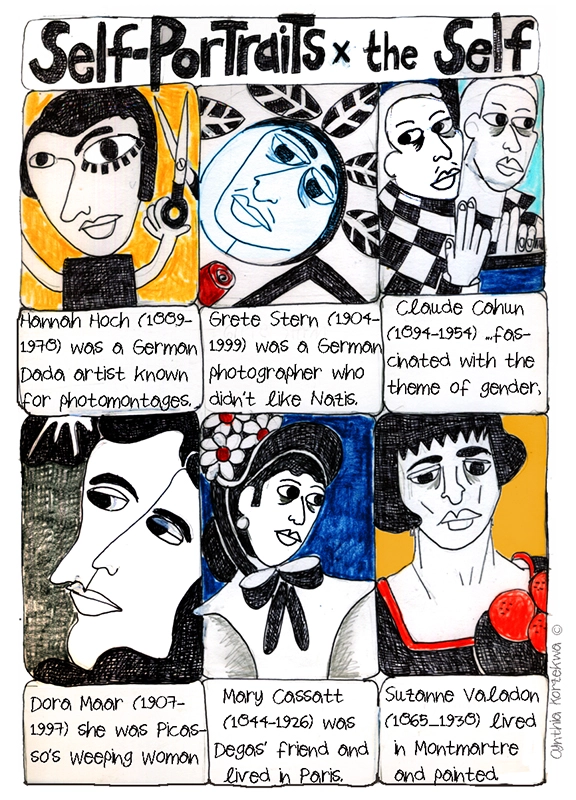
Suzanne Valadon

Napoleon III (1808-1873) was the last Emperor of France. He lost his majestic role in 1870 when the Prussians defeated the French army at the Battle of Sedan. Before his defeat, Napoleon wanted to reassert international French influence and tried to expand France’s colonial power. He even tried to create a Second Mexican Empire (seems that, despite the French Revolution, the French had a thing for Empires).

Napoleon dreamed of the modernization of France. This included the reconstruction of Paris by Baron Georges-Eugene Haussmann.  Haussmann’s plan to modernize Paris relied much on the creation of new boulevards which would help relieve traffic congestion. Obviously, to make room for the boulevards, existing buildings had to be demolished causing many people to lose their homes. And as the population of Paris continued to grow, the geographical boundaries needed to expand. The solution was to annex surrounding communes into the city.

For about a decade, Paris was a huge construction site.

Many previous residents of the area had to move to places like Belleville (where Edith Piaf was born) and Ménilmontant (where Maurice Chevalier was born) and Montmartre. In 1860, Montmartre and other communes became a part of Paris. And, as the rents were cheap and the area full of nosey cafes, artists began moving into the area. And the Bohemian spirit flourished.

Although born outside of Paris, Suzanne Valadon grew up and eventually died in Montmartre. Her real name was Marie-Clémentine and for years she went by Marie. But here I will refer to her only as Suzanne.

Suzanne was raised by her single mom who washed people’s dirty clothes to support herself and her daughter. Childhood was a different thing for the poor than for the rich. Suzanne had no time for childhood. For awhile she worked as a seamstress. Like Coco Chanel, Suzanne had learned to sew from the nuns. But Suzanne had too much energy to sit around stitching. Circuses were quite popular at the time and Suzanne set her heart on becoming a trapezist. Although petite, Suzanne was very agile and had much physical strength. Enthusiastic about her new career, Suzanne had a tendency to be a bit too audacious. This caused her to fall during a performance. Her back was hurt and she could no longer perform. Now she needed a new career.

Because of all the artists who’d moved to the area, there was much demand for artists’ models. Suzanne was not only beautiful, but she knew how to hold a pose. Modeling became her chief source of income. Now Suzanne was having a great time modeling and hanging out with the artists at the Lapin Agile drinking and dancing and being bohemian.  She was now a part of the avant garde Paris.

In 1883, eighteen year old Suzanne gave birth to Maurice. She wasn’t sure who the father was (some speculate Renoir but he denied it). Busy trying to earn a living, she’d leave her son in the care of her mom. Her mom, unfortunately, was an alcoholic and would often give little Maurice liquor to keep him quiet. By the time Maurice was a teenager, he was an alcoholic with mental health problems.

Around the age of nine, Suzanne began teaching herself how to draw but kept it a secret. Now, as an artists’ model, she was able to learn by watching the artists at work. While the artist looked at her, she looked back. She modelled for Toulouse-Lautrec who, once he saw her drawings, encouraged her to keep drawing. Suzanne was still going by Marie-Clementine but Lautrec changed that. Since Suzanne was always getting involved with older men, Lautrec started calling her “Suzanne” as in “Suzanne and the Elders”. And the name stuck.

One of Suzanne’s big concerns was her son’s mental instability that would continue to torment her for years. Hoping that it would help heal him, Suzanne taught her son how to paint.

Sexually, Suzanne was very uninhibited and had numerous overlapping lovers. For a few months she was involved with Satie who fell head over heels. Suzanne was also keeping herself entertained with Paul Mousis, a wealthy stockbroker whom she married in 1895. It was a radical change of lifestyle for her. For 13 years she lived in economic tranquility for the first time. She had a chauffeur and a maid and money enough to buy all the paints she needed. But Suzanne was not a bourgeois and grew bored with her affluent lifestyle. She wanted to go back to Montmartre where she felt at home.

Maurice had started trying to sell paintings. One day he brough home a friend, André Utter, a 23 year old artist. Suzanne, impressed by his looks, used André as a model for her Adam in the painting “Adam and Eve”. The rapport became sexual. Suzanne’s husband was not happy and the two divorced in 1913.

Now a new and bizarre menage is formed between Suzanne, her son, and her son’s best friend. André became part of Suzanne’s household and, in 1914, they married. Andrè was no longer Maurice’s friend but his step-father. The trio used to have many quarrels and drunken brawls to the point that they earned the name trinité maudite (cursed trinity).

And for many years, the trio continued like that.

Initially, Utter had been very good at selling paintings for Suzanne and Maurice. But then the dynamics started changing. Utter started messing around with the girls driving Suzanne wacko.

But Suzanne was now a recognized artist who could maintain herself with the sales of her paintings.

Suzanne died in Montmartre in 1938 at the age of 72. Her funeral drew quite a crowed, Even Picasso was there.

Suzanne the model:

Auguste Renoir – Dance at Bougival – painting of Suzanne Valadon – 1883

Berthe MorisotTightrope Walker – painting of Suzanne Valadon, 1886

Edgar Degas – The Tub – painting of Suzanne Valladon - 1886

Toulouse-Lautrec – The Hangover – portrait of Suzanne Valladon 1889

Related:

Renoir’s Art Model Was the Greatest Painter You Never Heard Of + Suzanne Valadon: Artist and Muse of Montmartre + The Blue Room painting +  Henri De Toulouse-Lautrec, Artist Of Montmartre +

Artists’ canteen: the Lapin Agile cabaret + WOMEN ARTISTS: Suzanne Valadon +

Old Montmartre in Photos and Paintings + Montmartre Then & Now + Montmartre, la leggendaria collina degli artisti di Parigi +

Synergy & Solidarity

Posted in art, Art Narratives, Beauty, Conditions of Possibility | Tagged , , , , , , , , , , | 4 Comments