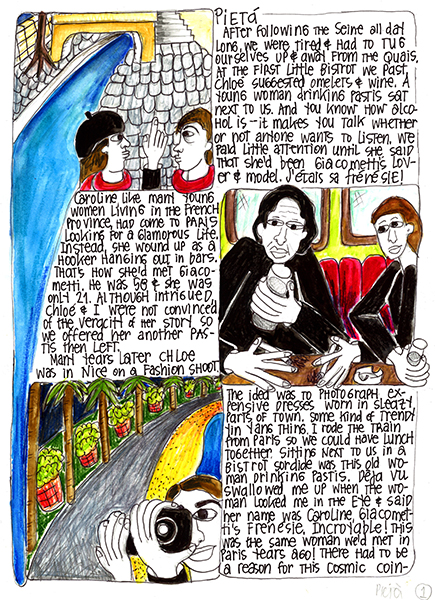
After following the Seine all day long, we were tired and had to tug ourselves up and away from the quais. At the first little bistrot we past, Chloe suggested omelets and wine. A young woman drinking pastis sat next to us. And you know how alcohol is. It makes you talk whether or not anyone wants to listen. We paid little attention until she said that she’d been Giacometti’s model and lover and, j’étais sa frénésie! (I was his frenzy!)
Caroline, like many young women living in the French province, had come to Paris looking for a glamorous life. Instead, she wound up as a hooker hanging out in bars. That’s how she’d met Giacometti. He was 58 and she was only 21. Although intrigued, Chloe and I were not convinced of the veracity of her story so we offered her another pastis then left.
Many years later, Chloe was in Nice on a fashion shoot. The idea was to photograph expensive dresses worn in sleazy parts of town. Some kind of trendy yin yang thing. I rode the train from Paris so we could have lunch together. Sitting next to us in a petite bistrot sordide was this old woman drinking pastis. Déjà vu swallowed me up when the woman looked me in the eye and said her name was Caroline, Giacometti’s frénésie. Incroyable! This was the same woman we’d met in Paris years ago! There had to be a reason for this cosmic coincidence. Maybe she was an oracle disguised as a drunk. I had no choice but to hear her out.
Giacometti, ranted Caroline, was a vampire who needed women to survive. Even his female statues looked like anorexic votives exhausted by the demands he’d made on them. And those Etruscan shadow statues that Giacometti copied had convinced the Existentialists that he was one of them–always in the dark as to the meaning of life. I was beginning to think that Caroline had had too much pastis and was getting ready to go when something she said caught my attention.
Not long before his death, Giacometti had spent hours looking at the Pietà Rondanini. Whereas many had interpreted Michelangelo’s last statue as the sculptor’s end, Giacometti, instead, saw it as a new beginning. Had Michelangelo continued to make one Pietà after another for 1000 years, said Giacometti, they would all be unique simply because Michelangelo was too busy moving ahead to fall backwards.
The word of the oracle had finally arrived!
Michelangelo was only 24 when he completed the Vatican Pietà and 89 when he last worked on the Pietà Rondanini. The sculptor said that once he’d seen an angel in a block of marble and carved until he set the angel free. It was the same approach Michelangelo had used with the Pietà Rondanini. Finally Jesus had been liberated from conventional aesthetics.
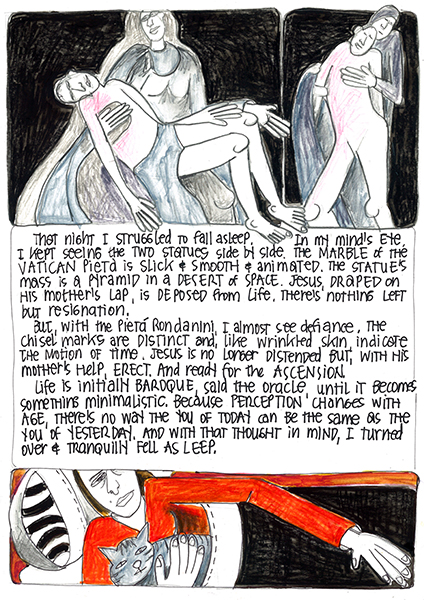
That night I struggled to fall asleep. In my mind’s eye I kept seeing the two statues side by side. The marble of the Vatican Pietà is slick and smooth and animated. The statue’s mass is a pyramid in a desert of space. Jesus, draped on his mother’s lap, is deposed from life. There’s nothing left but resignation.
But with the Pietà Rondanini, I almost see defiance. The chisel marks are distinct and, like wrinkled skin, indicate the motion of time. Jesus is no longer distended but, with his mother’s help, erect. And ready for the ascension.
Life is initially Baroque, said the oracle, until it becomes something Minimalistic. Because perception changes with age, there’s no way the you of today can be the same as the you of yesterday. And with that thought in mind, I turned over and tranquilly fell asleep.
Carrillo De Albornoz, Cristina. “Giacometti enabled me to know myself better”. The Art Newspaper, issue 223, April 2010. Retrieved October 18, 2018 HERE.
Lord, James. Giacometti. A Biography. Farrar, Straus and Giroux. New York. 1997.
Related: Alberto Giacometti’s studio comes to life in Paris…..Sitting on rue Victor Schoelcher, just 1km from Alberto Giacometti’s original studio on rue Hippolyte-Maindron, the Institute’s new home features a faithful reimagining of the artist’s chaotic atelier + Fondation Giacometti-Studio + Yvonne Marguerite Poiraudeau book in French + Giacometti’s final frenzy: the paintings of Caroline + when Caroline met Giacometti, she was living at the Hotel de Sevres in Montparnasse +
For a while Caroline disappeared and the desperate Giacometti went looking for her. She was in prison (Petite Roquette) for petty theft. Giacometti bought her an apartment making his wife Annette even more jealous of the young model. Caroline continued to be a prostitute and Giacometti enjoyed listening about her sexual encounters. SOURCE
Once upon a time (about 13.8 billion years ago), only a tiny speck existed. That speck, although small, was loaded with energy. And when the speck could no longer contain itself, it exploded. Bang! The insides came out but there was no place for this matter to go so space was created.
As the universe expanded, it lost much of its density (just like a flabby muscle) and started cooling off. The speck’s particles, once united, were now left alone to drift in space. Tired of the loneliness, the particles began seeking the company of other particles. Together they created atoms. And the atoms, that also liked to group together, created clans we now call stars and galaxies.
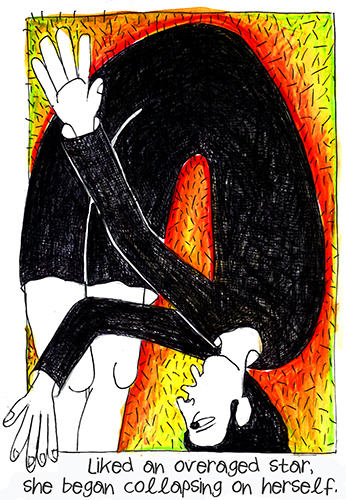
For billions of years the universe constructed its identity with these Lego-like atoms. Now the universe was full of brightly burning stars that, once formed, also expanded. Nuclear energy within the star kept it shining. But when the energy ran out, the supernova star collapsed on itself and exploded spreading its dust around the universe.
Space is such a lonely place. The homeless supernova dust, tired of being alone, looked around for new contacts and friends. Slowly the dust coalesced to create a new solar system that included Earth, the planet we now call home.
Thus the Earth is made from old supernova stardust. And since man was created on Earth, this means we, too, are made of stardust.
On the seventh day of his artistic creating, as mentioned in Genesis 2:7, God grabbed some dust from the ground and, like a sculptor, began to create man. What is this dust if not stardust? Otherwise, why would Joni Mitchell sing “We are stardust, we are golden and we’ve got to get ourselves back to the garden” if we’re not a product of this supernova debris. The atoms in our body were created during the Big Bang which means our bodies are made up of 13.7 billion year old atoms (which could explain why I’m often tired).
Now there are those scientists who’ve taken the Bang out of our creation insisting that the tiny speck referred to above did not explode but simply started stretching itself out more and more. Unable to stop itself, more than a Big Bang, it was a Big Blob that just kept/keeps expanding pushing other galaxies further away from the Earth. But be it a Big Bang or a Big Blob, the power of stardust remains as my friend, Luz, knows well.
On the Night of San Lorenzo in 1954, Luz caught a falling star and took it home. Here, using a coffee grinder, she pulverized the star then added to it a few of drops of frankincense oil to it.
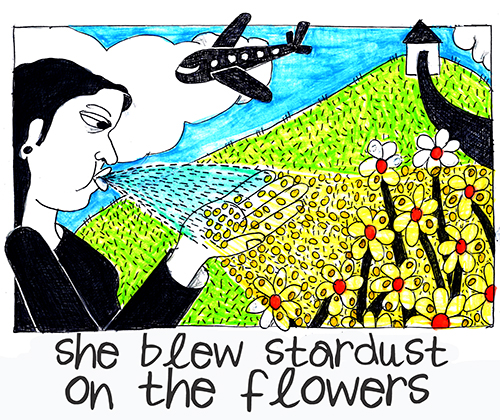
Now there are seed bombers who like to throw around little mud balls full of seeds as a means of introducing vegetation where there’s none. Luz like the idea very much. But instead of seeds for her balls, she decided to use stardust. And, whenever Luz came across barren land, she’d hold up a handful of dust and blow it into the air. She was amazed at the result.
Italian artist Giacomo Balla (1871-1958) was a key proponent of Futurism and a signatory of their 1910 Manifesto. He was most interested in depicting light and motion. Although a native of Turin, Balla moved to Rome in 1895. Here he met his wife, Elisa Marcucci. The couple had two daughters, Luce and Elica.
Now Balla pursued his artfull time earning a living as an illustrator and a portrait painter. But, after meeting Filippo Tommaso Marinetti, Balla adopted the Futurist style. He used the style not only in his paintings but in his clothing and furniture designs as well.
Around 1904, Balla and his family moved into an old monastery in the area of Parioli (corner of via Paisiello and via Porpora) and Balla began painting inside his home as if it were a three D painting. The Ballas often had visitors and, during World War I, Balla’s studio became a meeting place for young artists.
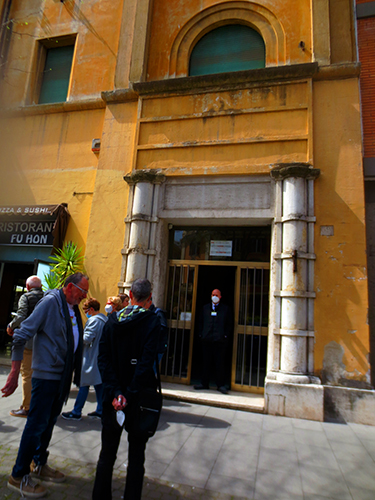
In 1926, the Balla family was forced to move to another neighbourhood, that of Delle Vittorie. Here, at via Oslavia 39b, Balla lived and worked until his death in 1958. His daughters continued to live in the house until their own deaths in the early 1990s. And it is this house, inhabited by members of the Balla family for 68 years, that’s recently been opened to the public thanks to a collaboration with the MAXXI (Rome’s National Museum of Contemporary Art).
Entrance of building where the Balla Family lived, via Oslavia 39b, Rome
Part of the L-shaped hallway with its pastel colored amoeba-like shapes… Futurist painting, said Balla, wants to destroy immobility. So notice the painting hangings above (now copies, the originals removed). They are hanging from the ceiling as opposed to hanging on the wall. This way the painting can move if there’s a breeze and help Balla keep his painting in motion.
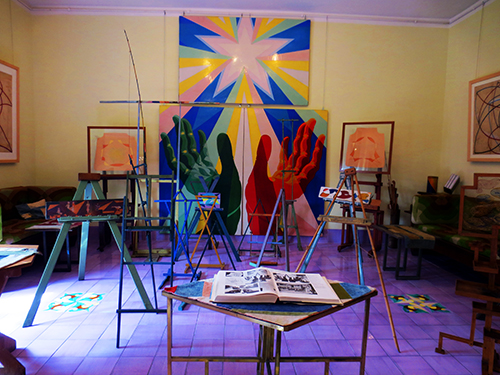
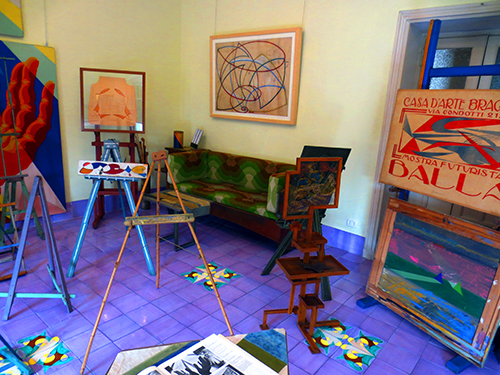
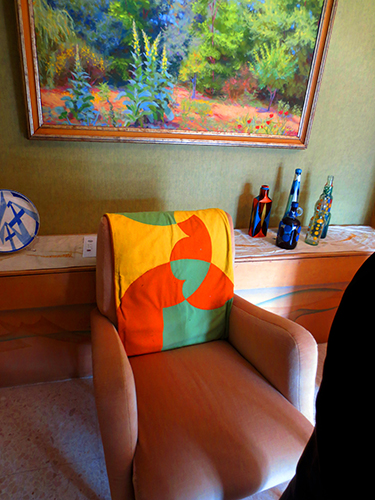
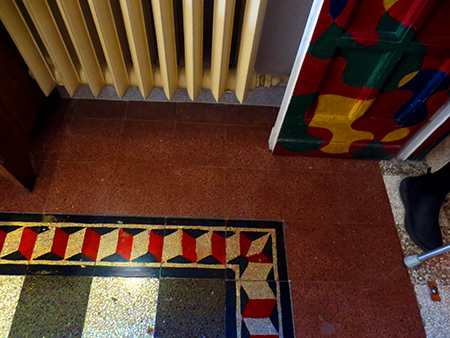
the combo living room and laboratory with its lavender floor tiles, handmade furniture and textiles….
Balla and his daughters would frequently move around Rome to paint in en plein air thus the need for various portable easels as pictured above. However, they lost their enthusiasm for outdoor painting during WWII. On March 23, 1944, Elica was painting en plein air when she heard an explosion. It was a bomb planted by members of the Italian resistance movement that the SS Headquarters on via Rasella. Thirty-three German soldiers were killed so the next day, in retaliation, the Germans massacred 335 Italians at the Ardeatine Caves. That day the Ballas lost their enthusiasm for outdoor painting and began staying at home to paint. Obviously, this influenced their subject matter and style.
In the foreground towards the right is an asymmetrical frame with tiny shelves. Called a “smoking cabinet”, the frame holds a textile representation of smoke.
In the living area as well as in other parts of the house are many examples of Luce’s handiwork. Elisa, her mom, was a seamstress just as Balla’s own mother had been a seamstress. Luce and her sister undoubtedly learned how to sew from their mom.
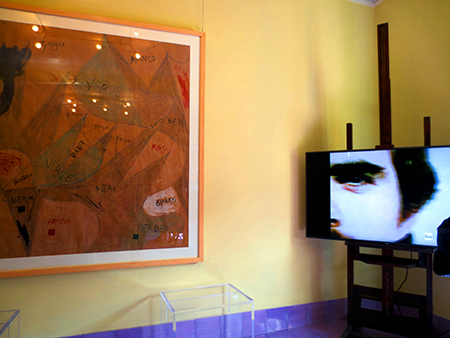
living room area with Balla related video going on
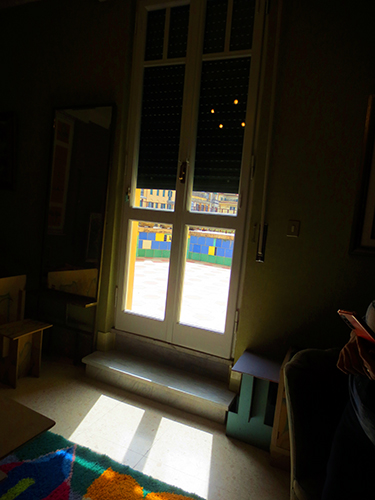
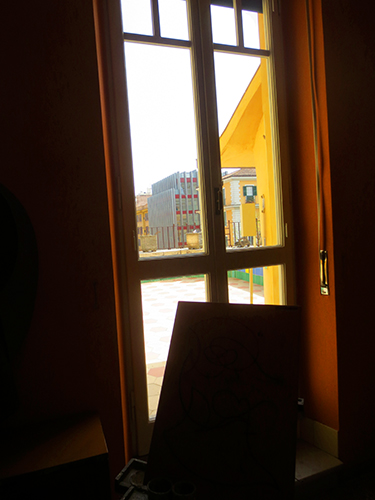
view from the living room window
bathroom dressed in painted tiles
Walking into the kitchen the first thing you notice is a painting by Elica showing her parents and sister sitting at the table. The mother, Elisa, is reading the paper, the sister, Luce, is sewing, and the family patriarch simply sits and reflects.
Notice the glass door with a yellow frame? It has a most incredible story…somehow the adjacent apartment had to, as some form of compensation for damage done, give one of its rooms to Balla so a big hole in the wall was made to create an opening.
The kitchen is the room I most enjoyed—the plates, obviously, were designed by Balla.
the kitchen balcony
to the left a sink for doing the laundry and to the right a sink for washing dishes…
counter with marble cutting board and hand painted flowers
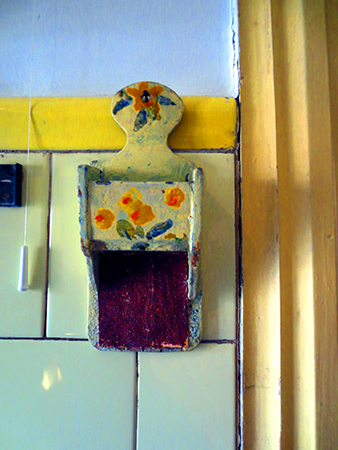
painted matchbox hanging on the wall
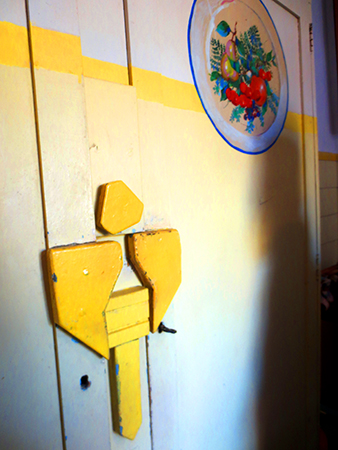
how to close a cabinet Balla style
more handpainted décor…
Balla’s portable table setting
Luce Balla’s bedroom…Luce (1904-1994) was the Balla’s eldest daughter. Her work focused more on textile arts.
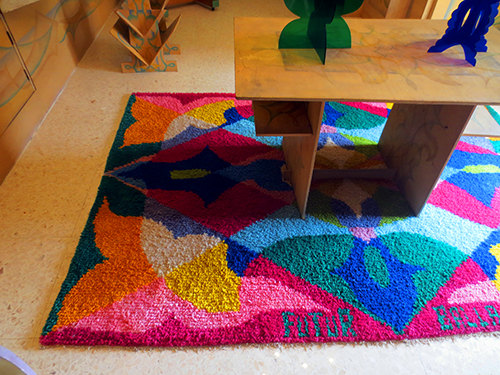
Notice the jacket hanging in the wardrobe…a jacket made by Luce based on the designs of her father. On the table are examples of Balla’s Futuristic flower sculptures that his daughter helped him make. They were then sold and helped subsidize the family income.
rug designed by Balla but crafted by his daughter Luce
The mural on the ceiling was also meant to hide the electrical wire that crawls across the ceiling.
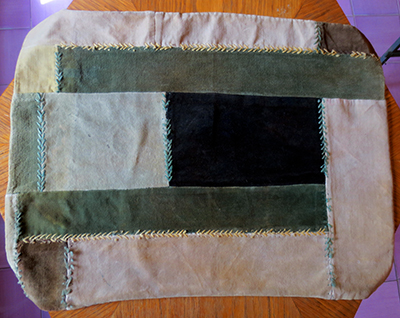
more of Luce’s Futuristic Patchwork
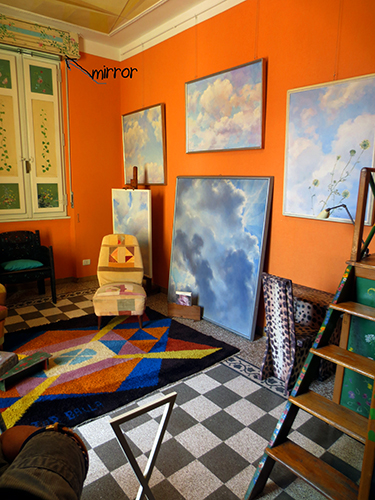
Elica Balla’s bedroom…Elica (1914-1993) threw herself into the Futurists movement and participated in many exhibitions. After her father’s death, her main desire seemed to be that of perpetuating her father’s fame. In the mid-80s, Elica wrote his biography “Con Balla” when she was in her late 60s (unfortunately, the book is now out of print).
To the right are the stairs that led up to Elica’s “loft” for dreaming. Elica had a passion for clouds and had a mirror fixed above the window meant to reflect another mirror placed on the sill. That way Elica could have various views of the sky.
Futur Balla décor in Elica’s bedroom
desk under loft
“Colonial” desk and chair made from orange crates by Balla
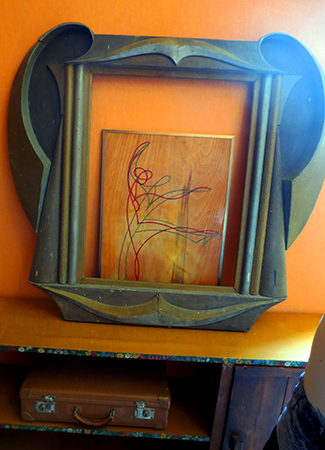
Futuristic Frame
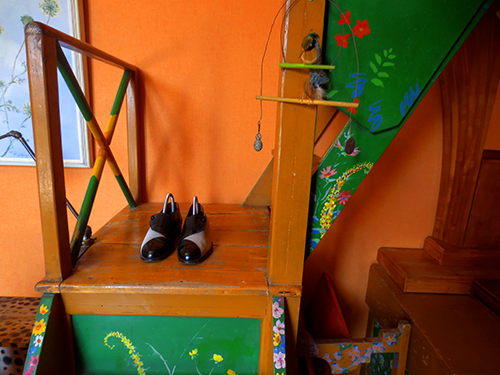
Balla’s shoes
Back in the hallway, built in storage space Balla style
A jacket designed by Balla hanging on the hallway coatrack….Balla was very interested in fashion and wrote the “Dress Manifesto Antineutral” describing Futurists clothing. Fashion designer Laura Biagiotti developed an interest in Futurist creations and began her own collection of Balla’s work (with 130 works now at the Biagiotti Cigna Foundation). So inspired by Balla, Biagiotti based her Summer/Spring collection of 2015 on Balla’s works.
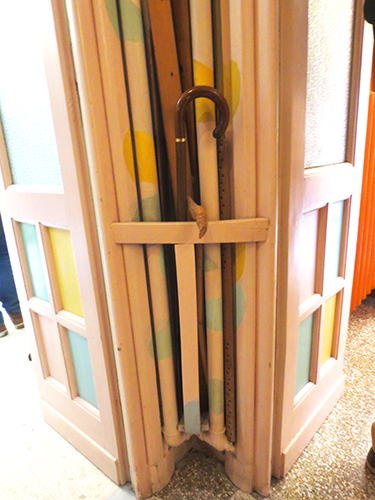
hallway umbrella stand to hide the pipes
The hallway makes a turn and trades its pastels for primary colors. This part of the hallway led to Balla’s Red Studio and to the bedroom he shared with his wife.
The Red Studio
The entire house is highly painted and decorated until you get to the Balla’s bedroom. Here the original furniture has disappeared as have many of the art objects. For a while those who controlled the Balla estate transformed the bedroom into an office space. There is no “feel it on your skin” sensation in this room as with the rest of the house.
This screen is not a Balla original put painted in his style (maybe to fill up the space left by original objects that had been taken away). It reminds me somewhat of Fortunato Depero (who designed the Campari soda bottle still used today).
desk
wardrobe
unfinished painted screen
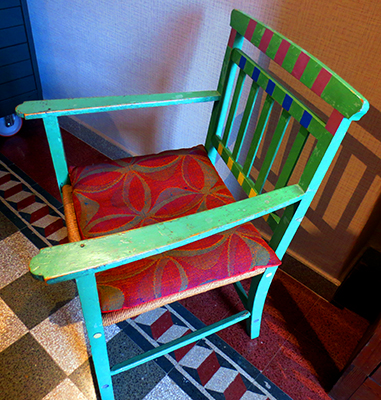
painted chair
The Ballas had a nice big terrace and used it a lot for socializing and for creating art happenings. The doors leading to the terrace were two: one in Luce’s bedroom and the other in Elica’s.
entrance to the terrace from Luce’s bedroom
entrance to terrace from Elica’s bedroom
During the last part of his life, Balla had his bed placed in front of the terrace door in Elica’s bedroom so that he could look outside and see his terrace in the foreground dominating the rest of the world.
the Balla terrace as seen from the corner of via Oslavia and via Vodice
After Balla’s death in 1958, Luce and Elica continued to live at via Oslavia until their own deaths in 1993/4. There is little information available as to how they lived these final years.
The Balla daughters lived a sheltered life. They were taught at home by private tutors instead of going to school. They were also expected from an early age to help their father actualize his designs as tapestries and other design objects. Bascially, the entire family evolved around Balla and his artistic activities.
Hopefully, someday soon a woman will decide to write about the life of these two daughters who lived in their father’s shadow even 35 years after his death.
Giacomo Balla is buried at Verano Monumental Cemetery in Rome (being a family tomb, I would assume his daughters are here, too). See fotos HERE. Other Futurists at Verano HERE.
Time moves faster in New York City. Surrounded by masses of bodies always in a rush makes me claustrophobic. So, for relief, I stretch my neck to look up as if the sky were the Sistine Chapel ceiling. NYC is heaven for some, hell for others. For me it’s a limbo, a penance I have to pay to enjoy its pleasures. Like the MET.
In 1870, the Metropolitan Museum of Art was born and its first acquisition was a Roman sarcophagus. Later, in 1946, the Museum of Costume Art merged with the MET as The Costume Institute. For years it was just a bunch of dated dresses collecting dust. Then Diana Vreeland came along and, with an explosion of extravagance, pumped life into a cadaver.
Hugh and I were in New York to celebrate my birthday. Diana had curated the exhibit The 10s, The 20s, The 30s: Inventive Paris Clothes 1909–1939 and I was anxious to see it. The exhibit included designers like Paul Poiret (who began his career making doll clothes for his sister), Madeleine Vionnet (known for her bias-cut Grecian style dresses), and Elsa Schiaparelli (addicted to Surrealism).
Schiaparelli’s evening jacket designed with Jean Cocteau had me drooling. I was dripping all over myself when this woman came up to me and loudly said: “Where in the world did you get that dress you’re wearing?” To my amazement, it was Diana Vreeland and she was asking me about one of my own creations. Intimidated, I stumbled around for words thinking she was going to rip me to shreds. Instead she said “Darling, that dress is wonderfully wicked. “ When I told her I’d made it, she stared at me with x-ray eyes. Ten minutes later I was in her office drinking Scotch and water. Water, she said, is good for your health.
Since we were both addicted to our Daily Aesthetics, we had much in common. Her aesthetics were by far more sophisticated (and expensive) than mine. But, she said while eying my dress, bad taste is better than no taste at all. “You gotta have style,” she continued, “It’s a way of life. Without it, you’re nobody.”
You know the saying in vino veritas, well it works with Scotch, too. And soon Diana was telling me all about herself. I‘ve found that people are always willing to talk if they find someone willing to listen.
Diana had been very unhappy as a child. Part of her unhappiness stemmed from the exceptional beauty of her mother and sister causing Diana to be considered the ugly duckling of the family. But at age 14, she decided to change this and initiated a self-improvement program. She started keeping a diary aimed at helping her achieve perfection and decided to: 1. Transform the way she looked 2. Improve the way she spoke 3. Work hard in everything she did. Diana’s strategy was “Become the best possible version of yourself”.
To transform her looks, she relied much on fashion. Because the way we dress not only changes the way we see ourselves, it also changes the way we’re seen by others. But clothes aren’t enough. Diana understood that it took style and personality to make a nondescript person appear wildly attractive.
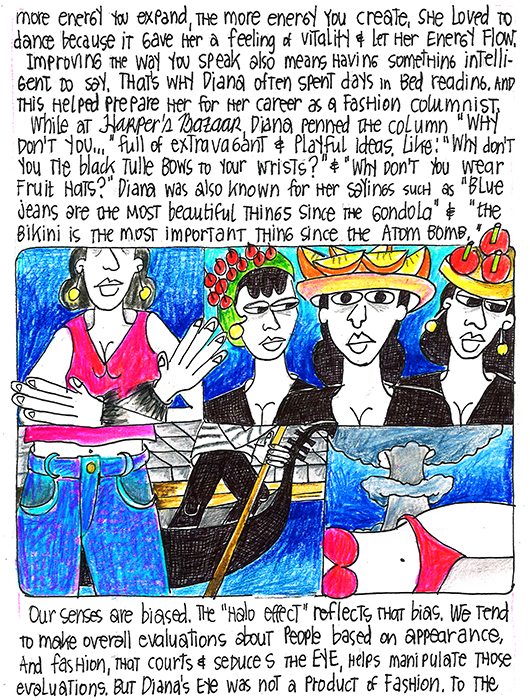
Projecting energy also makes a person captivating. So Diana made it a point never to be idle but always in motion. Because the more energy you expand, the more energy you create. She loved to dance because it gave her a feeling of vitality and let her energy flow.
Improving the way you speak also means having something intelligent to say. That’s why Diana often spent days in bed reading. And this helped prepare her for her career as a fashion columnist.
While at Harper’s Bazaar, Diana penned the column “Why don’t you…” full of extravagant and playful ideas. Like: Why don’t you tie black tulle bows on your wrists? and Why don’t you wear fruit hats?
Diana was also known for her sayings such as “blue jeans are the most beautiful things since the gondola” and “the bikini is the most important thing since the atom bomb”.
Our senses are biased. The “halo effect” reflects that bias. We tend to make overall evaluations about people and places based on appearance. And fashion, that courts and seduces the eye, helps manipulate those evaluations. But Diana’s eye was not a product of fashion. To the contrary, her sense of fashion came from having developed her own personal aesthetics and from those aesthetics she educated her visual sense.
Diana’s eyes were hungry and in constant motion searching for nourishment. They were hungry for novelty that could make her dendrites grow.
Vision is often considered the most important sense organ. However, there’s a difference between looking and observing. One is passive, the other active. Diana’s eyes were active. And for that reason she believed that the eye must travel.
John Berger, in Ways of Seeing, writes that seeing came before words and that “the relation between what we see and what we know is never settled.” The way we perceive what we see is affected by knowledge and belief, by our way of seeing the world (Weltanschauung).
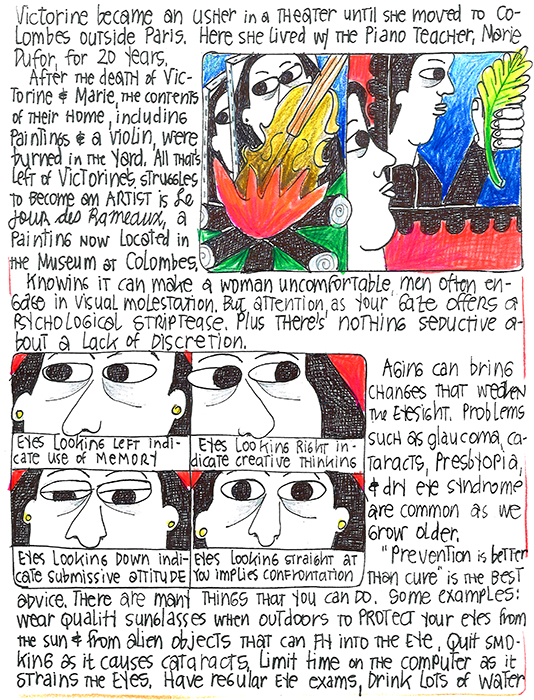
When walking down the street, notice the men looking at women and turning them into objects. This looking is not a reciprocal experience as women, when walking alone, avoid eye contact because eye contact attracts attention it’s considered provocative as Victorine Meurent knew well.
Years before I’d been to the Musée d’Orsay to see Manet’s Le Dejeuner sur l’herbe. The woman in the painting was looking at me. She was sitting on the grass totally naked next to two men fully clothed. I’d read that the painting had created quite a scandal and that the first time it had been shown, an outraged man tried to hit it with his umbrella.
You see, the painting made men uncomfortable because of the way that the model, Victorine Meurent, looked at them. Men, accustomed to rubbing their eyes all over women’s bodies, could not accept Victorine’s gaze that said “instead of you looking at me, I’m going to look at you”. Even in terms of using the senses, women were not considered men’s equals.
Victorine, Manet’s favorite model, had often been described by art historians as a drunk and a prostitute. But it wasn’t true. Victorine, who from a poor family, wanted to be an artist. She sang in cafes, gave violin lessons, and modelled just to earn money for art lessons. And, in 1862, going from one gig to another as a street musician playing her guitar in cafes, she met Manet. Intrigued, Manet asked her to model for him. He painted her eating cherries on the street, as a matador without a bull, and as a woman with a child near Gare Saint-Lazare.
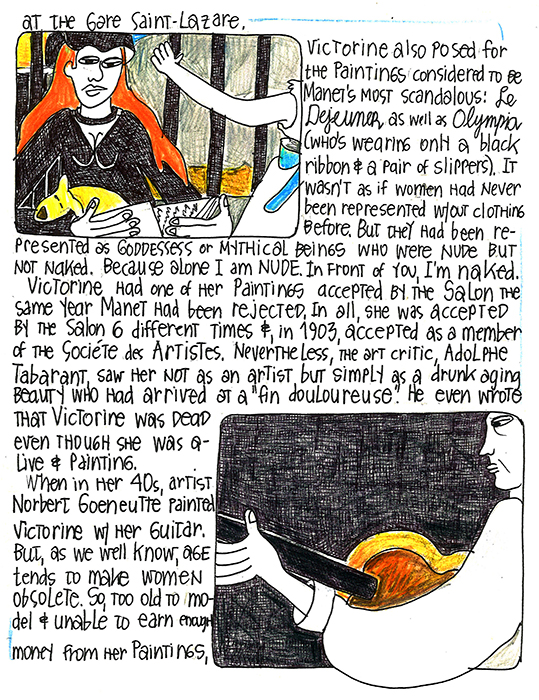
Victorine also posed for the paintings considered to be Manet’s most scandalous: Le Dejeuner as well asOlympia (who’s wearing only a black ribbon and a pair of slippers). It wasn’t as if women had never been represented without clothing before. But they had been represented as goddesses or mythical beings who were nude but not naked. Because alone I am nude. In front of you, I am naked.
Victorine had one of her paintings accepted by the Salon the same year Manet had been rejected. In all, she was accepted by the Salon six different times and, in 1903, accepted as a member of the Sociéte des Artistes. Nevertheless, the art critic Adolphe Tabarant, saw her not as an artist but simply as a drunk aging beauty who had arrived at a “fin douloureuse”. He even wrote that Victorine was dead even though she was still alive and painting.
When in her 40s, artist Norbert Goeneutte painted Victorine with her guitar. But, as we well know, age tends to make women obsolete. So, too old to model and unable to earn enough money from her paintings, Victorine became an usher in a theater until she moved to Colombes outside of Paris. Here she lived with the piano teacher, Marie Dufour, for 20 years.
After the death of Victorine and Marie, the contents on their home, including paintings and a violin, were burned in the yard. All that’s left of of Victorine’s struggles to become an artist is Le jour des rameaux, a painting now located at the museum in Colombes.
Nutritious food also helps. Bell peppers help reduce the risk of age related macular degeneration. Blueberries reduce the risk of cataracts and glaucoma. The beta carotene in carrots and sweet potatoes combats the loss of vitamin A which is the leading cause of blindness in poor countries. Chia seeds contain much omega 3 that helps protect the eyes from macular degeneration and dry eye syndrome.
Diabetes is a leading cause of blindness. To help prevent diabetes, limit your sugar intake, drink a lot of water, exercise and lose weight.
Sight is the most relied upon of the senses. To prepare for old age, we can exercise our eyes just like we do our bodies. Here are four examples:
To relax your eye muscles, with enthusiasm, rub the palms of your hands to heat them up then place them over your eyelids.
To exercise focusing, sit in a comfortable chair then stretch one arm straight out with the thumb sticking up. Gradually pull the thumb closer to your eyes then further away again.
To exercise peripheral vision, sit with your head facing straight ahead. Without moving your head, look towards the left then look towards the right.
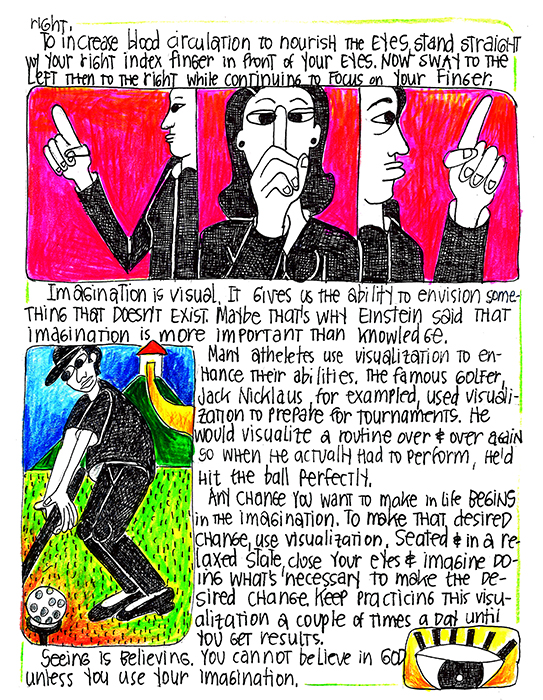
To increase blood circulation to nourish the eyes, stand up straight with your right index finger in front of your eyes. Now sway to the left then to the right while continuing to focus on your finger.
Imagination is visual. It gives us the ability to envision something that doesn’t exist. Maybe that’s why Einstein said that imagination is more important than knowledge.
Many athletes use visualization to enhance their abilities. The famous golfer, Jack Nicklaus, for example, used visualization to prepare for tournaments. He would visualize a routine over and over again so when he actually had to perform, he would hit the ball perfectly.
Any change you want to make in your life begins in the imagination. To make that desired change, use visualization. Seated and in a relaxed state, close your eyes and imagine doing what’s necessary to make the desired change. Keep practising this visualization a couple of time a day until you get results.
Seeing is believing. You cannot believe in God unless you use your imagination.
Scrambling eggs was my specialty. I could scramble them with onions or cheese or mushrooms. I could also mix ‘n match them with tomatoes & basil or ground pepper & goat cheese or sour cream & bacon. Anything you could put in a sandwich, I could scramble with eggs. Unfortunately this was the extent of my culinary talents so I decided to enroll in Paris’ best cooking school, Le Cordon Bleu.
Located on rue du Faubourg Saint Honoré, the school was run by Mme Brassant, a petite but intimidating woman who was the quintessence of a Parisienne. Everyone in my class was French except an American woman who easily caught one’s eye. Her name was Julia Child and she was so tall that, when standing next to Mme Brassant, I always thought of David and Goliath.
Since we were both Americans, it was only natural that we started hanging out together. Often we’d have onion soup at the nearby Au Pied de Cochon or go to Les Halles to buy vegetables or to Dehillerin’s to buy cooking utensils. For me Dehillerin’s was like going to a museum and made me think of Brancusi sculptures.
Constantin Brancusi was a Romanian artist who moved to Paris where he began making abstract sculptures. So abstract that his sculpture of a young woman’s head was considered a phallic symbol and removed from an exhibition. Then, in 1926, Brancusi shipped crateloads of sculptures to be exhibited at the Brummer Gallery in New York. But when the customs officials opened the crates, they were stupefied. The crate was labelled “Art” but, as far as they were concerned, what they saw inside had nothing to do with art. Since artwork was duty free, the officials thought that the sender had labelled the contents as such to avoid paying import taxes. So they relabelled the objects as “kitchen utensils” and imposed a $240 tax on them.
Julia was with me when, at Dehillerin’s, I bought my first fouet à œufs, a whisk to beat eggs. Afterwards we went to her house on Rue de l’Universite and used my new whisk to mix martinis much to the amusement of her husband Paul. Julia had met Paul when she’d worked as a spy. Well, not a spy like Mata Hari but she’d been part of the O.S.S. in Ceylon (now Sri Lanka) where she processed top secret communications. It was here that Julia and Paul met and fell in love. After their marriage, Paul was assigned a diplomatic post in Paris and the couple moved to France. Living in Paris, she said, had made her open up like a flower.
Like most Americans, Julia grew up eating the typical diet of overcooked pot roast, canned vegetables, and desserts made with Jello. It wasn’t until France that Julia discovered the pleasures of food. She told me about her first meal in Rouen, a culinary experience that changed her life forever. She ate oysters, sole meunière along with excellent wine. It was this meal that made her attend Le Cordon Bleu. Julia later joined with her friends Simone Beck and Louisette Bertholle to write a French cookbook for Americans. They even gave cooking lessons (The School of the Three Food Lovers) in Julia’s kitchen for American women in Paris.
Eventually, Paul and Julia moved back to the U.S. Because of her cookbook, in 1962 she was invited to appear on WGBH, an educational TV station in Boston. Not knowing what she could talk about for 30 minutes, Julia arrived with a copper bowl, a dozen eggs, mushrooms, a whisk, skillet, and hot plate then made an omelette. No one could crack an egg with one hand like Julia! The viewers were enthusiastic. And this led to “The French Chef”. Julia was 49 years old.
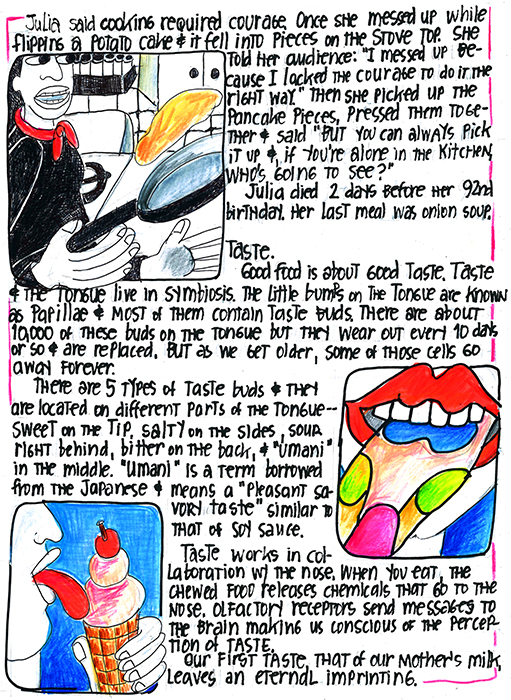
Julia said cooking required courage. Once she messed up while flipping a potato cake and it fell into pieces on the stove top. She told her audience: “I messed up because I lacked the courage to do it the right way”. Then she picked up the pancake pieces, pressed them together and said “But you can always pick it up and, if you’re alone in the kitchen, who’s going to see?”
Julia died two days before her 92nd birthday. Her last meal was onion soup.
Taste
Good food is about good taste. Taste and the tongue live in symbiosis. The little bumps on the tongue are known as papillae and most of them contain taste buds. There are about 10,000 of these buds on the tongue but they wear out every 10 days or so and are replaced. But as we get older, some of those cells go away forever.
There are five types of taste buds and they are located on different parts of the tongue—sweet on the tip, salty on the sides, sour right behind, bitter on the back and umani in the middle. “Umani” is a term borrowed from the Japanese and means a “pleasant savory taste” similar to that of soy sauce.
Taste works in collaboration with the nose. When you eat, the chewed food releases chemicals that go to the nose. Olfactory receptors send messages to the brain making us conscious of the perception of taste.
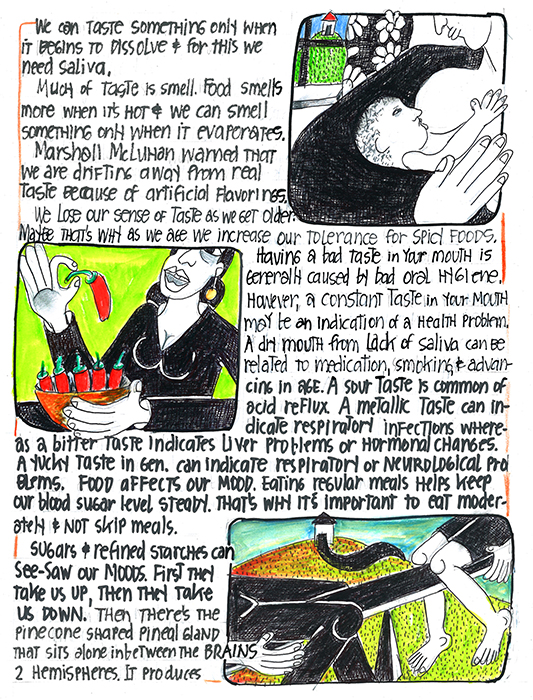
Our first taste, that of our mother’s milk, leaves an eternal imprinting.
We can taste something only when it begins to dissolve and for this we need saliva.
Much of taste is smell. Food smells more when it’s hot and we can smell something only when it evaporates.
Marshal McLuhan warned that we are drifting away from real taste because of artificial flavorings.
We lose our sense of taste as we get older. Maybe that’s why as we age we increase our tolerance for spicy foods.
Having a bad taste in your mouth is generally caused by bad oral hygiene. However, a constant taste in your mouth may be an indication of a health problem. A dry mouth from a lack of saliva can be related to medication, smoking, and advancing in age. A sour taste is common of acid reflux. A metallic taste can indicate respiratory infections whereas a bitter taste indicates liver problems or hormonal changes. A yucky taste in general can indicate respiratory or neurological problems.
Food affects our mood. Eating regular meals helps keep our blood sugar level steady. That’s why it’s important to eat moderately and not to skip meals.
Sugars and refined starches can see-saw our moods. First they take us up, then they take us down. Then there’s the pinecone-shaped pineal gland that sits alone in between the brain’s two hemispheres. It produces melatonin, a hormone that regulates sexual development, sleep cycles and the aging process.
Since ancient times, mystics have given much importance to the pineal gland believing it to be the connection between the physical and the spiritual world. Considered a source of enlightenment, it’s often symbolized by an eye on the center of the forehead generally known as the Third Eye.
The Third Eye is the eye of the imagination, intuition, and visualization. But sometimes it’s closed and needs to be opened. Sunlight is very important for the pineal gland and we should soak up at least 30 minutes of sunlight every day. That’s why sundried fruits and vegetable are good for us. Dark green vegetables such as kale and other greens like turnips, mustard and collard are also important especially if eaten raw. The pineal gland also needs serotonin as found in almonds, bananas, hot peppers, rice, and potatoes.
The pineal gland does not like processed food. Nor does it like fluoride that’s often put in water and toothpaste because it calcifies the pineal gland and keeps it from functioning properly.
Process foods are full of chemicals (food additives) meant to cause cravings (so you’ll buy more). Fast foods are loaded with sugar and eating fast food all the time leads to addiction. And it’s this addiction to sugar that causes some children to suffer from attention deficits.
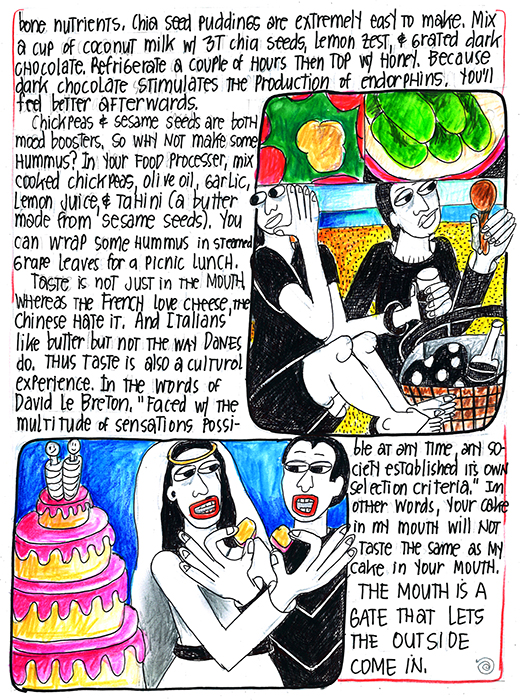
Taste is not just in the mouth. Whereas the French love cheese, the Chinese hate it. And Italians like butter but not the way the Danes do. Thus taste is also a cultural experience. In the words of David Le Breton, “faced with the multitude of sensations possible at any time, any society established its own selection criteria.” In other words, your cake in my mouth will not taste the same as my cake in your mouth.
The mouth is a gate that lets the outside come in.

































 The Narrative Within