After her son’s crucifixion, the grieving Mary sorrowfully cradled her son. Her mourning was a common theme in religious art known as “Pietà”. The most famous “Pietà” is Michelangelo’s statue in St. Peter’s Basilica.
For all those self-declared Christians who witnessed the abduction of children from their mothers by ICE only to be locked in cages, I ask: What would Mary have said? What Jesus would have said is written in the Bible:
“But whoso shall offend one of these little ones which believe in me, it were better for him that a millstone were hanged about his neck, and that he were drowned in the depth of the sea.” Matthew 18:6
The children mentioned above came from Christian South American countries. It would appear that soon the sea floor will be covered with millstones.
This Republican administration claims severe measures were taken against immigrants because “they’re taking our manufacturing jobs, they’re taking our money”. So how does the head of this administration justify having products with the family name being manufactured in places like China and Indonesia?
And I am still waiting for those who call themselves “Pro-Life” to justify their lack of outrage.
-30-
Sources: Migrant children in the US: The bigger picture explained (BBC) + HUNGER IN AMERICA, ESPECIALLY FOR CHILDREN, HAS “SKYROCKETED” DURING COVID-19, DATA SHOWS …the most recent Census data from the end of August of this year showed that 10 percent of households said they sometimes or often did not have enough to eat within the past seven days. Levels of food insecurity in Black and Latino households are significantly higher, at 19 percent and 17 percent, respectively, compared to 7 percent in white households + Pietà in art + Timeline of events related to migrant children’s detention centers in the United States + The president and his daughter largely manufacture Trump-branded products in countries like China, Indonesia, Turkey and Canada + Death sentence for abortion? The hypocrisy of US ‘pro-lifers’ is plain to see + Have mercy on us all. + #WhereAreTheChildren showcases the power and the pitfalls of social media
This post was written for young women who haven’t studied history and for those, no longer young, who, in the words of George Santayana, refuse to remember the past and are thus condemned to repeat it.
This post is dedicated to my mother who, as a single parent in the 1950s-1960s, didn’t need to study history to understand the injustices women were (and still are) subjected to.
Democracy, the idea that citizens should elect who governs them, has been around for c. 2,500 years. But for c. 2,400 years, women were not part of that process.
In the Russian Republic, women were given the right to vote in 1917. In New Zealand, this right had already been given to women in 1893. For Germany the year was 1918. But it was only in 1920 with the ratification of the 19th Amendment that women could vote throughout the United States. In theory, Black women had this right, too, although many southern states deprived them of it. It wasn’t until President Lyndon Johnson, a Democrat, that discriminatory voting practices were outlawed with the Voting Rights Act of 1965. But the battle for women’s equality was far from being over.
Thanks to her determination, Ruth Bader Ginsburg graduated from Cornell and then, in 1956, enrolled at Harvard. Of a class of 500, only 9 were women. Her professors gave her a hard time saying she was taking up the space a man should have. Discrimination didn’t stop her from earning a law degree from Cornell. Despite the fact that she’d tied for first in her class, she had difficulties finding a job.
Eventually, in 1963, Ruth found a job teaching at Rutgers Law School. She was paid less than her male colleagues simply because her husband had a well-paid job. In 1972, Ruth co-founded ACLU’s Women’s Right Project and began strategically fighting against gender discrimination.
Up until the mid-1970s, banks denied married women credit cards in their own names. Single women, for all practical purposes, were not even taken into consideration. Ruth fought and fought hard for gender equality. In 1974, the Equal Credit Opportunity Act finally came into effect prohibiting “discrimination on the basis of race, color, religion, national origin, sex, marital status, or age in credit transactions.”
When you see women on TV series like “Law and Order” sitting on a jury, please note that it took years before women were allowed to do so. It was believed that women were better off at home taking care of chores related to their husband and children. It was also believed that women were not intelligent enough to make rational decisions. Eventually, in 1975, the Supreme Court struck down this ban.
And if a woman who worked for necessity got pregnant (thanks to a male orgasm and not her own), she could immediately lose her job. Fortunately that changed with the Pregnancy Discrimination Act of 1978.
According to the Inter-Parliamentary Union, in Mexico c. 48% of the representation in government is female compared to the United States’ 24% leading me to believe that we need more Adelitas and fewer Karens.
Today Ruth has become a cultural icon best represented by her lace collars. She had quite a collection and wore them according to the cases that were to be heard (she had a special one for dissent). The standard judge’s robe accommodates the male’s shirt and tie. So Ruth, along with Sandra Day O’Connor, the first female Justice on the court, decided not to be masculinized and went for some lace.
Ladies, if you don’t want to dismantle what women before you have struggled to create, stand by your womanhood and don’t be obliterated by some power hungry misogynist. In the words of Ruth “I ask no favour for my sex. All I ask of our brethren is that they take their feet off our necks.”
Male and female roles should be seen as complimentary and not competitive. To be deprived of our right to contribute to society as ourselves as opposed to a male standardization as to what they think we should be not only harms women but is detrimental to society as a whole.
Born Again Discrimination…GOP Senator introduces bill that could require genital exams for girls competing in school sports, Sen. Kelly Loeffler’s bill to ban transgender girls from school sports is meant to “protect women,” …however, genital check is only for females and not males. I guess this is to protect the boys from showing the size of their penis risking ridicule.
God is not a weapon. God is not a sword to be welded against another child of God. God is not personal property. He does not exclusively belong to you or to anyone else.
You are not God’s press agent speaking in his name and organizing his activities. The words God has for you he whispers directly into your ear. He doesn’t need an intermediary. Nor does he need someone to take action for him –haven’t you heard about Noah’s ark?
Please stop speaking for God. And if you need someone to tell you what God is saying, then you are not listening to him because you’ve given your ears to someone else.
The Second Commandment says not to take the name of God in vain. This means not to use his name for your own personal agenda. Otherwise prepare to roast in Hell as you are being blasphemous. Furthermore, if you expect others to have respect for your religion, respect theirs as well. You know, “Do to others as you would have them do to you” (Luke 6:31).
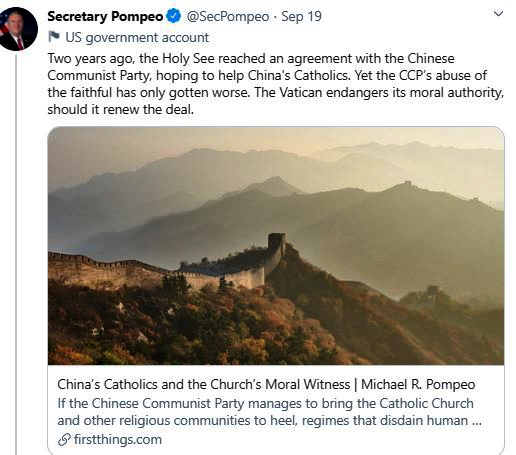
U.S. Secretary of State, Mike Pompeo, recently tweeted the following:
Pompeo’s tweet is pompous and out of place. First of all, the Vatican has been around much longer than Pompeo and will outlast him as well. The Vatican has no need for his advice. Pompeo is an Evangelical Presbyterian, not a Catholic. He should have more regard for other religions.
Furthermore, saying that “The Vatican endangers its moral authority should it renew its deal [with China]” is, once again, pompous. Pompeo is not in a position to talk about moral authority. Nor to judge the morals of others because, once again referring to the Bible, Jesus says “Let him who is without sin cast the first stone” (John 8:7).
Pompeo and the administration he’s entangled with have zero credibility (ex. their initial claims re: COVID that cost the death of 200,000 Americans). Whatever claims they have about the Chinese and Catholics is just another version of “The Boy Who Cried Wolf “. Because of their capitalistic demands, Pompeo and Co. have embarked upon a diplomatic war on China and simply want to bully the Vatican into being their accomplice. But Pope Francis, a Jesuit, has a soul as strong as steel. It’s not flabby and out of shape like the souls of power hungry politicians who use the name of God to pacify their own greed.
Pompeo will be in Rome next week. I hope he likes spaghetti.
-30-
Related: Pompeo contro il Vaticano: “Non rinnovi l’accordo con la Cina” + The article referred to in Pompeo’s tweet comes from HERE, an article he wrote for “First Things”, a publication of the Institute on Religion and Public Life…once again, the mixing of Church and State + Pompeo Ramps Up Diplomatic War on China
Article VI of the U.S. Constitution states that : The Senators and Representatives before mentioned, and the Members of the several State Legislatures, and all executive and judicial Officers, both of the United States and of the several States, shall be bound by Oath or Affirmation, to support this Constitution; but no religious Test shall ever be required as a Qualification to any Office or public Trust under the United States.
Establishment Clause….The Establishment Clause acts as a double security, for its aim is as well the prevention of religious control over government as the prevention of political control over religion. Under it the federal government of the United States as well as the governments of all U.S. states and U.S. territories are prohibited from establishing or sponsoring religion.
“In God We Trust” was adopted by Congress in 1956…”Some groups and people have objected to its use, contending that its religious reference violates the Establishment Clause of the First Amendment.[9] These groups believe the phrase should be removed from currency and public property. In lawsuits, this argument has not overcome the interpretational doctrine of accommodationism, which allows government to endorse religious establishments as long as they are all treated equally”
History of ‘In God We Trust‘…”The motto IN GOD WE TRUST was placed on United States coins largely because of the increased religious sentiment existing during the Civil War. ” This happened in 1861, way after the First Amendment of 1791. Therefore, the phrase is a violation of the Constitution.
Nun Who Heads Catholic Lobby Group ‘Horrified‘ by Trump Prayer Breakfast Appearance…When asked about this year’s Catholic Prayer Breakfast Sister Simone Campbell said “I am horrified that they are giving an award to Attorney General Barr who had reinstituted executions of people on death row, which is shocking and counter to Catholic social teaching. It is abundantly clear, ‘thou shalt not kill’, and he is doing that and he is being given an award.”
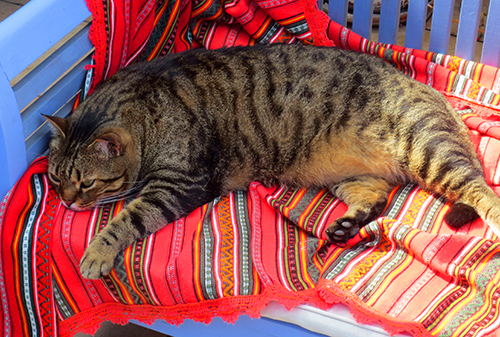
Every morning I sit on our terrace and just look at the plants and the bees and the butterflies that visit them. Save for the purrs of Volver, our cat, there is silence. The crisp air on my skin feels like a tender caress.
Volver the Cat, La Sussurrata
It is my terrace that gives me solace and helps me regroup those energies that have been scattered by the aggressiveness of the world outside. For me, my terrace is a sacred place. And, in this Age of Decadence, sacredness is a rarity.
Anna Jameson became interested in sacred art on her first trip to Italy. In 1842 she began writing Sacred and Legendary Art but, due to the extensive research and travel required, it took years to finish.
In c. 1845, Anna spent a winter in Rome and, in her lodgings at Piazza di Spagna, hosted many soirees where friends came and offered her new ideas to explore. It was here, in Rome, that she discovered religious art. Anna was Anglican. For her, as for most Protestants, Catholic iconography could be mystifying. All those paintings based on popular Catholic legends seemed like hero worshipping. The Reformation had rejected the tradition of Catholic art and, like the Taliban, had no problem in destroying it. But then came along Romanticism and with it an interest in medieval art inspiring people to learn more about the Catholic legends it was based upon. It was an Antique Mythology that was still, in the words of Anna, “vivid and vivifying”. These legends were “the intense expression of that inner life which revolted against the desolation and emptiness of the outward existence.”
After a long time in the dark ages when humanity was afflicted by “ignorance, idleness, wickedness, & misery” and when the powerful inflicted atrocities upon the weak forcing them to seek shelter from this outrage, “when the manners were harsh, the language gross; when all the softer social sentiments as pity, reverence, tenderness found no resting-place in the actual relations of life”, when all of this and more pushed man into “the dreary monotony of a stagnant existence”, finally, finally “arose a literature which reversed the outward order of things” and “refreshed the fevered and darkened spirit with the images of moral beauty and truth.” And it is of this legendary art that Anna writes about.
In Italy, the arts were generally pressed into the service of the Church. But, although the Church would have desired to impose its dogma more, she was “obliged to accept and mould to her own subjects the exotic elements she could not eradicate”. So a sort of compromise was made.
Anna’s Sacred and Legendary Art is divided into six sections: Introduction, Angels & Archangels, the Four Evangelists, the Twelve Apostles, the Doctors of the Church, and the Beatified Penitents.
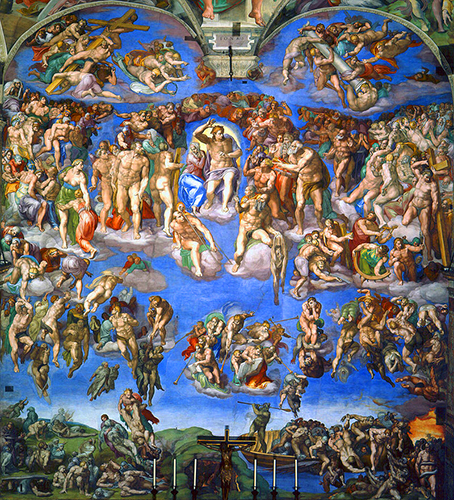
In each section, among other things, Anna speaks of the different artists’ styles towards approaching the same subject matter and has no problems criticizing artists including the greats. For example, she criticized Michelangelo because, as with Greek mythology, he focused on the worship of beauty, immortality, and power—all of which were antithetical to the values of Christianity. In his “Last Judgement”, Michelangelo made the Apostles look like Titans holding a war council, she wrote.
Michaelangelo’s “TheLast Judgement”
Sacred and Legendary Art is almost 500 pages long as Anna had much to say in order to explain the legends art was based upon as well as describe those elements (such as emblems and attributes) needed to help a viewer identify the various people represented.
In the section on angels, says Anna “there is something so very attractive and poetical, as well as soothing to our helpless finite nature, in all the superstitions connected with the popular notion of Angels, that we cannot wonder at their prevalence in the early ages of the world.” Going from a plurality of gods to just one must have been a challenge for many believers. Angels helped as the monothetic God was so very far away but angels made him seem closer. But not all angels are good.
“After the period of the Captivity, the Jewish ideas concerning angels were considerably extended and modified by an admixture of the Chaldaic belief, and of the doctrines taught by Zoroaster…it is then that we first hear of the good and bad angels, and of a fallen angel or personation of evil, busy in working mischief on earth and counteracting good….”
Angels had three main functions. They are Messengers, Choristers, and Guardians. But they are also Bouncers as seen in the many paintings of angels escorting Adam and Even out of the Garden of Eden.
Apparently, in the New Testament angels appear more often than in the Old and appear more as a reality than as a vision (which brings to mind Julian Jayne’s The Origin of Consciousness in the Breakdown of the Bicameral Mind).
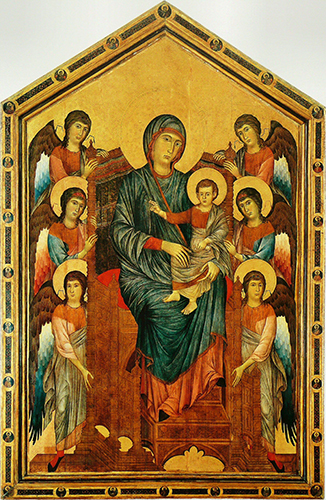
Cimabue, “Santa Trinita Madonna and Child Enthroned”, 1280-90, tempera on panel, 385 x 223 cm (Galleria degli Uffizi, Florence)
Anna makes reference to many artists and their renditions of angels. One of my favorite paintings is Cimabue’s “Santa Trinità Madonna and Child Enthroned”. Set against a gold leaf background, Mother and Child sit on a huge throne flanked by six angels. Anna describes the angels as being rather stern but that’s because, she continues, of Cimabue’s inability to express beauty. She much prefers the Cimabue angels in the Basilica of Assisi.
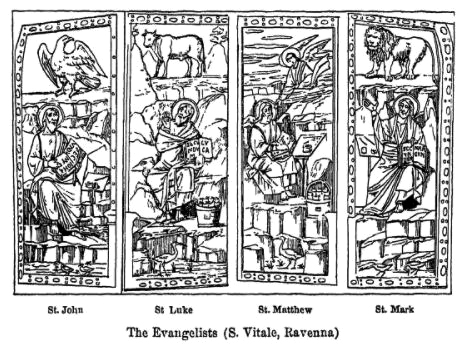
Anna begins the section on the evangelists by quoting Gregory of Nazianzus, theologian, archbishop, and ex-patron saint of Bosnia: “Matthew wrote for the Hebrews, Mark, for the Italians; Luke, for the Greeks; for all, the great herald John.”
I, personally, can testify that on many church facades in Italy, there are base-relief sculptures of the symbols representing the evangelists. Mark is symbolized by a winged man, Mark by a winged lion, Luke by a winged bull, and John by an eagle.
Writes Anna: “I have dwelt on these fanciful interpretations and disquisitions, because the symbols of the Evangelists meet us at every turn; in the mosiacs of the old Italian churches, in the decorative sculpture of our old cathedrals, in the Gothic stained glass, in the ancient pictures and miniatures, on the carved and chased covers of old books, everywhere, in short, where enters the idea of their divine mission—and where is it not?”
The Evangelists drawing by Anna Jameson
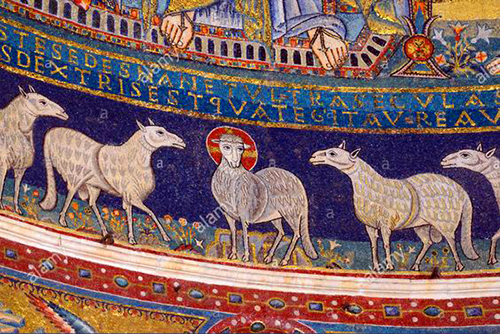
“The earliest representations of the Twelve Apostles appear to have been, like those of the four Evangelists, purely emblematical: they were figured as twelve sheep, with Christ in the midst, as the Good Shepherd, bearing a lamb in His arms; or, much more frequently, Christ is Himself the Lamb of God, raised on an eminence and crowned with a cruciform nimbus, and the apostles were ranged on each side as sheep.”
Christ with Apostles, Mosaics by Pietro Cavallini, Church Santa Maria in Trastevere Rome Italy. (Alamy stock foto)
The most well-known representation of the Apostles together is that of the Last Supper. And for this reason, Anna dedicates ample space to it in her book.
The Doctors of the Church were the representatives of the Church Militant, that is, those on Earth who are in constant warfare against its enemies (such as the flesh and the devil) as opposed to the Church Triumphant in Heaven. Anna writes that “as teachers and pastors, as logicians and advocates, they wrote, argued, contended, suffered, and at length, after a long and fierce struggle against opposing doctrines, they fixed the articles of faith thereafter received in Christendom.” In other words, they were the ones who created the dictates for the others to follow. In Western Art, the Doctors of the Church are represented by the Latin Fathers: St. Jerome, St. Ambrose, St. Augustine, and St. Gregory.
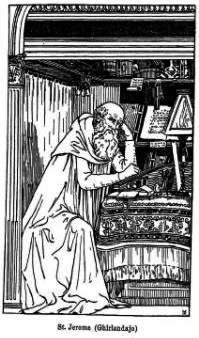
St. Jerome is often represented as an emaciated old man, bald, bearded, and half naked with a lion next to him. As he’s known for his translation of the Bible, he’s generally seen holding a book and a pen. And as for the lion, legend has it that St. Jerome was sitting in the monastery at Bethlehem when a limping lion walked in. Whereas the other monks got up and ran away, Jerome went to the lion and treated him as a guest. The lion lifted his paw exposing a thorn stuck in it. Jerome extracted the thorn and the lion no longer limped. Animals, it would seem, have a capacity to express gratitude many humans don’t have. The lion was eternally grateful to Jerome and that’s why he is often portrayed in representations of the saint.
Anna Jameson’s drawing of Ghirlandaio’s “Saint Jerome in His Study”
The best known Beatified Penitent is undoubtedly Mary Magdalene. She also is one of the figures whose identity has been most disputed. But there is no amount of theological dispute that can take away her fame. Religious tradition has her “sanctified in the imagination and in the faith of the people in her combined character of Sinner and of Saint, as the first-fruits of Christian penitence.”
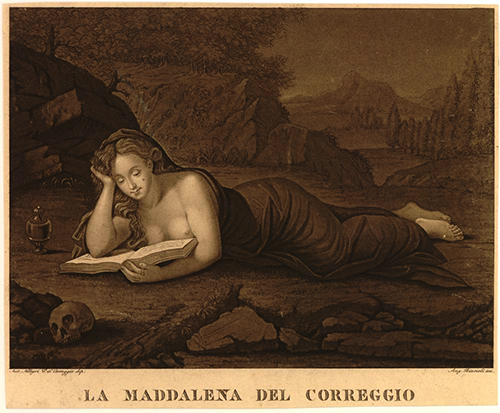
Of all the many Mary Magdalene paintings Anna saw, Correggio’s “La Maddalena” was unsurpassed. The only problem with it, said Anna, was the woman’s virginal beauty comparable to a Psyche or a Seraph.
Mary Magdalene is shown with her breasts exposed lying on the ground reading a book. Nearby is her famous alabaster jar and a skull. The jar represents the ointment used in the Anointing of Jesus whereas the skull and the book are symbols of penitence and of the contemplative life.
Thich Nhat Hanh says “Walk as if you are kissing the Earth with your feet.” Tomorrow morning on my terrace I will look as if I am kissing the Earth with my eyes.








 The Narrative Within