High Notes and Low Notes

Her mother sung in a choir and her father was an operatic stage manager.  So there is no surprise that Claudia Muzio became an opera singer. Her father’s job kept them on the move.  Although from Italy, Claudia’s family lived in London when she was a child giving her the chance to learn English before moving to Turin where she studied music at the age of 16.

Claudia’s career began early and moved forward with intensity.  Known as La Divina Claudia, she even sang with Caruso. It was the popular opinion of the times that Claudia was unsurpassed in her portrayal of Violetta in La Traviata (The Fallen Woman).

Claudia Muzio as Violetta

Internationally famous, in 1919 she went to Buenos Aires. And it was here that she met Aristotle Onassis. Onassis was born in Smyrna in 1900. During the Smyrna massacre of the Greeks in 1922, much of his family was killed.  It’s said that he had a homosexual relationship with a Turkish lieutenant in order to have his father freed from prison. Afterwards, Onassis and his family moved to Athens.

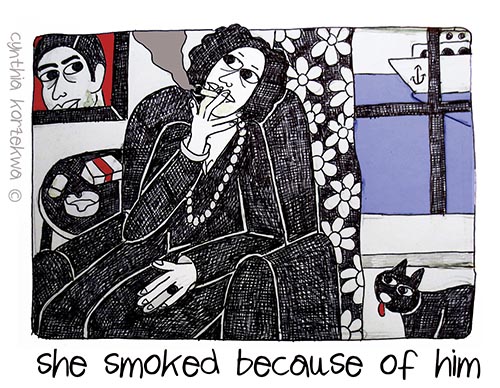
The Onassis family had had a successful tobacco business in Turkey but those days were gone and, as many other Greeks who’d been forced to leave Smyrna, Onassis had a difficult time surviving economically.  So he left for South America. Initially he worked for the phone company where he had no qualms listening in on the conversations of others.  This is the way he heard about a film that was to be made with the protagonist constantly smoking cigarettes giving him the idea of going back into the tobacco business and creating his own brand of cigarettes aimed at the female market. And to promote this cigarette, he needed someone famous to sponsor it.  Although he didn’t know her personally at the time, he decided on Claudia.  One evening he showed up in her dressing room with a huge bouquet of flowers and seduced her.  Claudia was 11 years older than Onassis and probably very flattered that he was so interested in her without realizing what his main objective was.

Claudia Muzio Smokes

Onassis convinced Claudia to promote his cigarettes and the publicity he received helped him earn quite a bit of money.  By the time he was 25, he was, thanks to the cigarettes, a millionaire. Now Onassis no longer needed Claudia and dumped her. Eventually he realized that the shipping magnates made more money shipping the cigarettes than he did in making them.  This happened right at the time of the Great Depression so, with the money he’d made from the cigarettes,  he easily bought six ships for half their value.

Not only a millionaire, Onassis was a playboy.  He said “I see every woman as a potential mistress.  Beautiful women cannot bear moderation—they need an inexhaustible supply of excess.”  So excess is what he gave them.

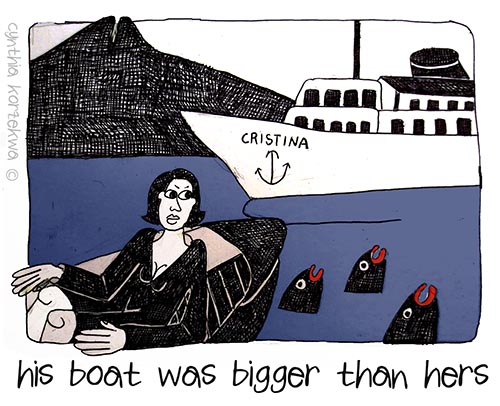
In the meantime, Claudia’s interpretation of Violetta had inspired another opera singer—Maria Callas.  In 1959, Maria and her husband, Battista Meneghini, were invited to a jet set party on Onassis’ yacht “Cristina”.  Other guests included Churchill, the Agnelli couple and Grace Kelly and her husband the prince. Onassis owned stock in the principality of Monaco and, when the value of his stock started going down, he convinced Prince Rainier that he needed to marry someone famous to promote Monaco and its casinos—the same strategy  used with Claudia to promote his cigarettes.  The  two decided upon Grace Kelly.

A Yacht Named Cristina

On board the Cristina, something chemical happened between Onassis and Maria. Maria decided she couldn’t live without the rich tycoon and left her husband to pursue a romance that would only provoke sorrow for her.  She was 36 and Onassis 53. The two had a relationship for years until Onassis dumped Maria for Jackie Kennedy.

So had it not been for Claudia Muzio helping Onassis make so much money, maybe Onassis would not have become rich and famous thus in the position to become Maria Callas’ lover and Jackie Kennedy’s husband.  Who knows.

Soprano e Basso

Poor Claudia was not lucky in love. After Onassis, she married a man who invested her money in the stock market and, with the Wall Street Crash of 1929, she lost everything.  This provoked a series of health problems leading to heart failure.  Claudia died in a hotel room in Rome at the age of 47.

And one could think that Onassis adored opera music having had two soprano lovers. But he once made the remark that opera was like listening to two Italian cooks fighting over a recipe.  It’s more than likely he preferred rebetika, a kind of Greek blues that evolved in the 1920s when the Greeks who fled Turkey settled in Piraeus.

Claudia Muzio (1889 – 1936) is buried at the Verano Monumental Cemetery in a tomb designed by Pietro Canonica.  For fotos go HERE.

Related:  Onassis, Jackie and me

Posted in Drawings & Paintings, People, Sound & Music, Verano Monumental Cemetery | Tagged , , , | 3 Comments

Bebina Bunny and Alexander von Humboldt

“One curiosity leads to another.”  Bebina Bunny


Recently I read Matteo Farinella’s article “Alexander von Humboldt” where he makes reference to Andrea Wulf’s “The Invention of Nature”.  It was a happy read as I discovered Farinella (illustrator of “Neurocomic”), Wulf and von Humboldt all in one article.

Alexander von Humboldt (1769-1859) was addicted to curiosity.  Interested in geography, nature, science, and philosophy, he left his native Prussia to explore the world to feed his addiction.  And the more he explored, the more he realized how all his curiosities were interrelated. This led to his many volume treatise “Kosmos”, where he pursued the unification of all knowledge instead of trying to isolate one idea from another. Von Humboldt perceived the universe as holistic—just one big entangled family and not just groups of unrelated entities.

Curiosity leads to knowledge. That’s why the gods considered it an evil (ex. The Tree of Knowledge that got Adam & Eve in trouble and the vindictive Zeus and Pandora’s Box). The more the gods could control knowledge, the more they could control mankind.

after Eden, they preferred carrots


But curiosity leads to important discoveries.  There’s the example of Heinrich Schliemann’s discovery of Troy as well as that of the 15 year old Canadian, William Gadoury, who recently discovered a Mayan city  by studying the stars.

Bebina Bunny’s Cabinet of Curiosities” is a tribute to curiosity. It is the story of a cabinet of curiosity created not with objects but with mindful pursuits of curiosity.  These pursuits are materialized by being written down, rolled up and placed into empty bottles.  Bebina, realizing that curiosity not only makes the world bigger but provides us with options, strives at collecting enough of these curiosity filled bottles to fill a room so she can create her own unique wunderkammer.

Bebina Bunny's Cabinet of Curiosities Book Cover

Bebina Bunny’s Cabinet of Curiosities

Related:  Paris as a Cabinet of Curiosities

.

.

Posted in Books, Drawings & Paintings | Tagged , , | Leave a comment

“Adelita or Die Lorelei?”

The Mexican Revolution was not just about Mexico. It was also about other countries that got involved for political aka economical reasons.

Paul von Hintze studied at the Naval Academy which eventually led to his becoming an admiral in the German navy. But he also had much social swag and a manipulative empathy.  This made him perfect for a diplomatic career.  That’s why Emperor Wilhelm II appointed him as German Ambassador in Mexico in 1911.  A year before, the Mexican Revolution had begun as a protest against Porfirio Diaz’ dictatorship. Once in Mexico, von Hintze immediately created a network of secret agents and pushed the sale of German-made arms.

Paul von Hintze and the Mexican Revolution

During a revolution, people die.  Soon after von Hintze’s arrival, a group of insurgents passed by the town of Covadonga. Shots were fired at them and they responded with more gunfire resulting in the death of four German citizens. Von Hintze demanded that these insurgents be caught.  He was unrelentless and the killers were finally captured and executed in front of him.  Furthermore, von Hintze insisted that the Mexican government (now under Francisco Madero) pay a colossal sum to the Germans as a form of restitution.

Adelita Rode His Horse

One of the most popular songs in Mexico at this time was La Adelita. Adelita represents those women who considered themselves soldiers in the revolution and were prepared to shoot at the enemy, too.  She represents those women who chose to be protagonists and fight for their rights instead of passively letting others nullify their existence.  It is Adelita’s bravery that makes her beautiful.

Von Hintze continued to participate in Mexican politics often interfering with revolts. When General Huerta effected a coup, Madero was arrested. Von Hintze tried to secure Madero’s safe conduct out of Mexico but was unsuccessful and Madero was executed.

Politics is about subterfuge.

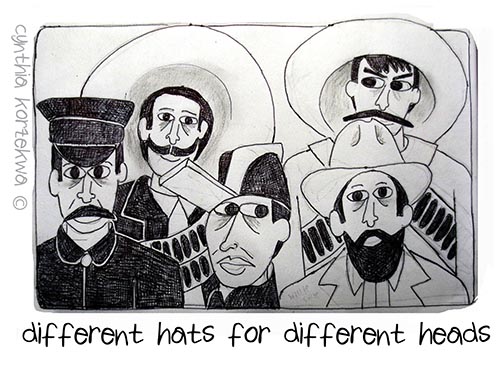
It’s said that the spirit of Montezuma, Emperor of Mexico until the Spaniards arrived, still curses the presence of foreigners and has his revenge by inflicting them with bacterial diarrhea.  Although capable of executing revolutionaries, von Hintze was impotent in front of  Montezuma’s Revenge. The problem was so severe that he went back to Germany to be cured. When he returned to Mexico, von Hintze found Huerta a self-proclaimed president whose main ability was that of creating chaos.  Von Hintze said that Huerta was so unprepared that he promoted waiters to generals.  Huerta created a regime of terror and was so despised by the people that he was given the nickname El Chacal (the jackal). Pancho Villa and Alvaro Obregon defeated Huerta’s troops forcing him to resign.

Different Hats for Different Heads

In 1914, Huerta went into exile and von Hinzte left for a new diplomatic gig in China. Changes were going on in Germany, too. And, after the conservative chancellor Georg von Hertling was forced to resign, von Hintze’s career mellowed out. For a while he was president of the Society for Germanic Culture in Foreign Countries.  Then he went to live in Austria and travelled before dying in Merano, Italy.  He’s buried in the Verano Monumental Cemetery.

Note:  the title of this post is based on two songs.  One, La Adelita, as mentioned above and the other, Die Lorelei, a German folk song written in 1801 by Clemens Brentano.  But, in 1824, the words were re-written by Heinrich Heine to describe a siren who lived on the Lorelei and distracted sailors with her song and her beauty causing them to crash on the rocks.

Paul von Hintze (1894-1941) is buried at Verano Monumental Cemetery

Links: Modern version of Adelita by Calaveras de Azùcar + Viva Zapata!  film + Pancho Villa film + Die Lorelei sung by Erich Kunz

.

.

Posted in Verano Monumental Cemetery | Tagged , | 1 Comment

The Hero of Two Worlds

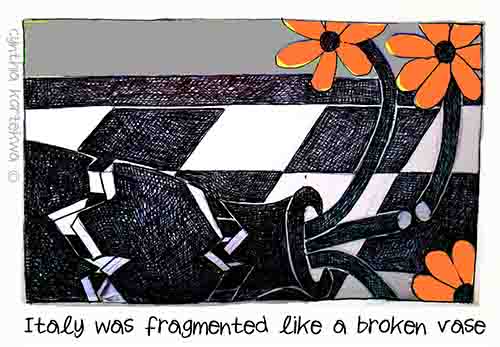
Italy Was Fragmented Like A Broken Vase

After the fall of the Roman Empire, Italy was fragmented and divided up into various kingdoms. Battles routinely moved boundaries but, in the early 1800s, Italy was basically divided into 3 parts: the Bourbons in the south, the Pope in the center, and the Savoys in the north.

In 1848, a series of revolutions broke out in Europe.  The masses were tired of being commanded by the conservative elite–having too much meant depriving others of having enough.

In Italy a move towards the unification of the country began which led to the Risorgimento and, subsequently, the unification of Italy in 1870.

The men given credit for this unification are Giuseppe Mazzini, Victor Emmanuel II, Camillo Benso count of Cavour, and Giuseppe Garibaldi. But, even though they all claimed to want a unified Italy, their motivations were not the same. Victor Emmanuel II and Cavour both wanted to unite Italy but as a monarchy under Piedmont rule.  Mazzini wanted to unite Italy but as a republic.  Garibaldi didn’t care if it was a monarchy or a republic just as long as it was united.
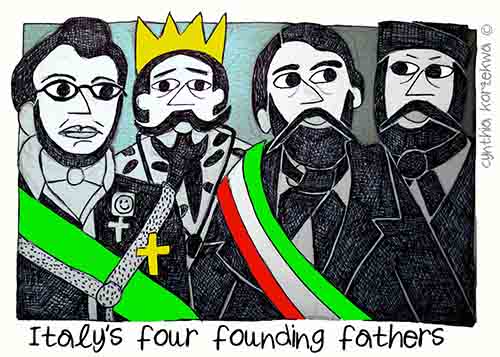
Italy's Four Forefathers

Garibaldi, the romantic rebel, was born in Nice.  He grew up with the presence of the sea and it’s distant horizon  that constantly beckoned him.  He worked as a sailor and became a merchant marine captain.
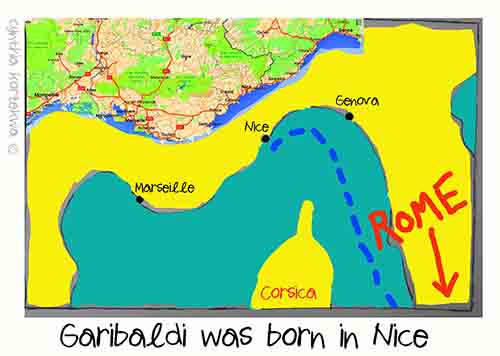
Garibaldi Was Born In Nice

In 1833, while heading towards Constantinople, the 36 year old Garibaldi met Emile Barrault, a follower of  Henri Saint-Simon.  Saint-Simon believed that man should adopt humanity as his homeland and fight for people struggling against tyranny.  For whoever fought such a battle, more than a soldier, was a hero. Dazzled by these ideals, Garibaldi now had a new horizon—that of becoming a hero.

Followers of Saint-Simonianism believed in the importance of brotherhood.  Some followers even encouraged the wearing of clothing that buttoned down the back. Needing help to unbutton your clothes symbolized your need for others in general indicating that our lives are all interrelated.

Garbaldi 4 b

Now Garibaldi’s goal to be a hero had him participating in revolts and subversive activities not only in Italy but in South America as well. He was always on the run.  And always in trouble.  Nevertheless, Garibaldi was audacious and brave.  The Argentine dictator Manuel Rosas once caught him and had him hung by his feet and whipped. The stoic Garibaldi didn’t complain or cry out in pain. For the oppressed and idealistic, there was no doubt that Garibaldi was indeed a hero.

they hung him upside down

In Brazil where the air smelled of revolution and intrigue, he continued to fight for just causes. But the life of a revolutionary, despite the people around you, is often lonely.  Then he met Anita.  Overwhelmed maybe more by his need to be loved than by Anita herself, he immediately whispered in her ear “You will be mine!”   Convinced, she left her abusive husband and ran off with Garibaldi.

Together, in the name of liberty and equality,  they fought many battles in Brazil.

But, in 1848, revolutions were exploding all over Europe and Garibaldi decided it was time to go back to Italy. As in Brazil, Anita was at his side and together they fought to defend the Roman Republic. But Anita, already pregnant and sick with malaria, didn’t have the strength to continue the struggle and died in her husband’s arms  not far from Ravenna.

he held her in his arms for the last time

After 1848, Garibaldi modified his heroic image: Less hippy and more savoir faire. Less of a bandit and more of a gentleman.
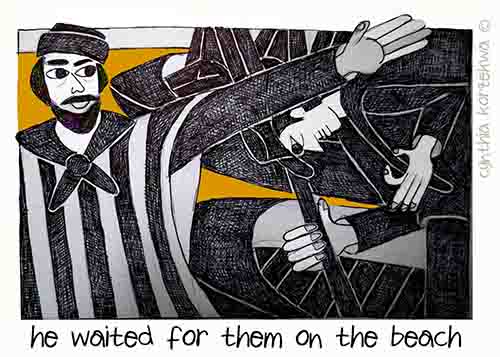
He Waited For The On The Beach

Garibaldi is best known for the Spedizione dei Mille (Expedition of the Thousand) a crucial battle for the Risorgimento.  In 1860, Garibaldi, along with 1000 volunteers, arrived in the Kingdom of the Two Sicilies to overthrow Bourbon rule. Despite the advantage the Bourbons had in numbers and arms, Garibaldi and his troops were victorious and the Bourbon ruler and consort, King Francis II and Queen Maria Sophie, forced to leave.
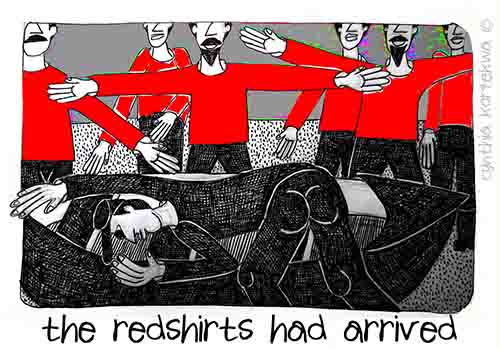
they'd reached the shores of Marsilia

King Francis II and Queen Maria Sophie were destined for sadness. Sophia Maria, Empress Sissy’s younger sister, married Francis by proxy.  When they finally meet in the bedroom, Francis ignore his bride and spent the night praying.  In 1859 they become rulers of the Two Sicilies.

King Francis II is known mainly for being insignificant whereas Maria Sophie was considered a kind of heroine because of her efforts to care for and encourage royal troops during Garibaldi’s attack. Only 18 years old at the time, she had no problems picking up a gun and shooting at the enemy. Marcel Proust made reference to her in La prisonnière calling her  a “soldier queen”.  Gabriele D’Annunzio, instead, saw her as the “stern little Bavarian eagle.”

the queen acted like a soldier

Maybe Maria Sophie  just had a lot of pent up frustration to release. Francis II had a malformation that kept him from consummating the marriage with her. Frustrated, Maria Sophia spent much time bathing in the sea of Naples, smoking cigars, and riding her horse around town. After the couple was forced to flee to Rome, she had an affair with a Papal Guard (Zuavo), got pregnant, and was sent off to Bavaria to avoid scandal.

Marie Sophia loved a zuavo

The situation was a mess especially considering that royalty made alliances via their off-spring and Francis was not doing his part.  The family forced him to have an operation and viola, Marie Sophie got pregnant again but this time by her husband. Unfortunately, the baby did not live long (some say because of nanny’s incompetence). The couple was destroyed psychologically. Francis turned to God and Marie Sophie turned to lovers.

When the unification of Italy becoming more and more a reality, Francis and Maria Sophia were forced to leave Rome and wander from one royal home to another. Francis eventually gave up and died but Marie Sophie kept on trucking. Her Italian experience had provoked a need for revenge. Her desire to cause conflict in Italy as to break up the unification led to speculation that she was involved with Humbert’s assassination.

Admirers.

The Three Muskateers man, Alexandre Dumas, adored Giuseppe Garibaldi.  Not even he could have invented such a character! Dumas wrote two Garibaldi related books: Mémoires de Garibaldi and I garibaldini. The French author was with the hero during the Expedition of the Thousand.

The Three Muskateers

Garibaldi had another admirer—Abraham Lincoln.  Lincoln asked Garibaldi to come help him with the American Civil War but, not feeling that the main purpose of the war was the liberation of the slaves, Garibaldi declined.
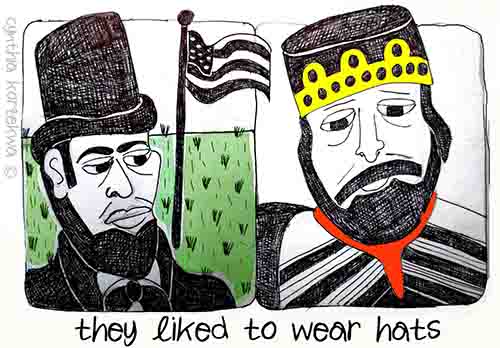
 

They Liked Hats

Il Gattopardo.

Giuseppe Tomasi di Lampedusa (1896-1957) was the 11th prince of Lampedusa, an aristocratic Sicilain family that was slowly dissipating into nothingness. He grew up with an excessively unattached father and an overly attached mother.  The company he most enjoyed was that of his books.  Shy and introspective, at the age of 36 he married an aristocrat and psychiatrist from Latvia, Alexandra Wolff Stomersee, aka Licy. The couple begin their married life in Palermo living with Tomasi di Lampedusa’s mother.  But the situation didn’t last long as Licy was too independent minded to be dominated by a mother-in-law and moved back to the family castle in Latvia. For years Licy and Giuseppe Tomasi di Lampedusa had a Marriage By Correspondence.  After the mother-in-law’s death, Licy moved back to Palermo.

Tomasi di Lampedusa was an avid reader and most every day for 10 years would start his day off at a pasticceria followed by a visit to Flaccovio’s, his favorite bookshop. More bookshops and more cafes then he’d return home by bus.  Licy, instead, slept all morning because her psychiatry practice kept her working until late at night.

Tomasi di Lampedusa always carried books with him with at least one Shakespeare because, if affronted by a disagreeable situation, reading Shakespeare for him was like taking a Valium.
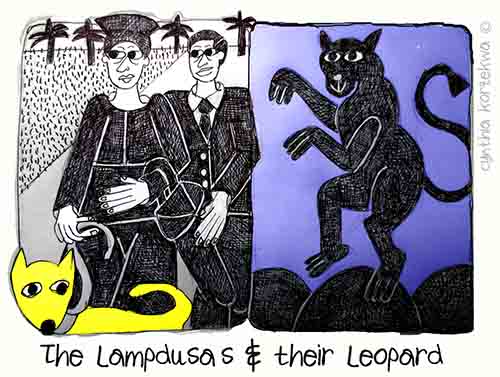
The Lampdusa's & their Leopard

Nearing the age of 60, Tomasi di Lampedusa felt the need to write the history of Sicily from his family’s point of view. The Leopard (Il Gattopardo) is the story of how the unification of Italy provoked the decline of the Sicilian aristocracy. The title comes from the family coat of arms that bears a leopard.

Protagonist of this tale is Prince Fabrizio de Salinas, a middle-aged aristocrat living in Sicily. Garibaldi has arrived on the island with his Redshirts and Don Fabrizio sees his world of privilege quickly crumbling away.  He knows the change is necessary but, as for most all of us, change is not always easy to absorb.  So, no longer able to identify with the events, he begins a process of alienation.

Garibaldi is not the only one who challenges the status quo.  So do the nouveau riche. Don Fabrizio’s nephew, Tancredi, is engaged to the beautiful but crass Angelica whose father is a rich merchant.  Tancredi is attracted to Angelica’s money and Angelica to Tancredi’s aristocratic status.  They pretend to themselves that they are in love with one another when they are actually in love with their ambitions.

It is Tancredi who truly personifies what is happening.  He says: if we want everything to stay as it is, we must change everything.  The young aristocrat who has a title but no money knows he must adapt and adapt he does.  So he becomes one of Garibaldi’s Red Shirts then part of the Royal Army then a member of the Parliament. He also marries for money and describes his fiancé  as a beautiful amphora full of coins. For survival,  Tancredi transforms himself when necessary.
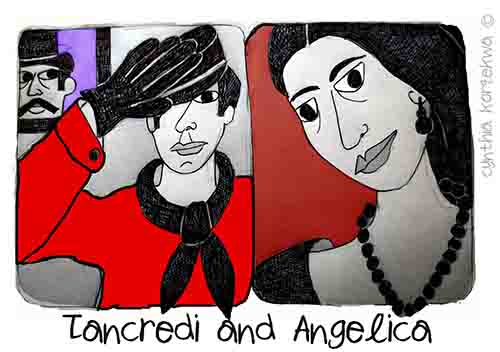
Tancredi & Angelica

The Leopard was published after Tomasi di Lampedusa’s death in 1958 and later made into a film by Luchino Visconti most notable for its 45 minute ballroom seen .

Garibaldi’s overthrow of the Kingdom of the Two Sicilies has sometimes been called “the solution that didn’t resolve anything”.  Don Fabrizio said that Sicilians didn’t want to improve because they saw themselves as perfect and their vanity was stronger than their misery.

The novel ends with Don Fabrizio daughters, all old maids, who desperately try to hold on to a reality that no longer exists. Resisting the inevitable, their life has become sterile, sad, and self destructive.


Boundaries are made to be moved.


The Garibaldi Family Tomb is at Verano Monumental Cemetery whereas Garibaldi himself is buried on his island, Caprera.

Posted in Uncategorized, Verano Monumental Cemetery | Tagged , , , , , | 1 Comment

Futurists without a future

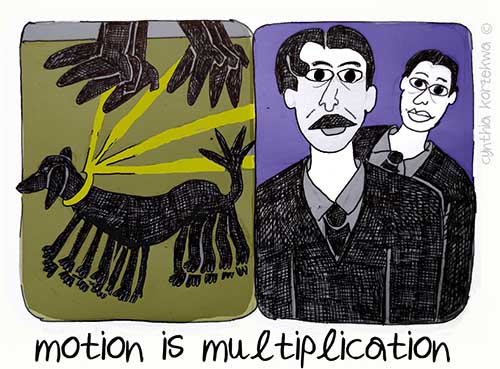
At the beginning of the 1900s, the United States  and much of Europe was being swept away by the Industrial Revolution.  But Italy, burdened with grandeurs of the past (Ancient Rome, Renaissance, Baroque) had difficulties updating itself.  So a group of young, animated and slightly rebellious Italian writers and artists got together to promote not the present but the future.  Led by the Milanese Filippo Tommaso Marinetti, they created Futurism.  In 1909 Marinetti wrote the group’s manifesto which promoted modernism and the aesthetics of speed.  They praised machines but scorned women. The Futurists wanted to make things happen and this was possible only via motion and motion was a manifestation of force.

Chronophotography and Cubism

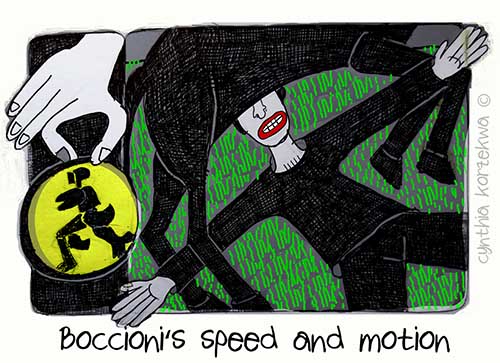
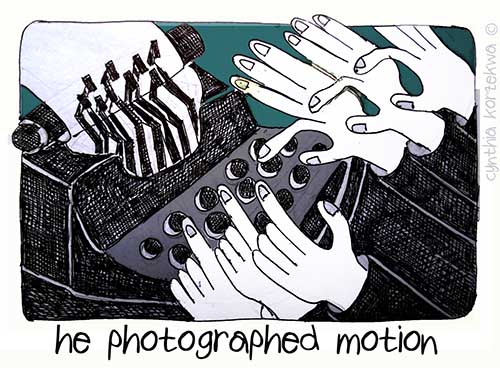
The Futurists were mesmerized by the time lapse photography of Étienne-Jules Marey and contaminated by Cubism.  Their movement soon became international.  But, unfortunately, the Futurist art movement became highly politicized.  Extremely nationalists, they strongly identified with Mussolini.  And, because they glorified war calling it the world’s only hygiene, many Futurists enrolled in the army during World War I.  This proved a bad decision for Futurist sculptor Umberto Boccioni. During military training, he fell from his horse and was trampled to death.  The speed and motion he promoted was the same thing that killed him. Boccioni’s  presence can still be felt today as his most famous work, the Hermes related statue, Forme uniche della continuità nello spazio, is commemorated on the Italian 20 cent coin.

Boccioni‘s speed and motion

By 1914 the artists started bickering among themselves and, after WW I, the movement began dissipating. But Marinetti tried resuscitating his dying movement by calling it “il secondo Futurismo”. Marinetti tried to make his Born Again Futurism the official art of the Fascist government. But Mussolini’s aesthetics were that of the Roman Empire. Plus Mussolini’s mistress at the time, Margherita Sarfatti, was a cultural tzar and preferred the Novecento movement to that of the Futurists. So Marinetti, a conformist at heart who only wanted to be part of the status quo, began making one compromise after the other.  A proclaimed atheist, he resigned himself to Catholicism  justifying himself by saying that Jesus was a Futurist.

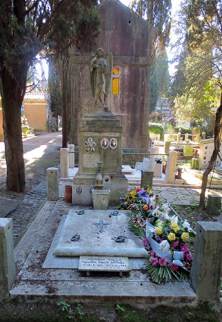
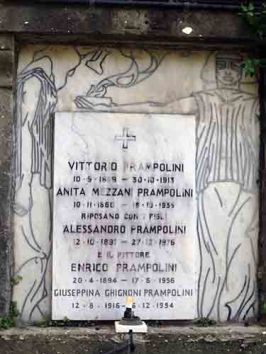
Buried at the Verano Monumental Cemetery are three active members of the Futurist movement:  Giacomo Balla, Enrico Prampolini and Anton Giulio Bragaglia.

Giacomo Balla  (1871 – 1958)

Balla was part of the group right from the start. When he was just nine years old, Balla’s father died. He was forced to work at an early age and later attended night school to learn how to draw.  For awhile he worked as an illustrator but also painted portraits and landscapes.  Living now in Rome and far away geographically and psychologically from his hometown, Turin, Balla lived difficult days and became sensitive towards people who struggled to survive.

So possessed by the idea of movement, Balla named one of his daughters Elica (“propeller”).  The other daughter’s name was Luce (“light”), another one of his fixations.

Balla remained faithful to the Futurist style until he, too, got bored with it and went back to traditional painting with a fondness for portraits. He also enjoy painting the walls and furniture of his home in Rome.

Giacomo Balla

Enrico Pampolini (1894-1956)

Aeropittura became very popular with the second generation Futurists.  It was inspired by the way being in an airplane changes your perspective as compared to being on the ground.  One of the main aeropainters was Enrico Pampolini. Prampolini studied Applied Arts at the Academy of Fine Arts with Duilio Cambellotti (who adorned various tombs at Verano with his stained glass windows).  Painter, scenographer and architect, Prampolini was interested in all of the new European art trends.

In 1917, Prampolini designed the sets for Thaïs, a Futuristic film directed by Anton Giulio Bragaglio. Prampolini’s backdrops were full of geometric shapes and symbolic figures such as cats and masks. Painted optical illusions interacted with the real indicating that fact and fiction often live in symbiosis.

Enrico Pampolini

Anton Giulio Bragaglia (1890-1960)

Brothers Carlo and Anton were the sons of Francesco, director of the Cines movie studio and that’s how they got started in filmmaking. Together they created the gallery Casa d’Arte Bragaglia in Rome (1918) to help promote avant garde art.  However, Carlo’s filmmaking took him in a very commercial direction (he directed many films starring the Italian legend Totò) whereas Anton preferred experimental art and its theory.

Anton became a part of cinematography history with his film Thaïs based on a novel by Anatole France. It’s  the story of Countess Vera Preobrajenska and the married men she seduces—a plot typical of the femme fatal movies of the time.

Anton Giulio Bragaglia

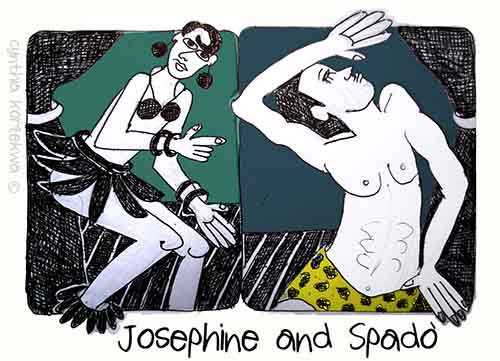
But Anton also loved “the moveable mask” and  theater.  He created Il Teatro Sperimentale degli Indipendenti (1922-1936) attracting a number of performers including Alberto Spadolini.  Anton refered to Spadolini’s dancing as “aereodance”.  The speed the Futurists tried to represent in their art, Spadolini represented in his way of dancing.  And when Mussolini forced the theater to close, Spadolini moved to Paris.  Here, known as Spadò, he painted, acted and danced.  He was partners on and off stage with Josephine Baker for awhile as they both exalted their bodies and enjoyed dancing naked.  Spadò was also a secret agent for the Resistenza.

Josephine and Spadò

Angiolo Mazzoni  (1894-1979)

Leaving the Verano Cemetery via the main gates, in the distance you can see the water tower, adjacent to the Termini train station, designed by Angiolo Mazzoni.  Mazzoni (who worked for awhile with mega Fascist architect Marcello Piacentini) was a well-respected architect during the Fascist government and designed the Roma Termini train station once known as being the biggest and most trafficked train station in Europe.  Even today it’s been defined as “a universe in continual expansion” because of the changes it continues to make.  Mazzoni  had even greater plans for the train station but, because of WW II, the worked was stopped.  After the war, Fascists were no longer well received in Italy so, in 1948, Mazzoni moved to Bogata and stayed there until 1963.

Angiolo Mazzoni Water Tower

Related: CASA BALLA, A COLOR EXPOLSION + Lo scandalo di casa Balla +  Unfortunately, Balla’s home (1929-1958), the CASA MUSEO DI GIACOMO BALLA, Via Oslavia 34  Roma, is closed to the public + Fotodinamismo Futurista, Anton Giulio Bragaglia video + Politics as Art: Italian Futurism and Fascism by  Anne Bowler pdf + Angiolo Mazzoni in Toscana + Video Anton Giulio Bragaglia: Thaïs (1917)  + Josephine Baker Vintage Naked on Stage + TESINA SULL’ARCHITETTO : ANGIOLO MAZZONI (1894 – 1979) ARCHITETTO INGEGNERE DEL MINISTERO DELLE TELECOMUNICAZIONI

Giacomo Balla's Grave at Verano

Giacomo Balla, Verano, Basso Pincetto, riquadro 139

Enrico Prampolini's grave at Verano

Enrico Prampolini, Verano,  Rampa Caracciolo, tra i riquadri 160 e 161, fila IV, loculo 22

Anton Giulio Bragaglia

Anton Giulio Bragaglia, Verano, Alto Pincetto, Viale della Marina

.

.

Posted in Drawings & Paintings, Rome/Italy | Tagged , , , , , | 4 Comments