
My computer,s hard disc bit the dust….so time out for awhile.
My computer,s hard disc bit the dust….so time out for awhile.
Day 31

When I finally arrive on the beach of Krios and find, with luck, a bit of shade under a tamarisk, the first thing I do is lay down my towel. Beach towels are like territorial flags and say “this space is taken”. They indicate a line of demarcation, a boundary.
Today I have reached a boundary—the limit in terms of these 31 days dedicated to daily posts regarding my walks to Krios.
I began this series as a reflection on walking as a spiritual practice. But the reflection today is: just what is meant by spiritual? Spirituality has so many definitions that it has none. So I’ve given it one of my own: spirituality is the contemplation of what gives meaning to life.
While walking to Livadia today, I asked Pierluigi if, in his readings, he’d come across anything of interest regarding spirituality. So he began talking to me about anima mundi–the belief that everything that exists is connected by a world soul.
But my walks are not about the world, they’re about me. Because there’s a territorial domain inherent in my spirituality–it belongs to me and no one else. Religion is a different story. It aims to transform multiple needs in to a single creed. Maybe we can’t be sure that God exists but a need for God undoubtedly does.
Several people have contacted me expressing their interest in the idea of walking as a means of re-connecting with the self. So, if anyone reading this is would like to write a piece for my blog about walks, I would be thrilled to post it. You can contact me at korzekwa at gmail dot com.
Thanks for keeping me company!
By the way, I will be taking a short break from blogging.
Keep On Trucking. OM. Trucking. Trucking. Keep On Trucking.
Day 30

Several years ago, I read “Super Consciousness: The Quest for the Peak Experience” and became a Colin Wilson fan. A Peak Experience, term coined by psychologist Abraham Maslow, is an ecstatic state when one feels a sense of euphoria and interconnectedness with the world around them. Intrigued, I also read Wilson’s “Access to Inner Worlds” (1983). Wilson believed that our everyday consciousness lacks animation because we habitually use only certain parts of our brain. So, to make our life more alive and exciting, we need to expand our perception. And this means training our attention in order to create a peak experience at will.
Wilson devised this exercise that, with practice, can help achieve control over one’s attention:
Take a pencil and hold it up against the ceiling then concentrate on the pencil with all your might. Relax then concentrate again. Keep doing this on and off concentration until you’re able to focus your attention at will. This exercise is a bit boring and fatiguing. It even produces a strain behind the eyes. However, if you persist, at a certain point you will feel much discomfort followed by an immense relief. And this will create a peak experience. Like an orgasm, first it’s tension then a relief producing euphoria.
Altering our perception is an act of will.
Wilson also used Wilhelm Reich’s breathing exercises for the focusing of perception: lie down on the floor and take a deep breath. Exhale as slowly as possible going down from the lungs to the stomach to the genitals as you say “out, down, through”.
Wilson said that if first you do the breathing exercise followed by the pencil exercise, you will be rewarded with a feeling of exaltation.
Breathing is inter-relating with our environment. By breathing, we become a part of the world around us. That’s why, if I live in a smog filled city, I will absorb this smog and become toxic, too.
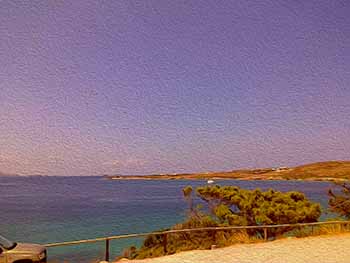
Research shows that living close to the sea makes one healthier because of the air that’s full of minerals and negatively charged ions. These ions help strengthen our immune system, absorb oxygen, balance serotonin levels and counter-balance the positive ions (free radicals) we get from computers, TV and electricity in general.
We take breathing for granted without realizing its true power. If done properly, breathing can revolutionize our lives. That’s why I like to sit on the beach to do some basic Pranayama yoga breathing exercises. Blood needs fresh air to flush out toxins and the sea air is perfect for this.
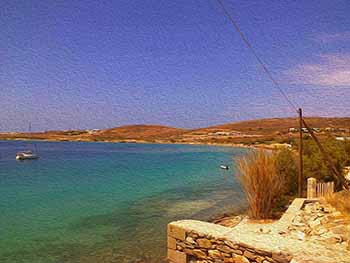
Life is but a series of breaths. Yogi Ramacharaka
As for the mantra today, it’s from Berlin’s “Take My Breath Away”. Ok, maybe I’m being a bit kitsch and I should have used Sting’s “Every Breath You Take” but that’s just how I woke up today…feeling kitsch.
Breath in. OM. Breath out. Breath in. OM. Breath out.
Related links: the breathing earth + Breathing, the Center of Life +
Day 29

Different people approach the water in different ways. There are those who go into the sea just to rinse and cool off. Others go in with water mattresses and float around. Some people actually swim. My favorite are the groups of middle aged and beyond Greek women wearing hats who go way beyond the shore and kind of hover together and talk and talk and talk. From a distance they look like floating heads.


There is no life without water. And maybe that’s why we are so attracted to being near the sea. The author, Wallace J. Nichols, claims that the nearness of water stimulates our brain by releasing dopamine, serotonin and oxytocin. Up to 60% of the adult body is composed of water and for the brain it’s about 80%. So being near the water is like being nearer to ourselves.

The sea offers other rewards. The color blue is relaxing and the frequency caused by the waves is good for our personal vibratory level. Furthermore, water gazing permits our mind to drift so we are present but relaxed. Water, says Nichols, meditates you.

Being around water isn’t enough. You have to drink it, too. Water helps keep your flow. This means moving oxygen around and sending blood to your tissues. Water also lubricates your joints and keeps you from feeling stiff. And, of course, water helps you eliminate toxins and solid wastes. And if you suffer from fatigue, this could mean that you’re dehydrated.
Drinking a glass of water first thing in the morning has many health benefits such as balancing the lymph system purifying the colon and renewing cells.

Today’s mantra comes from Alexi Murdoch’s “Blue Mind”.
I’m drifting. I’m drifting. I’m drifting. I’m drifting.
Related links: Hydromancy + Look at the crowds of water-gazers there. Melville + Whale Song + The Sea Inside by Philip Hoare
Day 28
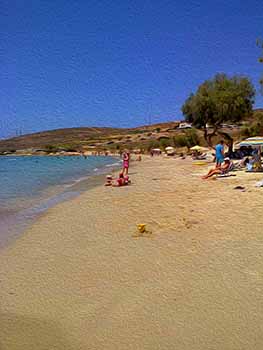
Krios beach, Paros
At the end of the beach on Krios is a small cement pier used for the boat that brings people from Parikia. Not everyone prefers to arrive on foot like I do. These people disembark in groups carrying bags, chairs, umbrellas and other beach paraphernalia. They look like refugees so I call them the Boat People. But I chide myself for this because these tourists have nothing at all in common with real refugees.
boat to Krios
Before there were cars, there were boats. Maritime history goes back thousands of years. The oldest recovered boat is a dugout canoe dating c. 8,000 BC. But there are rock carvings in Azerbaijan dating 10,000 BC showing reed boats. Who knows when the first boat was made.

boat at Krios
Boats have had a tremendous impact on the evolution of civilization. They permitted people to migrate and settle other lands. And this migration made inter-relating so much more complex.
From the land, I look towards the sea and see only a subtle line that divides the water from the sky. The horizon is seemingly so poetic. From afar. However, the idea of getting in a boat and sailing towards that line swallowed by blue makes me feel queasy.
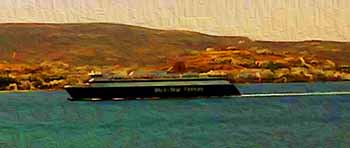
Blue Star ferry towards Paros
At one point or another, we learn to navigate. Often we need help. Sailors had the stars and then the compass. And, eventually, experience.
Daily life is a kind of sea. And navigating it isn’t always easy. That’s why I count on my ideals to give me a direction.
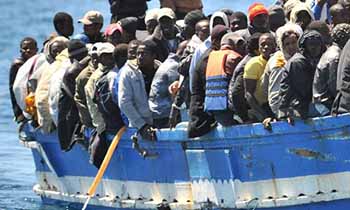
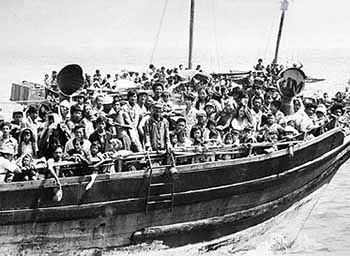

Today’s mantra comes from Cristopher Cross. Cross, from San Antonio like me, released his debut album at the time when I left Texas for Europe. The song is “Sailing” and the reappropriation comes from the phrase “Fantasy, it gets the best of me”.
Fantasy keeps me free. OM. Fantasy keeps me free.
Related links: Prehistoric Craft, history of boats + Christopher Cross Sailing Lyrics + world’s oldest boatyard + A History of the Magnetic Compass + Stone Age petroglyphs at Gobustan + Noah’s Ark


 The Narrative Within