ART FOR HOUSEWIVES has provided me the opportunity to come in contact with many interesting, animated and exciting people. One such person is my Blog Buddy, Tittin Rinde. We met via our blogs, hers being BACKTRACKING SLOWLY.
Tittin is a Norwegian living in France. She studied textiles at the Oslo National Academy of the Arts. And her big love is colour.
Tittin now dedicates much of her creative energy towards making jewellery. What she likes best is re-designing old, broken or unused pieces. Friends also give her their abandoned objects to take apart. Tittin now has a website, GREY PEARL STUDIO, oriented around her jewellery. She also writes a newsletter about «art, jewellery, design and the process of changing vocation. With personal observations of the pitfalls and joys that naturally follow».
Titten’s reflections regarding her art and art making process:
«The flotsam and jetsam of our ever consuming ways of life. I love making small wearable objects made of waste. I’m fascinated by manmade debris. Discarded objects, each carefully thought out and intended for a specific function; to hold, carry, contain, encase, protect and keep. Objects that were once designed, planned and produced, negotiated, packed and shipped to a user for a brief life of illusionary importance. Like a red plastic cap on a carton of orange juice; of great importance as long as there’s juice in the carton. When empty, the cap is no longer meaningful. In a blink its symbolic value changes from positive to negative. For a brief moment I see the red plastic caps as bright, but modest, manifestations of man’s inherent need to invent and improve. The next moment I’m sad at how easily we are moved from appreciation to condemnation. Imbued now with a certain sentimental quality, plastic caps hold my attention in a nagging way, which subsides only when I manage to give them new life».
Below, examples of Tittin’s charming work:

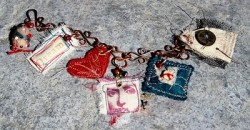
“From grey to green” Charms story: 1)Watch out for the alarm bells! 2) Put your heart into any work, and you will succeed! Bracelet by Tittin Rinde
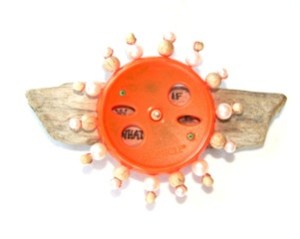 “Life compass” Drift wood from Cap d’Antibes, pearls, wood pearls and some bright plastic waste. The text says; “What if?” and “Why not?” + N/S E/W of course. Brooch by Tittin Rinde
 Marbles in an onion net. A prototype bracelet by Tittin Rinde
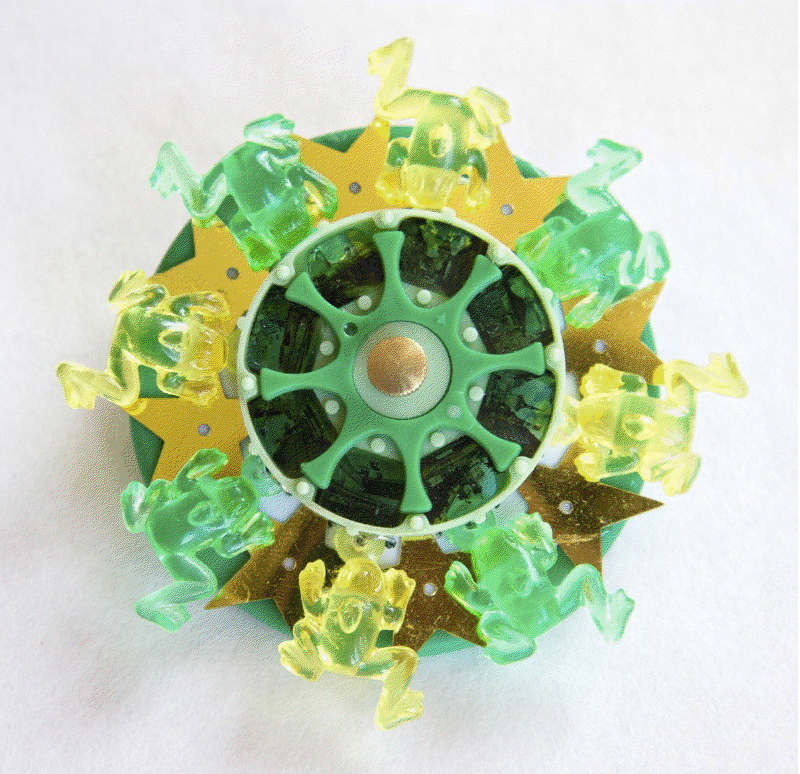
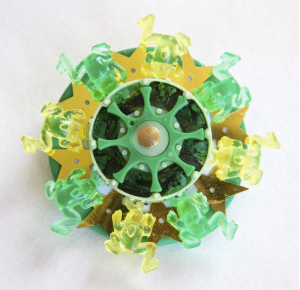 “Frogs flocking back to pond” Inspired by Tittin’s sister’s longing back to their childhood in Switzerland. Brooch by Tittin Rinde
Working with your hands.
There is something magical that happens to us when we work with our hands. So I asked Tittin if she would be willing to write something about working with ones hands and eccola! :
Do you want to lay your hands on the magic dust?
That magic dust which turns badness to blessing. The magic dust that surrounds the people who seem to land on their feet, whatever trouble they meet.
Take a look at your hands and tell me; how long, when and what do you use them for?
Your hands are magical.
Some intuitively know it; what they touch turns to gold. Others know because they watched their mother’s, an aunt’s or a grandmother’s busy hands turn bundles of yarn into items of use. Another proof to my claim is Cynthia self, who turns trash to treasures; but more than that, she shows us that by start doing, more follows. And after that it is a newer ending story.
The magic dust, my friends, is creativity. We all have it. One way to let creativity flow, is to still your brain and concentrate on letting your hands do a job. Soon you may feel a sweet anticipation at how your efforts will manifest and in this mind frame imagination rules and everything is possible. You may even remember this feeling from childhood. And in fact, anything, I repeat, ANYTHING you can imagine, can be made, done, created!
You may believe you’re not creative, but trust me, you’re all wrong. We all are born creative. And please, help spreading that word. I believe that the more people recognise and honour their creativity, the more hope there is for us on this planet.
The two C’s – change and creativity.
Change is another wonderful trigger for creativity. Cynthia asked me to say something
about change, which I’m more than happy to – another mantra of mine – as nothing lifts me like a change. My first big change, country and language, at the age of 4, could easily
have made me dread change, timid and anxious as I was (much like Pippi Longstocking’s
little friend who wondered if one really was allowed to do the unusual things Pippi
suggested).
Yet, I became one of those who thrive on change – not just the pleasant changes; like moving from cold Norway to the sunny, French Riviera, but I’ve learned to benefit from the really uncomfortable ones as well. So when going from affluent comfort to working really hard to make ends meet I find my creativity expands. It literally thrives. I see it for my work as well; the tighter the belt is for a project the better it works, as if a tight belt pushes all energy up to the head and pops out as creativity.
And I’m not alone, neither to be challenged nor becoming more creative. We live in times when many have to, or want to, tighten the consumer belt, whether for economical or ecological reasons.
Thanks to the “wwww” or wonderful world wide web, I know I’m not alone; it shows that blogs and sites with creative takes on alternative living are blossoming. A good sign for humanity, that not only do many adapt in such positive ways, but there’s a whole wave of courageous and creative people who seem to thrive and find new business in their thriftiness and niftiness.
If you don’t believe me, go surf the net, or look deeper into this blog, study the links, you’ll find the world opens and hopefully it will not paralyse you with its vastness, but inspire you to expand.
Many tricks and tips are about making things, reusing. Again, the magic formula is craft; these are activities that force us to use our hands much more, to polish skills we actually already have. We just forgot, because lately we had become more adept at using a keyboard than brushes, scissors, pins and needles.
As a small child I had no choice but adapting to the changes forced on me. I did what all small children do when faced with a challenging reality; I fantasised, lived in my mind. Fortunately not by shutting out reality, just retreating now and then, to a pleasant room in my mind for a well deserved rest. As an adult I recognise the room; it’s were I do all my creative work.
I used to play with dolls as well as play acting, pretending to be different personalities. But the best part was preparing and planning the play. Finding outfits, creating accessories, making dolls clothes. I can still recall that feeling of excitement when starting a project. There’s so much going into children’s play, I think it’s fair to call it a project. And I wish all unhappy or maladjusted children could have a place to go where they may join in a project and use their hands to create something that contributes to the good of all, or their tribe.
I think we enjoy being thrifty or crafty not just because it’s satisfying and saving money, but also because we reconnect with a state we knew as children. An utterly blissful state from a period where we with ease switched in and out of a parallel reality – our fantasy life – for some more real than reality. A place where creativity is allowed – a place where all things become possible. We all have this place; we know it’s there, and some of us are lucky enough to have stayed in touch with it forever through our vocations. The satisfaction that comes from just letting our hands do, often repetitive, work for hours, is truly magical.
We can’t all be Picassos (living a long celebrated creative life), but we owe it to ourselves to stay in touch with our core. It keeps us able to stretch our minds and stay alert much longer. The growing interest in female crafts like knitting, crocheting and textile crafts in general is a clear sign that we need this combination of hand and plan.
Cynthia has had her ear to the ground for years ability to pick up what’s going on around, and share it – I say take it in try it out and save your mind and our little globe.
Many many thanks to Tittin for taking the time out to write this piece for my blog!

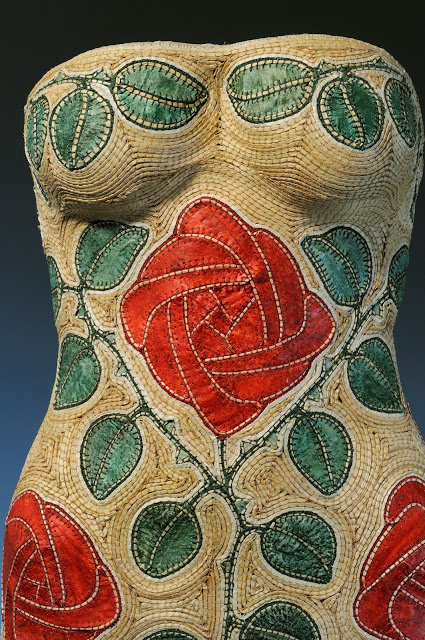
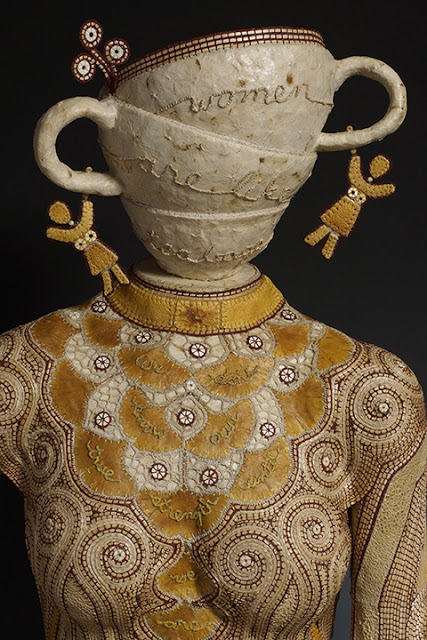 Jan Hopkins and Art from Food Scraps
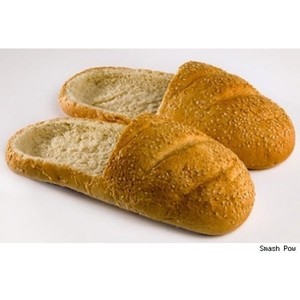 Bread slippers and more food as clothing
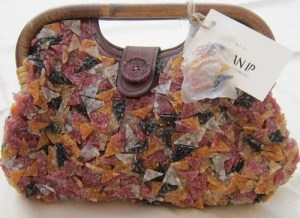 An edible purse: London-based designer Hoyan Ip reuses leftovers to create fashionable trimmings, such as buttons, belt buckles, sequins and embellishments in various shapes, sizes and colors.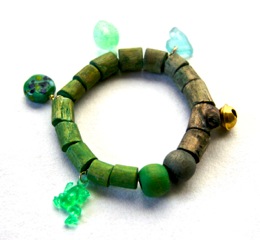




 Flamingo



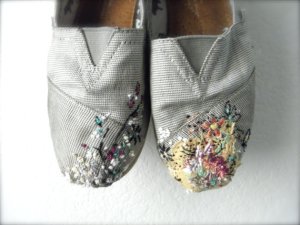
 BOOTIES





 The Narrative Within