Cats in a Garden                                                       

World War I had much to do with creating new directions in art and literature. Virginia Woolf wrote that everything seemed to be going so well “then suddenly, like a chasm in a smooth road, the war came.”  Initially idealistic soldiers proudly marched off to war and everyone applauded their bravery. But when they came back, the soldiers were most often physically and/or psychologically wounded.  Europe was left depleted and many romantic ideals were destroyed provoking disillusioned artists and writers to break with tradition. In literature, the Modernist Movement began. Writers such as James Joyce and Virginia Woolf developed stream of consciousness pushing the reader to float around inside someone else’s head instead of their own. And maybe influenced by Freud and his dream interpretations, Modernists were into disguising their truths with symbolism.

Katherine Mansfield (1888-1923) was born in New Zealand, a country that was slowly trying to create an identity of its own. Too slowly for Katherine who moved to England at the age of 19. Here she started hanging out with the Bloomsbury Group and had no problem adapting to their bohemian lifestyle and their experimentation with literature and sexuality.

At the age of 29, Katherine was diagnosed with pulmonary tuberculosis. Not wanting to stay in a sanatorium, she went to the village of Bandol, France hoping that the French sun would be good for her health. But it wasn’t and her health deteriorated. Although sick and depressed, she continued to write. And one of the stories she wrote at this time was “Bliss”.

“Bliss” is about 30 year old Bertha Young who has an interior frenzy she interprets as bliss. Bertha is especially “blissful” about a dinner party she’s having that evening. Preparations finished, she goes to her balcony to look at her garden. Focused on a pear tree that is standing against the jade-green sky, Bertha is pleased with the beauty she sees. Then the cats show up—a grey cat dragging its belly across the lawn with a black cat crawling behind it. The cats give her the creeps. She shivers then turns away from the balcony window.

That evening the dinner party goes well and she’s so excited by the presence of a new acquaintance, Pearl Fulton. Although nothing in particular has happened between them, Bertha is convinced that they share something very rare and intimate. This feeling is intensified when the two are alone in the garden looking at the pear tree. Bertha feels so much bliss that her breasts feel like they’re burning.

Finally, the guests begin to leave. Bertha’s husband, Harry, helps Pearl put on her coat. He moves to embrace Pearl while telling her that he adores her. They don’t know that Bertha has seen them. Finally, Pearl leaves and Bertha is reminded of the cats in the garden.

So what’s the deal with the cats? According to literary analyses, many scholars believe that the cats symbolize the deception of Harry and Pearl. The problem with symbolism is that it works only if everyone shares the same symbols. We adore our cat, Volver, and in no way could we ever think of him as a symbol of deception or anything else negative.

Another problem with symbolism is that if you spend too much time trying to figure out the symbols, you can lose sight of the plot. Or you can even try looking for symbols that don’t exist. Take To Kill a Mockingbird, for example. The mockingbird is an obvious symbol. However, asked why there was so much symbolism in her book, Lee denied that this symbolism existed. So why are characters named after Confederate generals, she was asked. Because, she responded, “Those characters in the book were white trash. In the South, all the white trash are named after Confederate generals.” (This answer may indicate why Lee’s Pulitzer Prize winning book keeps getting banned in many school districts dominated by a white supremacist mentality.)

As for Katherine, desperate to stay alive, she tried unorthodox cures as conventional ones were obviously not helping. This eventually took her to George Gurdjieff’s institute at Fontainebleau where she sought solace in Gurdjieff’s esoteric teachings. Katherine was here only a few months when, after running up a flight of stairs, she suffered a pulmonary haemorrhage and died an hour later.

-30-

Related: Pillow Books and Lingering Lists + A Place for Grief, a Place for Love Katherine Mansfield + Why ‘To Kill a Mockingbird’ Keeps Getting Banned +

Posted in art, Books, Volver the cat | Tagged , , , , , , , , , , , | Leave a comment

Whatever Happened to Pitty Sing?              

Sometimes in the morning, on our terrace surrounded by plants and bees and butterflies, I look at our sleeping cat, Volver, and feel as if I am in a tableau vivant.

Frida Kahlo lived in a tableau vivant of her own. After seeing her paintings for the first time, Andre Breton said Frida was one of them, a surrealist. However, Frida did not agree. She said she was a Mexican artist relying on Mexican imagery and all Breton had to do was go to Mexico to understand why. Aztec artifacts, Day of the Dead folk art, and Catholic Church iconography, for example, offered imagery that not even the most hard-core surrealist artist could surpass.

“Unos Cuantos Piquetitos” (1935) by Frida Kahlo and me

But way before surrealism, there was the Gothic style both in architecture (ex. Notre Dame with its buttresses and gargoyles) and literature. As for literature, many academics say that the first gothic novel was Horace Walpole’s The Castle of Otranto (1764) that introduced gothic characteristics: eerie architecture falling in ruins, an atmosphere of mystery and uncertainty, the presence of the supernatural, and a woman in difficulty because of some tyrannical man.

Women, with less social mobility, enjoyed the sensationalism gothic literature offered. It helped get them out of the house, so to speak. Plus all the stories of vulnerable women being exploited by men was something that they could easily relate to. So attracted to this genre, women writers eventually took it over and began redefining the female sensibility according to how they themselves experienced social and economic upheaval. Present day scholars often refer to this as Gothic feminism.

But literary trends come and go and eventually the interest in Gothic literature dissipated until it was rediscovered by the American south. The post-Civil War south offered many of the grotesque elements found in Gothic novels—decadence, questions of moral integrity, distorted personalities, oppression and discrimination.

One well-known Southern Gothic writer was Flannery O’Connor. Before reading Flannery, it’s best to understand two things about her. The first is that she suffered from lupus and knew she would die young. The second (maybe somehow dependent upon the first) was that, devout to her religion, she considered herself not just a writer but a Catholic writer.

Last night an intense dream woke me up. I thought maybe reading a bit would help get me back in the mood for sleeping. So I grabbed Flannery’s Complete Short Stories and read “A Good Man Is Hard to Find.” The story, published in 1953, is described by Flannery herself as “the story of a family of six which, on its way driving to Florida [from Georgia], gets wiped out by an escaped convict who calls himself the Misfit”. Although not exactly the best example of literature conducive towards a good night’s sleep, once finished it did give me something to think about.

The main character is the grandmother. She is some kind of post-bellum, expired southern belle who expresses her “superior” morality by constantly criticizing others. While driving towards Florida, the grandmother is sitting in the back seat with two of her grandchildren and her cat, Pitty Sing, secretly stashed in a basket. The grandmother (as she is always referred to) nags her son Bailey to take a dirt road so she can see a plantation she visited when she was young and pretty. To shut his mother up, Bailey takes the road. But slowly the grandmother realizes she’s made a mistake and they are not going in the right direction. Embarrassed and afraid of how her son will react, the grandmother makes an abrupt move that sends Pitty Sing out of its basket and onto the shoulders of Bailey. Bailey, startled, loses control of the car. The car flips and falls into a ditch.

No one is severely injured and they all scramble out of the car. In a few minutes they see a hearse-like car driving down a hill towards them. The car arrives where they are and three men with expressionless gazes get out. All three are armed. While Bailey is trying to explain the predicament they’re in, the grandmother stares at the driver. Gradually she recognizes him from a newspaper article. He’s an escaped convict known as Misfit. But instead of keeping the information to herself, she blurts out “You’re the Misfit! I recognized you at once.” To which Misfit replies: “It would have been better for you if you hadn’t recognized me at all.” Finally realizing the mistake she’d made, the grandmother starts crying. And as Misfit’s companions start taking the other family members towards the woods to kill them, the grandmother is left alone with Misfit.

Finally Flannery has arrived where she wanted to go to from the start—a moral duel between grandmother and Misfit. The grandmother thus far has been portrayed as someone who is selfish, someone who is constantly orbiting around herself. But now, with a gun pointed in her face, everything changes. She begs for human compassion, something she herself has never offered to others. Seeing Misfit’s twisted face, she cries out to him “Why you’re one of my babies. You’re one of my own children” then touches him on the shoulder. Misfit responds by shooting her three times in the chest.

Faced with death, the grandmother seeks God’s mercy. And, in doing so, Flannery seems to say that the grandmother redeems herself. But not having Flannery’s same creed, I often find her stories somewhat difficult to relate to.

Sometimes, instead of seeking God’s mercy, maybe we should try seeking our own.

-30-

Flannery O’Connor and The Diary as Prayer    

Related: Elements of the Gothic Novel by Robert Harris pdf + Scream Queens: The Women Who Pioneered Gothic Literature + The Grotesque Stories Behind the Famous Gargoyles of Notre Dame Cathedral + Victorian Gothic by Jack Clark + THE FEMALE GOTHIC + Southern Gothic | Definition, History, Characteristics & Famous Writers

and for those who wound up here looking for the band:

Posted in Art Narratives, Books, Volver the cat | Tagged , , , , , , , , , , , , , , , , , , | 6 Comments

Our House

Last night I woke up hearing noises. Were they real or just residues of a dream? Not knowing, I decided to read and pulled out a book of short stories by Maeve Brennan that I hadn’t finished reading. And after a few pages I understood why I’d left it unfinished. The book, The Springs of Affection, includes stories about the married life of Hubert and Rose Derdon. They live in Dublin and have a son, John. Hubert works as a salesclerk in a store of men’s clothing. Rose is a housewife. The couple has a little house in the suburbs with a bow window and a small garden. Aside from the house, there seems to be little else that unites them. Their marriage makes me think of a loaf of bread that winds up as a pile of crumbs.

One story is “Family Walls”. Since it hadn’t rained in several days, Hubert had considered walking home instead of taking the tram. But as he was thinking about it, he walked closer and closer towards the tram. Once at the tram, he took his usual seat and thought about how just thinking about doing all that walking had made him feel good. He was still feeling good when he got home. But as he was hanging his raincoat on the rack, he saw his wife closing the kitchen door. Had his wife seen him and intentionally closed the door in his face? Hubert began staring at the kitchen doorway not knowing what to do. And the less he knew what to do, the angrier he got.

A short time later Rose appeared in the doorway and told him his dinner was ready. Hubert said he didn’t want it and that the next time she shut the door in his face, he’d leave and never come back. Furthermore, he wanted her out of the room so he could be left alone. So Rose left.

Hubert wished he’d never seen the door close. It made him think about things that he didn’t want to think about. But it was, in part, the fault of living in such a small house. “There wasn’t a corner in it where you could hide without causing questions—those silent questions that were not questions but reproaches.” But then again, even if the house was small, he had nowhere else to go. Rose didn’t have anywhere else to go either.  After many years of marriage, the only thing Rose and Hubert seemed to have in common was their address and a collection of petty hatreds.

Most mornings I drink my coffee on the terrace with Volver who’s usually stretched out on one of the sofas. There’s something about a sleeping cat that gives me a feeling of peace and joy. It makes me think of the song Our House: “Our house is a very, very fine house, with two cats in the yard. Life used to be so hard. Now everything is easy ‘cause of you.”

This song was written by Graham Nash. Nash, shortly after meeting Joni Mitchell, went to live with her in her Laurel Canyon home. One morning while hanging out on Ventura Blvd, Joni saw a vase that she liked a lot. She bought it and, when the couple got home, Joni started putting flowers in it. As Nash watched her, he felt something magical. An ordinary experience suddenly became so extraordinary that Nash wanted to immortalize it and, within an hour, had written “Our House”.

Although Nash and Joni broke up a couple of years later, a moment of domestic bliss that they shared together will remain forever thanks to a song. And a beautiful song at that.

But whatever happened to the cats?

-30-

Related: MAEVE BRENNAN: THE SPRINGS OF AFFECTION + Graham Nash Has ‘Wild Tales’ To Spare +

Posted in Art Narratives, Books, Volver the cat | Tagged , , , , , , , , , , , , | Leave a comment

Prediction or Prevention

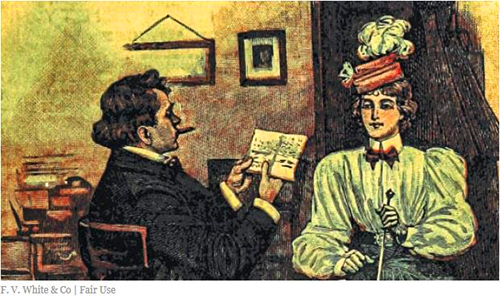
When the notorious Calabrian criminal Giuseppe Villella died, Cesare Lombroso, Italian criminologist and physician, performed a post mortem on him. Lombroso discovered that Villella had an indentation at the back of his skull similar to those found in apes. Like an epiphany that takes your life in a new direction, Lombroso wrote: “At the sight of that skull, I seemed to see all of a sudden, lighted up as a vast plain under a flaming sky, the problem of the nature of the criminal – an atavistic being who reproduces in his person the ferocious instincts of primitive humanity and the inferior animals.” And with one skull, Lombroso concluded that some people were born with an inclination towards crime as they were savage throwbacks to early man.

Lombroso, today known as the father of modern criminology, began making a list of those characteristics he felt were typical of born criminals such as an asymmetrical face, drooping eyes, excessively long arms, big ears, large jaws, and protruding chins. The painter Edgar Degas was fascinated by Lombroso’s theories and found them a stimulus for his artwork.

Criminal Physiognomies by Edward Degas

Degas was fixated with young ballerinas. And looking at the paintings he made of them, one initially gets the impression that their lives were full of grace and glamour. On stage they were magnifique but once the curtain came down, these young girls returned to their life of poverty, exploitation, and hazardous working conditions.

The younger dancers were often known as “petits rats” and often expected to offer themselves sexually to the wealthy male subscribers of the Paris Opera. One of these dancers was Marie van Goethem. History might have totally forgotten her had it not been for Degas. Degas often used her as a model but it is the sculpture he made of her that’s most remembered.

Degas’ Little Dancer

The title of the sculpture is La Petite Danseuse de Quatorze Ans (Little Dancer of Fourteen Years). Time has mellowed out its impact but when it was first exhibited, it shocked the public. Her protruding chin was, according to Lombrosian Theory, a clear indication of depravity. Furthermore, the statue had been placed under glass as if a medical specimen.

Poor little Marie, once she lost her little girl look, patrons of the Paris Opera were no longer interested in her and, more than likely, she finished her life as a prostitute.

In the late 1970s, about a hundred years later after Lombroso’s “epiphany”, the FBI’s Behavioral Science Unit began studying psychopaths and serial killers. John Edward Douglas, Robert K. Ressler, and Ann W. Burgess were part of the original team. The intent was to find out what common characteristics criminals had in order to predict their next move. And to do so, they interviewed criminals and invented a method of documenting those personal characteristics that probably led them towards crime. The childhood of these criminals shared many common denominators: trauma, abuse, dysfunctional families, poverty and the humiliation it produced. In other words, emotional malnourishment seemed to be the leading factor in creating a criminal.

The Child’s Bath by Mary Cassatt

Whereas Degas was painting young girls with creepy undertones, his friend and fellow painter, Mary Cassatt, was celebrating mothers and children. Cassatt’s paintings are about capturing everyday moments full of tenderness and love. In the painting above, a mother lovingly bathes her child permitting them to share an intimate moment of mutual nourishment. Isn’t this what childhood should be about?

Instead of fixating on predicting criminal behaviour, wouldn’t it be better to focus on preventing it? If we know that a dysfunctional childhood can provoke criminal behaviour, shouldn’t we as a society try to ensure that all our children have the same condition of possibility to lead a healthy life both physically and psychologically? Instead of investing in prisons, shouldn’t we be investing in our schools where qualified professionals are present to be on the lookout for children at risk? And knowing that a child’s home life plays a major role in his psychological development, shouldn’t we try to help those parents drowning in their own psychological despair and inadequacy that they are unable to help their own children because they can’t even help themselves?

We should be less concerned with punishment and more with prevention. And the best way to do this is by providing care for a wounded psyche before a scar is formed.

An adult can never escape his childhood because your childhood follows you wherever you go.

-30-

Related: The Story Behind Degas’ ‘Little Dancer’ Is Disturbing, But Not In the Way You Expect + A short history of the modern western jaw: from Aristotle’s physiognomy to facial biometrics + The ‘born criminal’? Lombroso and the origins of modern criminology + CESARE LOMBROSO: THEORY OF CRIME, CRIMINAL MAN, AND ATAVISM + The Impact of Criminal Anthropology in Britain (1880-1918) + What Type of Criminal Are You? 19th-Century Doctors Claimed to Know by Your Face + Criminal Physiognomies by Edward Degas reproduction found HERE + Ballerina: Sex, Scandal and Suffering Behind the Symbol of Perfection book review + Degas’s dancers are studies in cruel reality. But don’t go thinking he felt compassion for them + Iconographic Interpretations +

Mindhunter: Inside the FBI’s Elite Serial Crime Unit + Crazy, Not Insane, movie book, Dorothy Otnow Lewis + ‘They were not born evil’: inside a troubling film on why people kill + criminologist Dr Adrian Raine, From Abused Child to Serial Killer + Jim Fallon, Life as a Nonviolent Psychopath + The criminal gene: the link between MAOA and aggression

Almost Three Quarters of US States Have More Prisons and Jails than Degree-Granting Colleges + The US has more jails than colleges (WAPO) + incarceration is not proving to be the solution, Arrests for Low-Level Crimes Climb Under NYC Mayor Eric Adams

Posted in Art Narratives, Conditions of Possibility, female consciousness | Tagged , , , , , , , , , | 2 Comments

Centered

Ο Ομφαλός

Many years ago I participated in a Parian exhibition based on mythology. Using recycled materials, I made the above painting about Omphale and Hercules. The text is rewritten below:

Ομφαλός.

Hercules’ first home was his mother’s body. But once the cord was cut, he strayed and lost his way. The gods sent him to Omphale for the cure. Omphale made Hercules dress like a woman (because wisdom is in her body she said). And Hercules laboured to learn how to hear the Oracle within. Because Delphi lives inside us all. So learn to be a god: keep yourself centered.

Omphale, Queen of Lydia, although not recognized as a goddess, has an undisputed connection with the omphalos.

Omphlos, which in Greek means “navel”, refers to the center of the world. In Greece, the center was in Delphi.

But not everyone has the center in the same place.

Connie is my friend and part-time neighbour. Every year our friendship renews itself towards the end of spring and mid-summer when we are neighbors again. She is funny, wise, an avid reader, and a generous book lender. Naturally, when together, we often talk about books.

This year Connie was particularly hyped-up about Joan Didion. A few years ago I’d tried reading Didion but found her froideur too uninviting. But Connie, who likes science fiction, gothic and most anything dark in literature, didn’t have any problems with Didion. To the contrary.

One day, while talking about current events (we both share American roots) and how helter-skelter the world’s become, Connie brought up Didion. She insisted that I read Didion’s “Slouching towards Bethlehem” regarding how “The center was not holding”.

Although inspired by W. B. Yeats’ “The Second Coming”, whereas Yeats had written about the aftermath of WWI Didion, who’d recently moved to California, had written about the Haight-Ashbury of 1967.

Didion writes of her new surroundings:

It was a country of bankruptcy notices and public-auction announcements and commonplace reports of casual killings and misplaced children and abandoned homes and vandals who misplaced even the four-letter words they scrawled. It was a country in which families routinely disappeared, trailing bad checks and repossession papers. Adolescents drifted from city to torn city, sloughing off both the past and the future as snakes shed their skins, children who were never taught and would never now learn the games that had held the society together. People were missing. Children were missing. Parents were missing. Those left behind filed desultory missing persons’ reports, then moved on themselves.

Yeats, too, had worried how when “Things fall apart; the centre cannot hold; Mere anarchy is loosed upon the world.”

And here, in 2022, we find that our center, which acts like gravity to keep us anchored, is once again shrinking away. Chaos is in command and those forces that should keep us centered are failing to do so.

The center has become the periphery and we are falling apart.

The Omphalos of Delphi

Rhea was the daughter of the earth and of the sky. Her husband and King of the Underworld, Cronus, had been warned by his mother that he would be overthrown by one of his sons. So, every time Rhea and Cronus had a son, Cronus would gobble him up. Rhea couldn’t bear seeing her sons annihilated. After giving birth to Zeus, she hid him in a cave. When Cronus showed up demanding his son, Rhea gave him a stone wrapped in a blanket pretending it was their baby. This stone came to be identified as the Omphalos at Delphi.

All of us, male and female, have their own omphalos, their own navel that is a constant reminder that, via an umbilical cord, we were once attached to our mothers to keep us alive. Although the cord may have been cut, its memory will always remain.

-30-

Related: Slouching toward Bethlehem + William Butler Yeats “The Second Coming” +

Posted in Art Narratives, Books, People | Tagged , , , , , , , , | Leave a comment