The Bluest Eye

Toni Morrison

Toni Morrison’s THE BLUEST EYE, although beautifully written, is a difficult book to read. Its topics of racism, incest, and child molestation keep the stomach in knots. Thus, despite the magnificent prose, there can be nothing poetic about the horrors of growing up as an African-American in a WASP America.

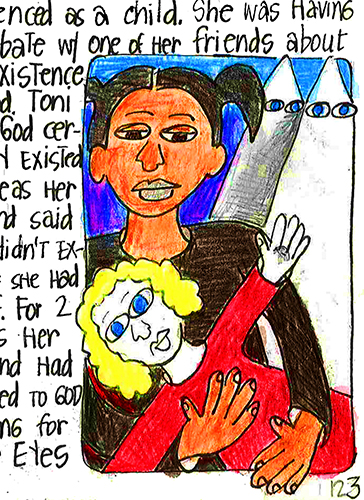
The novel gets its title from a prayer. That of Pecola, a little Black girl forced to live with a foster family because her home was burned down by her depraved and alcoholic father. Pecola considers herself to be ugly because of her dark skin. So she prays to God for blue eyes thinking that they will make her beautiful. For two years she prays but, despite all her prayers, her eyes were still brown. And for Pecola, those brown eyes are proof that God doesn’t exist.

Morrison dramatically illustrates how racism can lead towards self-hatred. And how self-hatred can lead towards insanity.

The message the book gives reminds me of Michael Jackson’s “Heal the World” lyrics. We can make the world a better place by learning to love more and to hate less.

To read THE BLUEST EYE by Toni Morrison on Archive.Org, go HERE.

Related: Lynching Postcards

-30-

P.S. Imagine that you are an American citizen born and raised in the U.S. and don’t have the right to vote. Although the Civil War, in theory, gave Black men the right to vote, it wasn’t until the Voting Rights Act of 1965 that racial discrimination in voting was prohibited.

Posted in Books | Tagged , , , , , | 3 Comments

Propagating Friendship

Summer before last as we were getting ready to leave Paros, my neighbor and adopted sister, Angeliki, gave me some cuttings from her canna lilies. I carefully wrapped them and replanted them once back in Rome. One part I planted on the balcony, another part in a pot that I keep on the dining room table. Every time I look at them, I get a feeling of joy and tenderness. And when I say “good morning” to the lilies, it’s like saying “good morning” to Angeliki, too.

Angeliki's Canna Lilies

A few years ago my Greek neighbour Vasiliki gave me some periwinkle cuttings. They were easy to grow and that Periwinkle Pink made me so cheerful that I started planting them everywhere and gave clippings to friends as well. Little did Vasiliki know how much joy she would be spreading when she gave me the periwinkles.

Balcony Periwinkle

I’ve always enjoyed propagating plants and often take walks with a small pair of scissors and a cloth bag in my purse in hopes of adding to my clippings. It’s not just about having plants for free. Above all, it’s about the idea of “da cosa nasce cosa”—from one thing comes another. From life comes life.

Clippings

Now I’ve started to collect clippings from my friends in Greece. It makes me ever so happy to have their plants near me when I’m in Rome. And when I water them, I greet these plants as if they were my friends there in person.

Propagating plants from your friends is like propagating friendship. Especially when one propagation leads to another.

-30-


Posted in Beauty, Ecofeminism, Lifestyle, Plants & Gardening, Women and Paros | Tagged , , , , , , , | 2 Comments

The Crown

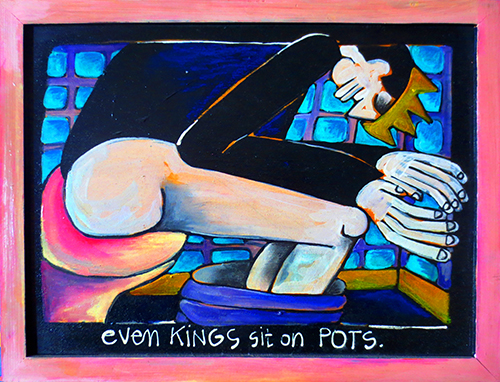
Even Kings Sit on Pots

After watching the series “The Crown”, on my list of things to be grateful for I added that of not being born into royalty.

Three thoughts regarding THE CROWN:

  1. As a child, Elizabeth’s education had been focused on constitutional history. She was taught that the monarchy represented dignity whereas the government represented efficiency. And that their mutual success was based on mutual trust.

Elizabeth was still a young and inexperienced queen when she learned that Churchill had lied to her about his health. Despite his talents as a debater, after being reprimanded by the Queen for dishonouring this trust, all Churchill could say was “I’m sorry”.

Lesson learned: if you are caught cheating, apologize and if you are unwilling to follow the rules, get out of the game.

  1. Their real family name was Saxe-Coburg & Gotha but they changed it to Windsor in 1917 because of the anti-German feelings in England at the time. In other words, the Windsors are German.

The Welsh, however, are of Celtic origin and thus true Britons. King Arthur who fought against the Saxon invaders was Welsh as were the Knights of the Round Table and Merlin the Magician. When, in the 1200s, the Welsh prince was killed in battle, the King of England appropriated his title, a title that was eventually inherited by Prince Charles. The English are only “British” thanks to an act of Parliament in the 1700s.

Understandably, the Welsh, after centuries of being used, began rallying for their independence from England. So, when it came time for Charles to be invested as Prince of Wales, to placate rebellious Welsh sentiment, Charles was sent to Wales in order to learn to say his ceremonial speech in Welsh– as if that would placate tensions.

Capel Celyn was a rural community in north western Wales that was flooded to create a water reservoir for Liverpool and its industry. In other words, for the benefit of England, a Welsh village was destroyed.

Lesson learned: a ruler is not necessarily a leader. And imposing yourself on others is a form of violence no matter what language you speak.

  1. As a child, Prince Philip and his family were exiled from Greece. Philip lived with Nazi relatives until he was sent to Scotland to study with a Jewish professor who’d fled German persecution. Eventually Philip met and married Elizabeth before she became queen. Although he enjoyed the advantages of being a part of the royal household, he didn’t enjoy being no. 2 in the couple. So he sought compensation in fast cars, airplanes, physical workouts, and a Thursday lunch club for men only but with female waitresses. Philip kept himself distracted this way until middle age when the seams of his façade started to unravel. About the same time, Apollo 11 landed on the moon and Philip began fantasizing that he was an astronaut, too. When the real astronauts arrived at Buckingham Palace for a visit, Philip requested a private meeting with them. But the thrill was quickly gone when one of the astronauts, suffering from a cold, sneezed and needed a handkerchief. When Philip asked the space travellers what they thought about while en route to the moon, they replied that there was no time to think as they were too busy executing the robot-like chores necessary to make such a journey. Philip was disappointed. He’d wanted to meet gods but, instead, had met ordinary men.

Lesson learned: greatness is often a result of the repetition of ordinary and sometimes menial actions.

-30-

Posted in Drawings & Paintings, People | Tagged , , , | Leave a comment

The Carpet

The Carpet

Despite the drizzle, we walked to the Chinese restaurant to have lunch. Leaves that once hung over our heads were now matted on the ground—a melancholic reminder of existential change.

Posted in Beauty, Lifestyle, Plants & Gardening, Rome/Italy | Tagged , | Leave a comment

Katherine Anne Porter

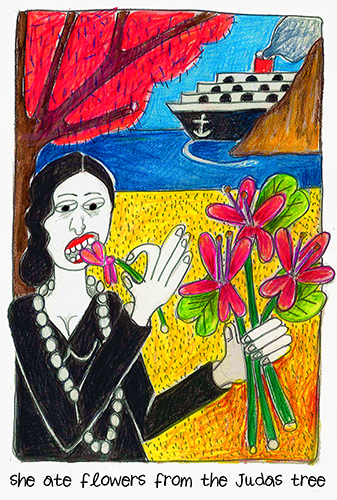
She Ate Flowers from the Judas Tree

Katherine Anne Porter was born in Texas in 1890. Her mother died when she was just a child and her father, overwhelmed, dumped his daughter on relatives. So it’s not surprising that Katherine did her best to run away from her childhood.

After an abusive marriage, a short career as an actress, and time spent in a sanatorium, Katherine began focusing on writing. In 1920, the magazine she was working with sent her to Mexico to cover the revolutionary movement. Here she became friends with Diego Rivera.

Katherine’s life in Mexico inspired some of her finest stories including that of “Flowering Judas”, a story about post-revolution Mexico. The protagonist is Laura, a gringa, who is in Mexico City teaching children English. She sees herself as someone who wants to help the downtrodden and gets involved with Marxist insurgents.

Laura is very attractive and has many suitors. One suitor is a 19 year old youth who comes on her patio one night and serenades her for a couple of hours. To get him to go away, Lupe, the housekeeper suggests that Laura throw him a blossom from the Judas tree which she does. The young man tucks the flower in his hat band, sings one more song, then goes away. But he continues to come back, follows her around, and leaves poems for her in the doorway.

Despite all of her politically related activities, Laura lacks commitment. Towards herself, towards her beliefs. One night Laura dreams she’s eating flowers from the Judas tree thus named because it’s the tree that supposedly Judas Iscariot hung himself from. Only in a dream does Laura acknowledge her self-betrayal, a betrayal that leads to feelings of isolation and alienation.

Moral: be true to yourself if you want to get a good night’s sleep.

The story of Laura is very similar to that of Katherine’s. They were both Roman Catholics, both young attractive women living in post revolution Mexico, both more at home when away from home. Both had difficulties anchoring themselves.

Katherine’s nephew, Paul, remembers her with great affection. Everything about her, he says, seemed glamourous. She liked to rouge her earlobes and wear long stings of pearls because she saw herself as a work of art. Katherine liked troubadour songs and writing in the margins of her books. She even tried correcting the Encyclopedia Britannica (as well as her cookbooks).

Katherine was a great conversationalist and loved to read poetry out loud. You could hear the punctuation when she spoke. She loved laughter and naughty jokes but, considering herself a Southern belle at heart, could never say obscenities.

Mary Queen of Scots and Joan of Arc were her role models. Katherine was an early riser, loved cats, and collected recipes. She made her own bread believing store bought bread was only for feeding pigeons. Having studied at the Cordon Bleu in Paris, she enjoyed sighing, kissing her fingertips, and rolling her eyes when talking about food.

Ship of Fools was the only novel she ever wrote. It was turned into a film offering her some economic security to maintain her eccentric lifestyle.

To read the essay about Katherine written by her nephew, see “Remembering Aunt Katherine” by Paul Porter in Katherine Anne Porter and Texas, An Uneasy Relationship, anthology ed. Machann & Clark (on Archive.org)

To read Katherine’s short stories, see The Collected Stories of Katherine Anne Porter  also on Archive.org.

Related: Springtime in Rome + Eudora Welty (1909-2001) + Ship of Fools film 1965 trailer + host James Day talks with writer Katherine Anne Porter about her nearly fifty year career youtube + SHIP OF FOOLS on Archive.org

Posted in Books, Drawings & Paintings, People | Tagged , , , , | 2 Comments