Seeds

“To plant a garden is to believe in tomorrow” Audrey Hepburn

I feel uncomfortable. The world is coming unravelled. And at such a quick pace. It’s overwhelming, demoralizing, life threatening. So, to keep from feeling totally incapacipated, totally without hope, I plant seeds. Anywhere and everywhere.

A few years ago, I believed that my need for a reconfiguration within was about getting old. But, with the way things are going, aging is no longer my primary concern. Survival is.

Once I have an idea as to how I plan to approach this Ever Present Spookiness, I will be changing the header title of this blog to Synergy and Solidarity. Because we are all in this tragedy together.

-30-

Posted in Age of Reconfiguration, Beauty, Synergy and Solidarity | 1 Comment

Uncaging the Bird

This summer I will learn how to express a complete thought without letting others interrupt me. And I’m not talking just about verbal interruptions but about facial expressions as well. Have you ever tried speaking to someone whose body is present but whose mind is on a kite headed elsewhere. Or whose cement face tells you they have no interest at all in what you’re saying. It can be so distracting that it’s easy to lose your train of thought.

A few weeks ago I read Maya Angelou’s “I Know Why the Caged Bird Sings”. It’s the story of Marguerite Johnson before she became Maya Angelou. It’s the story about the heavy burden of Blackness. It’s the story of how childhood sticks to you like glue all your life no matter what you do. It’s also the story of how a woman learned to articulate her feelings so that she could defy the odds and sing her song.

When she was a child, Maya and her brother were sent to live with their Southern grandmother. Maya shares with us her feeling of abandonment, the harshness of bigotry, the shame for having been abused, and the burden of the resulting insecurities.

After Maya was raped, she stopped talking. But she had a life line thrown at her by Mrs. Bertha Flowers, the aristocrat of the local Black community, who “had a private breeze which swirled around, cooling her.” Mrs Flowers had no intention, she told Maya, of making her talk. But that was no reason to abandon language. And it was good that Maya read but reading wasn’t enough. “Words mean more than what is set down on paper. It takes the human voice to infuse them with the shades of deeper meaning.” So Mrs. Flowers lent Maya books but on the condition that she was to read them aloud even if just to herself.

So Maya read and started to fly. But then the racist slurs would send her back to her cage. “It was awful to be Negro and have no control” over one’s own life. And living with this prejudice coated her with a sensation of ugliness that was like an “uninvited guest who wouldn’t leave.”

In her teens, Maya went to live with her mother in San Francisco. Here the Blacks had learned to occupy space differently than those in the South. Her mother’s boyfriend, Daddy Clidell, taught her to play poker and blackjack. Because by playing cards you can learn to read a man’s character. Daddy Clidell also introduced Maya to a group of professional con artists who, as part of her education, taught her all about conning so she herself would never become anyone’s mark.

The most important lesson they gave her was this: “Anything that works against you can also work for you once you understand the Principle of Reverse.” And what gave a Black man the most power was the white man’s prejudice. The Black con man who could act the stupidest always won out over the powerful and arrogant white man. Like Detective Colombo whose apparent ineptitude makes the suspect dismiss him with arrogance thus unsuspectingly falls into a trap.

And years later, when Maya decided that she wanted to become the first Black ticket taker on the San Francisco street cars, she made sure to give her resume a narrative:

“Sitting at a side table my mind and I wove a cat’s ladder of near truths and total lies. I kept my face blank (an old art) and wrote quickly the fable of Marguerite Johnson, aged nineteen, former companion and driver for Mrs Annie Henderson (a White Lady) in Stamps, Arkansas.”

The narrative was convincing and Maya became the first Black to work on San Francisco streetcars.

Ahhh, there are so many new narratives for us to create. And I will now be focused on creating my own.

Thank you Maya.

Related: The Bluest Eye

Posted in Books | Tagged , , , | 2 Comments

Existential

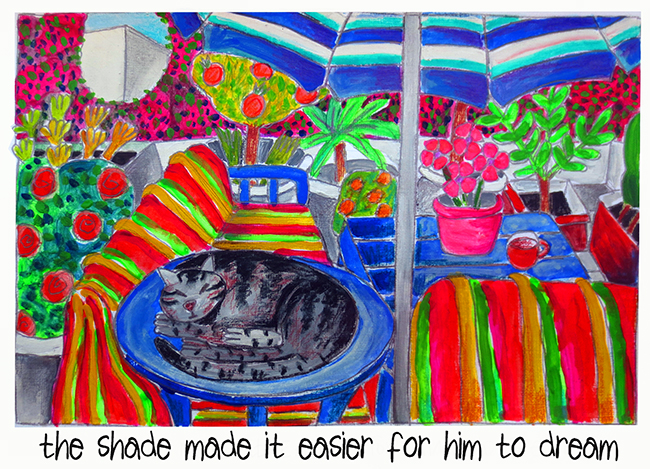
Inside or out…where do I want to be?

Posted in Art Narratives, Conditions of Possibility | Tagged | 4 Comments

Still Lingering

Toni O by Moe Bauschez

My mom died a year ago but, for me, she’s more alive than ever.

My parents divorced when I was six months old. My dad just disappeared and all the responsibility of raising me was left to my mom. And for a woman during the 1950s, it wasn’t easy. She told me that finding a place to live was tough as most property owners had the policy of “no pets or children allowed.” Plus women were, and continue to be, underpaid.

The demands on my mom were tremendous. She had to somehow magically work fulltime while being a fulltime mom as well. In other words, my mom, and other moms like her, were expected to be some kind of mythological figures capable of pulling off the impossible yet, nevertheless, were treated as second-class citizens.

My mom was a survivor and there’s nothing polite about survival. She preferred anger to fear because anger puts you in motion whereas fear is an immobilizer. That’s why, unlike my mom, I never experienced hunger. Plus my mom always made sure I had my own bed and nice clothes to wear.

My mom was young, beautiful, animated. As I little girl I remember walking down Houston St with her (she liked taking me to The Manhattan for roast beef and mashed potatoes) and watching all the people who’d turn to look at her because of her beauty and because she walked like a queen—shoulders erect and head held high. Slouching for this Queen was a display of weakness.

For the condition of possibility that life had given her, my mom was amazing and accomplished so much. Instinctively she knew from an early age the importance of learning. Because knowledge is power.

My mom subscribed to every record and book club possible so I grew up a music lover and avid book reader. But my mom also insisted on my knowing how to clean, cook, and sew before leaving home. Because my mom wanted me to be an independent woman, too.

During her last hospital stay, she told me in a sad voice “Honey, I’m sorry but I’m not as strong as I used to be.” No longer able to be that independent woman she’d always been, she crumbled and began to fade away.

Many things can be said about my mom but, hopefully, she will be remembered for her courage and determination. And echoing laughter.

Single moms are so underrated and unappreciated. That’s why, on this anniversary of my mom’s death, I’d like to thank not only my mom but all the other mothers who’ve had to raise a child on their own. Women who’ve had to affront so many obstacles alone—an aloneness than can easily transform itself into loneliness, anxiety, and despair.

Ciao Toni O.

x-x-x-x-x

Toni O.

Posted in Toni O | Tagged , , | 4 Comments

A Powerful Purse

Last year, because of a major family crisis, I was left feeling impotent as it seemed there was nothing I could do to resolve the problem. So one day my daughter, who was concerned about me, came and started painting my bedroom. Her philosophy: don’t focus on what you can’t change but on what you can change. So I did and, no longer feeling powerless, began to feel much better.

This year there’s a new crisis and a big one, too. And the feeling of powerlessness has returned.

Last year my dear friend, Anthy, gave me a purse made of woven packaging bands. It was in terrible shape and one side was completely unwoven and many of the bands too brittle to manipulate. But, because of my love for transformation, she gave me the purse thinking I could do something with it.  The purse was in such a bad state that I was tempted to dump it. Then I remembered how good I felt after my bedroom walls had been painted blue. And so decided that the old purse needed a makeover, too. I knew that I had the power to transform it and, by doing so, would simultaneously reactivate my own personal power again.

While working on the purse, I listened to Colin Wilson interviews on youtube.  Several years ago I’d read Wilson’s “Super Consciousness” which focuses much on Abraham Maslow’s Peak Experience. That is, a moment of great joy, euphoria, insight, self-actualization, etc. Maslow argued that these experiences occurred spontaneously and you couldn’t program them whereas Wilson believed that they could be self-induced. I tend to agree with Wilson. And Anthy’s purse is proof of that.

Anyone who works with their hands, who makes things, knows that the focused attention you give to what you’re working on puts you in a semi-trance like state. This form of active meditation mellows you out but the moment you see the results of your efforts, a feeling of pleasure hits you like a cool breeze. It’s the reward you get for having conceptualized an idea, worked on it, then actualized it.

When the brain connects activity with pleasure, it will want to repeat the process. And the more we repeat this process, the more it will become a part of us, and the easier it will be to access to the pleasure reward. So by fixing the purse, I am actually fixing myself.

The mind has exactly the same power as the hands; not merely to grasp the world, but to change it.                                                                                                                                                 Colin Wilson

A Mended Purse

Related: Blue Walls and Pretty Thoughts + Breaking the Loop + Super Consciousness 2019 + Colin Wilson: Strange is Normal youtube + Colin Wilson: The Peak Experience + The Case For Working With Your Hands + In Praise of Hands +

Posted in Daily Aesthetics, Ecofeminism, Mend & Repair, Muy Marcottage | Tagged , | Leave a comment