Just by being where we are makes us part of our environment whether or not we want to be. So, if the world around us becomes a part of us, why not turn it into art?
To make our life beautiful, we have to think beautifully and to be active participants. Because stasis does not lead to experience. And it is experience that shapes our sense of aesthetics. And it’s experience that forms those ideals that give our life a direction.
Simply focusing on beauty can transform our daily life. When my mom was a little girl, she had to walk to the well every day to get water for her family. It was very fatiguing but she focused on the Johnny Jump Ups she’d see once there. Just like the women of Gee’s Bend who, after a long day in the fields, would walk back home thinking about their quilt blocks. Because thinking about beauty soothes the spirit. And helps us transcend the ugliness that surrounds us.
Aesthetics are married to our senses and our senses are like invisible threads that unite us to our surroundings. But our senses need to be educated as they dramatically influence how we perceive the world around us.
Here are some examples of women who created a special rapport with smell, sight, touch, taste, and/or hearing.
The Depression had left us all in apnea. New York sidewalks were populated by people with corrugated foreheads and attitudes like milk gone sour. The heaviness of it all had dulled my senses and I desperately needed some art to give me a high. Diego Rivera was in town working on a mural for the Rockefeller Center and the idea of watching him paint gave me a buzz. So I snuck into the center to spy on the famed artist as he worked.
A young woman was taking tons of photos of the work in progress. Click click click. Soon I became more interested in her rapport with the camera than I was with Rivera and his wall. The woman made an abrupt turn and saw me. But, instead of trying to get me thrown out, she came over and asked if I was interested in meeting the artist. Rivera, whose ego always enjoyed meeting fans, was big bellied, had eyes like a bullfrog, and lips so big they looked like they could float. His wife Frida, instead, was petite and glaring. She was dressed like one of those souvenir dolls your aunt brings you after spending a tequila weekend in Mexico.
Having common curiosities is a good basis for a friendship. That’s how Lucienne Bloch, the photographer, and I became friends. Often we’d lunch together, or visit an exhibition, or have a few cocktails as we gossiped about the art world. She’d been invited by the Riveras to visit them in Mexico and, once there, sent me postcards that teased my fantasies so much that I decided to go to Mexico, too. One evening Rivera and Frida were hosting a big parranda and, thanks to Lucienne, I was invited to go.
The couple lived in a big blue house in Coyoacán. More than a home, it seemed like a museum as they had collections of Pre-Colombian and Mexican folk art everywhere not to mention Frida’s paintings. I particularly enjoyed the retablos and got the impression that Frida had somewhat appropriated the style for her own paintings. The kitchen table was set with mole, enchiladas, chile rellenos, refried beans and tons of tortillas. And bottles of tequila were everywhere.
All the people and the noise had made me feel somewhat claustrophobic so I went out in the garden for some fresh air. I was wondering how the same moon could shine the same way all over the world when the singing started. It was Cielito Lindo, Frida’s favorite song. The voice was so unique I went back in to see who was singing and saw a beautiful woman dressed in a man’s suit. She was Chavela Vargas and the songs she sang had inspired many of Frida’s paintings.
“Cielito Lindo”, for example, was the inspiration behind “Arbol de la Esperanza Mantente Firme”–a statement to the Tree of Hope to stay strong. The painting shows two Fridas. One, post operation, with scars exposed. The other Frida, elegant and strong, holding a corset for her back, a corset that gives her hope.
The popular Mexican song, “El Venadito Herido” (The Wounded Little Deer) inspired another self-portrait showing Frida half woman, half deer painted before an operation that left her bed-ridden for a year. Frida the Deer, has arrows sticking out of her like St. Sebastian, the martyr.
After discovering that Diego had been sleeping with her sister, Frida divorced him then cut her hair and dressed like a man before painting “Autorretrato con Pelo Corto” (Self-Portrait with Short Hair). On top on the painting is a phrase from a popular folk song: “Mira que si te quise, fué por el pelo, Ahora que estás pelona, ya no te quiero” (“See, if I loved you, it was for your hair, Now you’re bald, I don’t love you anymore.”)
Like Frida, Chavela also loved Mexican folk songs especially rancheras, songs populated by the broken hearted who go to cantinas to drink away their sorrows. This music was traditionally dominated by men until Chavela elbowed her way in to make space for las borracheras, women who could drown in alcohol as easily as men could. This Cantina Solution was a reply to conformity and fake respectability. Drinking like men suggested a form of emancipation.
Chavela was born in Costa Rica to indifferent parents. As a child she suffered from polio and risked going blind. A shaman living in a nearby indigenous village spit chewed herbs in her eyes and gave her a magical tea that made her fall into a deep sleep. When she awoke, her vision was perfect. For the rest of her life she would honour shamans especially the Huichols in Mexico who gave her the name Cupaima, the last female shaman.
Abandoned by her parents, Chavela moved to Mexico at the age of 14 where she sang in the streets until she got gigs in cantinas. Here she made no secret of her homosexuality and was known as a cigar smoking, heavy drinking womanizer. Chavela sang in cantinas for years until she was discovered by singer and songwriter extraordinaire José Alfredo Jiménez.
Jiménez did not play a musical instrument and knew little about musical technicalities but he wrote over 1,000 songs many of which are still well-know today. Together, Jiménez and Chavela turned pathos into poetry. Take, for example, En El Último Trago where the singer asks an ex-lover to drink together until oblivion. Because time hasn’t taught him anything so he continues to drink again and again with strangers to mourn the same sorrows.
Once her career took off, Chavela came in contact with a new milieu. She became friends with Frida and Rivera and was often their house guest. It’s rumored that Chavela and Frida had an affair together. Chavela sang at Elizabeth Taylor’s wedding in Alcapulco and was said to have seduced Ava Gardner.
But the Cantina Solution caught up with Chavela. She became an alcoholic and, during the 1970s, gave up singing. But almost 20 years later, at the age of 81, Chavela returned to the stage. She debuted at a sold-out Carnegie Hall at the age of 83. After each song, she was rewarded with a standing ovation. The audience couldn’t have enough of her. In the words of Pedro Almodóvar, Chavela made of abandonment and desolation a cathedral in which we all found a place.
Chavela spent the last year of her life recording Luna Grande, a mixture of music and poetry by Federico Garcia Lorca, the poet who, at the age of 38, was assassinated during the Spanish Civil War. In 1993, Chavela went to Spain and stayed in a room that once García Lorca’s. Every day, she said, a yellow bird would come peck on the room’s window and she was sure the bird was the spirit of Lorca himself. Chavela died a few weeks later.
The power of sound.
Singing is about sound and sound is a power. In Genesis, the sound of a word created the universe. In ancient Egypt, vowel chanting was used for healing. Pythagoras, believing that harmony obliterated chaos, used music for “soul-adjustments”. Vibrating strings can help the body raise its vibration frequency thus King David used harp music for healing himself and his soldiers. In Australia, the Aborigines use a musical instrument, the Didgeridoo, to speed up the healing process. Shamans worldwide use sound to heal often incorporating musical instruments such as gongs, tuning forks, and Tibetan singing bowls.
Alfred Tomatis (1920 – 2001) also believed in the therapeutic qualities of sound. While in the womb, Alfred’s mother’s resentment of her pregnancy could be felt by him. Probably because of this rejection, Alfred was born prematurely. Thought to be dead, he was tossed into a basket. But his grandmother pulled him out and saved his life. Nevertheless, the negative energy he experienced inside his mom made him a sickly child.
Alfred grew up and became an Ear, Nose, and Throat specialist. His father was an opera singer and sent his colleagues having problems “staying in tune” to his son for a cure. Opera singers, singing at their full vocal power, can emit between 110 and 140 decibels. And, since the sound comes from within, said Alfred, even though the “energy of a singer is not comparable to that of a jet engine, the intensity of the sound is the same”. Because “the amount of time a singer had practiced was directly proportional to the amount of damage to the ear”, Alfred deducted that it was the singer’s own voice that caused a loss of certain frequencies from their voice. Based on his theory that “the voice contains only those sounds that the ear can hear”, Alfred developed a method for affronting frequency hearing loss.
In 1967 monks at a Benedictine monastery had become lethargic and depressed. They’d been used to chanting several hours a day but then a new abbot arrived and decided that this time could be used in a better way and stopped the chanting. Initially no one could understand the monks’ change. Consulted, Tomatis suggested that the monks start chanting again as it was a way for them to keep themselves charged. Chanting and listening to certain kinds of music, said Tomatis, energizes the brain and body.
Sound is a vibration and vibration has a frequency. Nikola Tesla said that “If you want to find the secrets of the universe, think in terms of energy, frequency and vibration.” Frequencies can heal but they can also be harmful. For example, cell phone tower exposure can cause memory loss, headaches, sleep deprivation, and cardiovascular stress. Even electrical appliances in the home can make a very low humming noise that can throw us out of whack.
ELF (Extremely Low Frequency) waves have been used for mind control manipulation. For example, during the 80s Margaret Thatcher used ELF waves to affront inner city riots to the point of turning people into zombies. As human behaviour can be controlled by frequencies, ELF Waves & Co. are being used in various parts of the world by those in power.
Music frequencies can be used to manipulate as well. Once tuning forks vibrated at 432 Hz but, in 1885, the Italian Music Commission decided that orchestras should use tuning forks that vibrated at 440 Hz instead. This new vibration became a worldwide standard in 1953 leading to many conspiracy theories as 432 Hz resonates with the 8 Hz Schumann resonance, the heartbeat of the Earth. Some theorists claim that the Nazi Joseph Goebbels wanted the change in standards as 440 Hz makes it easier to use music for mind control. And other theorists believe that the modern music industry is using pop music to transform individuals into one of the herd so their behaviour can be controlled.
But frequencies can also be beneficial.
The throat chakra participates in the exchange of energy between the body and the head. If your throat chakra is blocked, you will have problems expressing yourself. Because through the throat we emit sound and its vibration. A blocked throat chakra can make us feel insecure. Singing as well as humming can help unblock this chakra.
Humming can also make your mood better and relax you. And it can even soothe your sinuses because it improves airflow between the sinuses and the nasal cavity. Humming also stimulates the vagus nerve, the longest nerve in the body that wanders around the body like a vagabond participating in many bodily activities. The vagus nerve helps prevent inflammation such as that that animates rheumatoid arthritis. But the vagus nerve can draw out anti-inflammatory neurotransmitters to mellow out the pain.
As we grow older, many of us experience hearing loss. The tiny hair cells within the inner ears begin to break down creating difficulty picking up sound vibrations. To protect against hearing loss, avoid exposure to persistent loud noises, never listen to high volume music with earphones, and use cotton swabs with care as they can push ear wax deeper into the ear canal and/or damage the eardrum. Hearing should be routinely checked. Loss of hearing isolates and the frustration can lead to depression and increase the risk of dementia. Because hearing helps to interrelate with the world around us.
OM is a mantra, a vibration and, when chanted, vibrates at the frequency of 432 Hz. Om or AUM, is believed to be the basic sound of the universe, the Cosmic Hum. If practiced properly and with continuity, OM chanting can improve the efficiency of the spinal cord, improve blood circulation, and detox body cells. Chanting OM also exercises the organs by making them vibrate.
Try chanting in your bathtub. Expand your diaphragm then contract it as you chant OM.
Change your voice and you’ll change your thoughts.
The backyard BBQ had been cancelled because of the rain so I stayed in that evening to watch TV. Eleanor Roosevelt was being interviewed by two males who routinely interrupted her answering one question by asking her another one. But she got their attention when, using carefully formed sentences spoken with a Mid-Atlantic accent, she defined a liberal. A liberal, said Eleanor, is a person who keeps an open mind, a person who can move forward instead of always looking back. In essence, a liberal is a person who is not afraid of change. Impressed, I wrote her a letter expressing my admiration for her aplomb. You can imagine my surprise when not only did she respond, she also invited me to tea the next time I was in New York.
Eleanor came from an affluent and socially prominent family. Her mother had more beauty than maternal instinct and often called her daughter “Granny” to indicate she was homely in her looks and in her ways. Eleanor would feel so ashamed that she’d want to sink through the floor. Her father was loving but an alcoholic and exiled from the family by Theodore Roosevelt, his brother and future president. By the time Eleanor was 10, both her parents were dead and she was sent to live with her frigid grandmother.
When she was 15, Eleanor’s grandmother sent her to Marie Souvestre’s boarding school in England. Mme. Souvestre not only taught her perfect French but, above all, Eleanor said, shocked her into thinking stressing the importance of developing an independent mind. Unfortunately, after only three years, Eleanor was sent back to the US for her social debut. Once home, she kept a photo of Mme. Souvestre on her desk to help keep her focused.
In the States, Eleanor taught immigrant children before marrying the suave distant cousin, Franklin. But it was also like marrying Franklin’s mother, too, as the domineering mother-in-law imposed her presence everywhere. Then Franklin was elected to the NY senate and the couple, along with their six children, moved to Albany giving Eleanor a chance to take control of her own home.
All seemed to be going well until Eleanor, while unpacking her husband’s suitcase, found a packet of love letters written to him by Lucy Mercer, Eleanor’s social secretary. Eleanor was crushed but it was the beginning of her emancipation. Being a good wife was no longer a priority.
One year after women obtained the right to vote, Franklin contracted polio and that’s when equilibriums radically changed. Not only did Eleanor help him with his cure, she also encouraged him to stay in politics making sure her voice would be heard as well. The Ugly Duckling was now a beautiful swan and it had nothing to do with looks.
Politically Eleanor fought for civil rights, feminism, and underprivileged youth. When the Daughters of the American Republic prevented the black opera singer Marion Anderson from singing at the Constitution Hall, not only did Eleanor resign from the DAR, she helped organize a concert for Marion on the steps of the Lincoln Memorial. And when Marion belted out “My Country Tis of Thee”, hearts quivered.
During Franklin’s presidential campaign, Eleanor had become friends with the bourbon drinking, cigar smoking, AP journalist Lorena Hickok. The two became very close and Hick, as Eleanor called her, moved into the White House where she remained for the next 13 years. Hick was a media expert and helped Eleanor, who had never wanted to become a President’s wife, learn how to deal with the press. Thanks to Hick, Eleanor began her popular newspaper column “My Day” about her activities as First Lady. Eleanor also had routine press conferences inviting only female journalists as they were barred from presidential press conferences. Yin yang.
Probably what most impressed me was Eleanor’s role in promoting the United Nations. She was instrumental in having the Four Freedoms included in the UN’s charter. These Freedoms are: 1. Freedom of Speech 2. Freedom of Worship 3. Freedom from Want 4. Freedom from Fear.
One thing I understood, had it not been for Eleanor, FDR would never have become president.
Finally I planned a trip to New York City to have tea with Eleanor. She lived in a lovely townhouse on East 67th Street. A housekeeper led me to a lovely room with leaded windows where I nervously sat until Eleanor walked into the room. She was about 70 years old, tall, wore a violet printed dress, pearls and a hairnet. Eleanor’s eyes were like blue seas that made you want to jump inside of them and swim.
As she poured the tea she said: “A woman is like a tea bag–you can’t tell how strong she is until you put her in hot water.”
Looking around the room I noticed there was a knitting bag full of yarns and needles. “Oh, you knit?” I asked. “Yes, my dear, you see knitting use to help me so much when discussing politics with Franklin. Sometimes he would say the most outrageous things and, instead of commenting, I would simply speed up the stitching. Knitting also helps me think things out and I always take some knitting with me when I travel. Here, take these.” And she gave me the most unusual pair of mittens I’d ever seen.
Eleanor knew how to spread her presence in the same way I knew how to butter my bread…a little here, a little there until you’re just about everywhere. I told her that I admired her courage as she’d often expressed opinions that had not been popular especially coming from a president’s wife. Eleanor just smiled and said: “Do what you feel in your heart to be right—for you’ll be criticized anyway. Instead of letting my role as First Lady influence my actions, I used it as a means of influencing the actions of others. Because the future belongs to those who believe in the beauty of their dreams. Furthermore, remember no one can make you feel inferior without your consent.”
“And don’t be afraid of growing old either” she said as she took one of her chocolate covered garlic pills for her memory. “Because beautiful young people are accidents of nature, but beautiful old people are works of art.”
As we grow old, we fear not only for our physical health but for our mental health as well. Mental health is about equilibrium. Insecurities are destabilizing because they make us rigid and fearful of change. But rigidity is not stability. Often it’s the lack of flexibility that provokes chaos. Bamboo doesn’t break when the winds blow hard because it knows how to bend.
The five things, according to some research, that most affect us when we’re old are: health, relationships, economics, sense of purpose, and discrimination.
Whatever we do often, we will do well even if it is bad for us. Because repeated actions create neural pathways. To create a path in a field of grass, you simply repeatedly walk the same route until you flatten the grass. In the same way, habits are formed. Thanks to neuroplasticity, the brain’s ability to change itself, we can create new pathways and transform ourselves no matter what our age.
Good mental health begins with good thoughts. If you want a positive change in your life, start with positive thinking. When a bad thought comes into your mind, nip it in the bud before the negativity goes into loop. Substitute the negative thought with a positive one. Or use a talismanic action such as making the word “happy” in sign language as you smile and say “I’m feeling glad all over”. To say “happy” place your hands in front of your chest, palms inward, then toss your hands up and down creating a circular motion. Repeat this motion with a smile on your face.
Relationships are about interrelating. So start by looking in the mirror and make friends with yourself. You won’t be happy with anyone if first of all you are not happy with yourself.
To avoid economic stress once retired: avoid debt, downsize and live near a public transport system. Get your house in order, make repairs, declutter, make your home an easy place to live in. The older you get, the more difficult is to keep up with everything so streamline now. Learn go be frugal ahead of time. Believe in less is more. And make the most of what you already have.
Things you can make with a loaf of bread when it’s no longer fresh: Croutons and Bread crumbs, bruschetta topped with a pesto made from windowsill garden herbs, and an Italian favorite, panzanella. Panzanella is a Tuscan salad made with soaked stale bread, tomatoes, onions, basil and maybe even cucumbers, capers and tuna. It’s seasoned with salt, vinegar and olive oil.
Learn to joy in activities that don’t require money: Have a picnic in the park, pretend to be a tourist in your own town and take walking tours, organize a romantic Evening in Paris at home (OK, maybe some money for the wine!).
Young or old, you need to give your life a purpose. Like Rita Montalcini. Despite her father’s objections, Rita went to medical school and became a biologist. Afterwards she became a university assistant but, because of the 1938 Italian Racial Laws, was forced to give up her position, flee, and assume a new identity. But that didn’t keep her from creating a lab in her bedroom to study the nerve growth of embryonic chicks. This eventually led to the discovery of Nerve Growth Factor (NGF) and, later on, a Nobel Prize.
NGF is important in regulating the growth and maintenance of neurons. NGF is important in terms of neuroplasticity. Rita was mentally sharp until her death at the age of 103. Some claim that it was because she took NGF eye drops. But it’s possible that it was because she still had a passion for life and went to her lab most every day. And when asked about aging, Rita responded: “At 100, I have a mind that is superior, thanks to experience, than when I was 20…the body does what it wants. I am not my body, I am my mind.”
Another problem with aging is the discrimination against the elderly. Often they are not taken seriously to the point they become invisible. What to do? First keep in mind that growing old is a privilege not everyone has. Socialize with others of your age, get involved, stay active. Avoid collecting dust by moving, dancing, and wiggling when you walk.
Believe in yourself. Practice affirmations in front of the mirror every day. Say stuff like “I am having the best years of my life” and “I’m feisty and I know it”. Learn the difference between saying “I’m sad” and “I’m feeling sad”. Wear bright colors! Dress up. Don’t be a Plain Jane. Wear a hat. Turn up the music and wake up the neighbors. Let them know you’re alive.
And remember what Confucius said: It doesn’t matter how slowly you go as long as you don’t stop!
It was 1926 and in Paris the autumn leaves were falling. For our weekend rendezvous, Hugh and I went to the Folies Bergère to see Josephine Baker dancing in her banana skirt. While she was naughtily dancing with her shadow, Hugh was visibly excited. Jealous, I decided that once back in New York I would try out for the Ziegfeld Follies.
At the casting I met Ann Pennington, already part of the chorus. Ann was very petite with long red hair and never went unnoticed. When I saw her dance I realized it would be best to quietly go back home to practice the two step in front of a mirror. Ann must have sensed my despair and asked me if I wanted to go to Harlem with her to listen to jazz. Maybe it was there that she’d perfected her version of the Black Bottom dance. Ann was so good at quivering and shaking that a magazine featured her dancing with Felix the Cat.
Our friendship dissipated after she started hanging out with Fanny Brice and the boxer, Jack Dempsey. It really broke my heart when I learned years later that Ann had bad arthritis and was living on welfare. Because Ann had given me one of the greatest gifts of all—the love of dance. Not that I’m any good at it. But that doesn’t keep me from moving. Because if you don’t move, you become stagnant and lose your flow.
Dance is the body’s response to music. Music gives the body a rhythm and changes brainwave frequencies transforming a bad mood into a good one.
Dancing synchronizes the mind with the body and makes you shift your weight from one side to the other. In Greek Art, the stiff Archaic was replaced with Classical flow thanks to contrapposto. The figure, instead of dividing its weight equally on both legs, puts its weight only on one foot allowing the figure to turn its axis. Man was not meant to be static and, to be in motion, you must shift your weight from one side to the other. You cannot walk or run or even dance without weight shift. Sometimes you must lose your symmetry just to keep your balance.
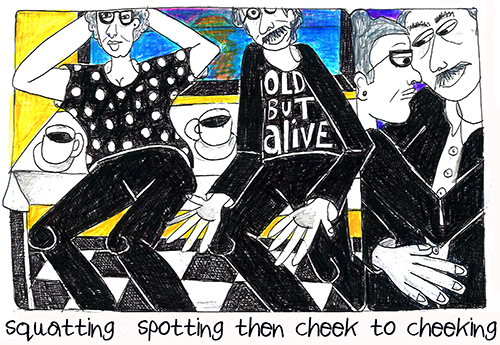
Dancing is also a means of inter-relating with others. Especially when dancing cheek to cheek.
Dancing has been around for a long time. In ancient times, dancing ceremonies were a means of worshipping Mother Earth as well as a means of bonding with other members of the community. The circle is the oldest known dance formation and many ancient depictions show women dancing alone or in circles. The circle symbolizes infinity, unity and wholeness. It also symbolizes Mother Earth, the womb and the seasons.
Dancing in a circle was popular even in Jesus’ time. In the Acts of John, mention is made of Jesus’ participating in a circle dance before his arrest. And, in Ecclesiastes 3, we’re told: “For everything there is…a time to weep, and a time to laugh; a time to mourn, and a time to dance.”
Dating back 40,000 years, trance dancing was considered a spiritual practice because it gave the body and soul a chance to reunite. Like the Whirling Sufi Dancers who spin around so much that they hyperventilate and enter a state of altered consciousness. The body is meant to act as a spinning wheel because spinning is a fundamental condition for existence—just think of atoms and chakras.
Because all life begins in the abdomen, once belly dancing was a fertility rite in honor of the Mother Goddess. Belly dancing is about sacred geometry–the circle, the wave, the spiral and the figure eight. The figure 8, also known as the Lemniscate (the mathematical symbol for infinity), is simply two circles united as one thus representing the blending of the mind with the body.
The criss-crossing motion of belly dancing creates a connection between both cerebral hemispheres. Nerve impulses on one side of the body integrate with nerve impulses on the other side of the body creating synergy and solidarity within.
Oriental dance moves vertically. Western dance moves horizontally. Western dance uses steps to appropriate space, whereas, little space is needed for belly dancing as its true space is the body itself.
To find solutions, dance. Because, as Einstein said, nothing happens until something moves.
-30-
Related: The Color of Sound + Red Color Sound Therapy youtube Color and sound have been used for health treatments since the beginning of recorded time Red is the earth element. The first chakra affects the legs and feet and influences walking, the anus, and elimination + Dancing and Alzheimer’s …. dancing is especially important as it helps prevent Alzheimer’s.