Three years ago I started my Age of Reconfiguration Project (aka Cool Breeze). I’d finished the entire draft in Greece and proudly hand carried it back to Rome eager to finish it. But Covid-19 stopped that as focusing on anything other than the killer virus was difficult. Unfortunately, a personal family drama also dominated my thoughts and my Reconfiguration Project was left to collect dust. But, considering current events, maybe now is the right time to revive it.
TEXT:
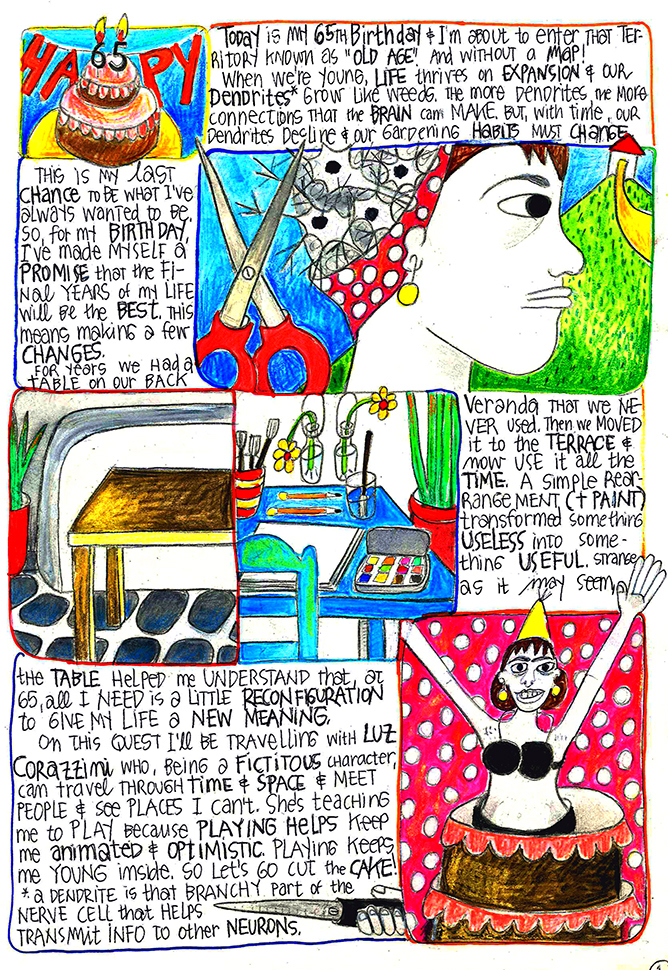
Today is my 65th birthday and I’m officially old.
Looking back I see that the first years of my life thrived on expansion. I was hungry for stimulation and new experiences that made my dendrites grow. But now, at 65, I need to be pruned.
This is my last chance to be what I’ve always wanted to be. So, for my birthday, I’ve made myself a promise that the last years of my life will be the best. This means making a few changes.
For years we had a table on our back veranda that we never used. Then one morning we moved it to the terrace and now use it all the time. A simple rearrangement transformed something useless into something useful. Strange as it may seem, the table helped me understand that, at 65, all I need is a little reconfiguration to give my life a new meaning.
On this quest I’ll be traveling with Luz Corazzini, who, being a fictitious character, can travel through time and space and meet people and see places I can’t. She’s teaching me to play because playing helps keep me animated and optimistic. Playing keeps me young inside.
These past two years have been heavy duty and it looks like things are going to get even heavier. It’s easy to be overwhelmed by all that’s happening and to feel insecure and even afraid. My mom, whenever I would express fears regarding the future, would tell me “Don’t even let your mind take you there.” Experience had taught her that thinking negative thoughts was the same as opening a portal that, once opened, was difficult to shut again.
Negative Thoughts have a tendency to go into loop and establish themselves so firmly in one’s mind that they suffocate everything around them. Like kudzu, that invasive plant imported from Asia that is so invasive it smothers the world around it.
So, to avoid having my mind smothered by mental kudzu, I’m making a “Pretty Memories” Catalogue by printing photos that will help me focus on all of the wonderful memories life has blessed me with. So now, whenever I’m feeling down, all I have to do is take a stroll in my Pretty Memories Catalogue and give my thoughts an alternative direction.
-30-
* “Kalo Mina” means “Good Month” in Greek and is a phrase commonly said on the first day of the month.
Our cat, Volver, discovered TV last year. For years he’d never given it any consideration then suddenly he became a fan. Now he even has his own youTube playlist. Not all videos excite him as much as the one with the big bird that got away. Volver got as near as possible to the screen and started clawing it trying to get to the bird. The bird flew away and Volver searched for him everywhere.
Volver is still waiting for the bird to come back.
Nancy Drew was my mentor. The 16 year old sleuth was everything I wanted to be—smart, independent, bold, and living life as an adventure. Because of Nancy, it was easy to imagine myself riding around in a blue roadster searching for clues to solve enigmatic crimes. Nancy expanded female awareness by proving that girls were just as capable as males in terms of affronting a problem and resolving it. So there was no need to be passive or subservient to patriarchal taboos. Nancy was a source of inspiration for many ex-little girls now successful women such as Ruth Bader Ginsburg, Barbara Walters, Sandra Day O’Connor, and Ellen Barkin.
Nancy had many talents—she could pick a lock with a hair pin, tap Morse code with her high heels, and use bright lipstick to write SOS messages. Nancy, using her wits and resourcefulness to solve mysteries, searched for lost wills, hidden heirlooms, missing people, etc.—anything necessary to right a wrong or find the truth. Because that’s what female sleuths do.
For years it was believed that Nancy Drew stories had been written by author Carolyn Keene until it was discovered that Carolyn Keene was not a person but a group of ghost writers. One such writer was Mildred Wirt Benson (1905-2002).
Mildred, born in a rural farming community in Iowa, was an avid reader as a child but noticed that books written for boys were by far more exciting and adventurous than those written for girls. In contrast to her other girlfriends, Mildred’s parents encouraged her to go to university. After graduating, she moved to NYC to pursue a career as a journalist where she met Edward Stratemeyer, a prolific writer and publisher. Already having created popular series such as The Hardy Boys and The Bobbsey Twins, Stratemeyer asked Mildred to help develop a female character who was “an up-to-date American girl at her best, bright, clever, resourceful, and full of energy.” The result? Nancy Drew.
Mildred wrote 23 of the first 30 Nancy Drew books leaving much of her personality imprinted on that of Nancy. For more than 50 years, Mildred help contribute to the success of the Nancy Drew series as well as developing her own independent novels. But she wanted to do more than just write about adventure, she wanted to experience it as well. So in the 1960s, she trained to be a pilot.
Mildred enjoyed travelling. She also enjoyed exploring archeological sites such as those of the Maya as well as canoeing in Central America’s crocodile infested rivers. Once in Guatemala, Mildred was locked in a room by Guatemalan drug traffickers.
Stratemeyer didn’t live long enough to see just how successful Nancy would become despite his belief that she was much too flippant. When he died, his daughters took over the Stratemeyer Syndicate and continued the tradition of hiring ghost writers, paying them a flat rate for each book and keeping the copyrights for themselves.
At the height of the Depression, Mildred was informed by Stratemeyer‘s daughter, Harriet Adams, that her wages would be lowered. Not pleased, Mildred took a hiatus from Nancy to concentrate on her own independent work (such as her Penny Parker Mysteries).
By the late 1950s, the Stratemeyer Syndicate transformed the strong willed Nancy into a “namby pamby” and diluted personality so much so that she no longer resembled the original Nancy. Harriet claimed that she had written all the Nancy Drew stories even though it is well established that Wirt and 28 other authors, following the Stratemeyer formula, did the actual writing. What Harriet did do was give Nancy a make-over by editing down Nancy’s persona and having her conform to the 1950s standards invented for women by men.
Harriet Stratemeyer Adams, age 89, died of a fatal heart attack while watching The Wizard of Oz. Mildred continued to work as a journalist by writing obituaries before dying herself at the age of 97.
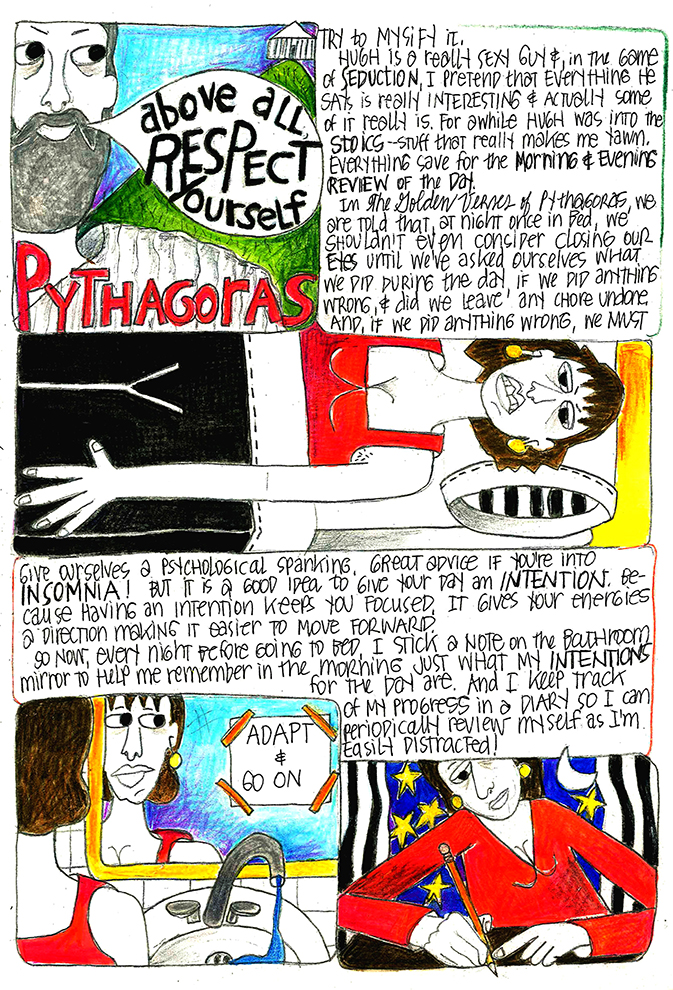
When Darwin wrote about the survival of the fittest, he wasn’t talking about working out in the gym. What he meant was: “It is not the strongest of the species that survives, nor the most intelligent; it is the one most adaptable to change.” In order to survive, one must be able to adapt to the changes that are constantly occurring around us.
something to read
Amor Towles’ A Gentleman in Moscow is a story that begins in Russia during the 1920s when the country was dominated by chaos and uncertainty following the Bolshevik Revolution.
The gentleman referred to in the title is Count Rostov, an aristocrat residing at the Hotel Metropol in Moscow. The count, for the sole reason that he’s an aristocrat, is arrested and placed upon house arrest. Thus, for the next 30+ years, the story is continually set within the context of the Metropol.
Count Rostov, despite having to continually adapt to an ever changing, ever repressing political reality, remains a gentleman. Although he has to make many compromises in order to survive, he never lets the external situation take him far away from his core. Because without integrity and honor, it’s easy to crumble.
In Greek there is a word for this love of honor: philotimo. Philotimo, the belief that it is one’s duty to do what is right, is considered the highest of all virtues.
My mother used to have a plaque in her kitchen with the saying “Virtue is its own reward.” As a child it sounded pretty cryptic but now it’s perfectly clear–if you behave like a jerk, you will feel like a jerk. So if you want to feel good, you have to be good.
-30-
Related: The entire story, 1922-1954, takes place with the structure of the Metropol Hotel. Amor Towles’ A Gentleman in Moscow can be found on archive HERE.