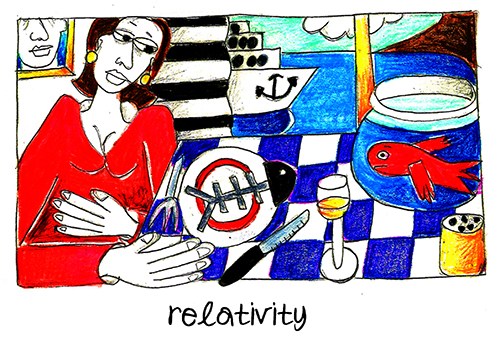
This morning I told my goldfish “it’s all relative.” He’d been looking out the window and saw the sea. “I could be there instead of here”, he’d said to himself wistfully. Reading his thoughts I said “or, instead, you could be here on my plate.”
-30-
This morning I told my goldfish “it’s all relative.” He’d been looking out the window and saw the sea. “I could be there instead of here”, he’d said to himself wistfully. Reading his thoughts I said “or, instead, you could be here on my plate.”
-30-
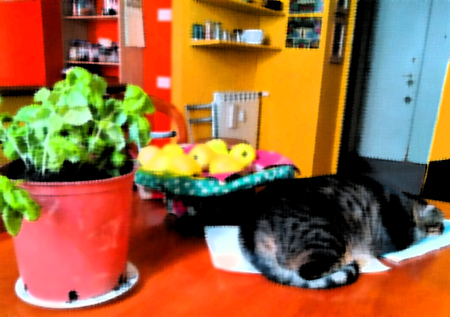
The other morning I was at the dining room table working on some notes. In front of me was a newly potted basil plant, a bowl of apples, and our cat, Volver, who was taking a nap on some of my drawings. “How lovely”, I said to myself, and smiled. This simple scene had elevated my spirits.
Beauty gives us a sensation of happiness. But if we are surrounded by ugliness and degradation, we, too, feel degraded. It’s like the Broken Window Theory—a car with a broken window is more likely to be robbed and vandalized than is a car with windows intact. Similarly, we are less likely to litter in an area that’s clean than we are in an area that’s full of trash. If our surroundings influence our behaviour, then simply being surrounded by beauty can make us a better person.
The cultivation of beauty in everyday life modifies our mind. But beauty is not just visual. In his Nobel Prize acceptance lecture, Russian-American poet and essayist Joseph Brodsky said that aesthetics is the mother of ethics. In other words, beauty is also about the way we live our lives.
Our personal aesthetics are constantly being expressed by the way we interrelate with the world around us. Smiling, expressing gratitude, or even politely waiting our turn are, for example, extensions of these aesthetics. And have you ever noticed that, after doing a good deed, you feel a pleasant sensation? Or that altruistic people seem to be happier than egotists? Could it be that practicing moral beauty can create new neurological paths and transform us into a better person?
Unfortunately, I have no time now for further reflection as pragmatic duties demand my presence. However, one thing is certain– for the Age of Reconfiguration, I want to learn how to live my life as if it were a work of art in progress.
-30-
Related: Joseph Brodsky’s Nobel Lecture + Pyotr Kropotkin’s Mutual Aid: A Factor of Evolution + Art as Experience by John Dewey + Art and Neuroscience
The Depression left some areas in the U.S. more devastated than others. Lorena Hickcock, journalist and intimate friends with Eleanor Roosevelt, travelled to the Appalachia and witnessed the desperation and the struggle for survival. Eleanor, who felt education was a necessity in a democracy, helped launch the Pack Horse Library Project sponsored by the WPA.
From 1935 to 1943, some 200 women on horseback helped deliver books to remote regions in the Appalachian Mountains. These women were paid $28 a month. They were not paid for expenses such as the horse or mule they rode.
Many men, unable to deal with the difficulties of the Depression, abandoned their families. Other men, such as miners, often fell ill due to work-related problems and could no longer provide an income especially as labour unions had no power to impose disability compensations. Women were often the only source of potential income needed to feed their children. And for this reason, they were willing to subject themselves to the difficulties of delivering books to isolated Appalachian homes.
Rural homes seldom had roads leading to them. So not only did the Pack Horse Librarians have to spend hours riding, they also had to affront aggressive geographical and extreme climatic conditions. Nevertheless, these brave women not only delivered books, they often gave reading lessons and read to the ill and the illiterate.
The most popular books were the Bible, those by Mark Twain, “Robinson Crusoe”, “Rebecca of Sunnybrook Farm”, and “Gulliver’s Travels”. Women’s magazines were also popular. The books were not supplied by the government and came mainly from donations. Thus there were a few books and many borrowers. This meant that books easily wore out. To make sure the books weren’t dog-eared, librarians made bookmarkers from old Christmas cards, wallpaper, and old flower catalogues. And what is truly amazing are the scrapbooks made to supplement the library. These scrapbooks were made from books and magazines so worn out that they were falling apart. So the librarians deconstructed them to create new books. And handwritten recipes and hand drawn quilt patterns were often included. These scrapbooks, aside from being works of art, were the testimony as to how important it was to share information—and how humans have a need for knowledge.

Jojo Moyes’ bestseller, “The Giver of Stars”, is about these librarians. The book is a lovely Sunday morning reading in bed book. The title comes from a poem by Amy Lowell. I guess a librarian could be compared to a giver of stars. Because “To seek knowledge is to expand you own universe.”
“The Giver of Stars” reiterates these concepts: 1.books are fundamental for the mind that wants to expand 2.there is power in female synergy & solidarity 3.we need to nourish that sensation of feeling good after we’ve done something good.
Beware of people who don’t like books.
-30-
Related: The Pack Horse Library Project + Horse-Riding Librarians Were the Great Depression’s Bookmobiles
Ray Yoshida scrapbook of comic book clippings + When Copy and Paste Reigned in the Age of Scrapbooking

As we age, we often begin to dislike our bodies. Pity as our home starts with our body. So if we don’t feel at home with our own selves, it’s virtually impossible to feel at home anywhere.
During the Age of Reconfiguration, it’s important to update the rapport we have we our own body. And for those of us lucky enough not to have major health problems, all it takes is what we already know—diet and exercise.
Our body can be our best friend or our worst enemy. Sometimes it all depends on us.
-30-
Related: The first home is our mother’s womb. It’s where our life begins. Ancient cultures had a respect for it that, unfortunately, is now obsolete.
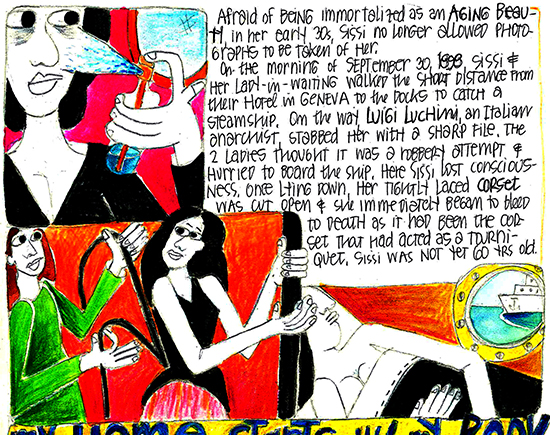
Sissi, aka Empress Elizabeth of Austria, was fixated with her physical appearance. And the older she got, the more maniacal she became. When the first signs of aging appeared, she refused to be photographed and carried a fan to cover her face. Her beauty routine took up much of her time. Not only did she exercise for hours every day, her diet consisted mainly of juiced raw veal and fruit. Sissi bathed in seaweed and olive oil and it daily took three hours to care for her knee length hair.

On the morning of September 30, 1898, Sissi was stabbed on the streets by anarchist Luigi Luchini. When the doctor came to medicate her wound, he cut open her tightly laced corset which caused her to bleed to death as the corset had been acting as a tourniquet. Sissi was only 60 years old.
-30-


 The Narrative Within