Birthday Post.

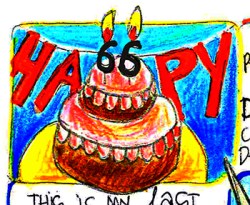
Birthday Cake

Today is my birthday. In 14 years, I’ll be 80 years old. The idea of becoming old is something I’ve been reflecting on for some time now. Especially those mornings when I wake up full of aches and pains.

Once I could do 10 things in one day. Now it seems like I need 10 days just to do just one thing. Nevertheless, I continue to overdose myself with projects that I can’t complete. My mental habits are terribly démodé but, as we all know, habits are hard to break.

Table Reconfiguration

For years we had a table on our back veranda that we never used. Then we painted it and moved it to the terrace. Now we use it all the time. All it took was a bit of reconfiguration to turn something useless into something useful. And that’s what I need– some mental restyling necessary to make space for the new me. In other words, I need to reconfigure my mental image of how I used to be with that of the way I am now.

I want the last part of my life to be the best part. That’s why I’ve written a manual for myself dedicated to the Age of Reconfiguration. It’s going to be tough as much effort and discipline will be required to keep myself mentally and physically fit. But I can’t wait to start! And will, right after my birthday lunch of truffles and wine!

Birthday Girl

(from Cool Breeze, the Age of Reconfiguration ©)

-30-

Posted in Age of Reconfiguration, Drawings & Paintings | Tagged , , , | 15 Comments

Why Keep a Journal

In “On Keeping a Notebook”, Joan Didion writes that she was just a child when she began keeping a journal. Her mother had given her a Big Chief tablet and told her, instead of whining, to amuse herself by writing down her thoughts. Joan amused herself so much that she kept on writing.
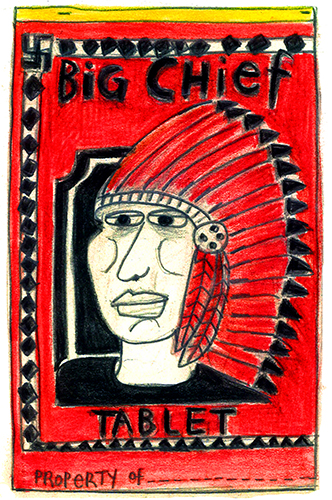
Big Chief

Joan explains that she is not interested in recording the day’s events because she finds this boring and meaningless. She prefers a journal that mixes what happened with what might have happened.

The way we write about things in our diary is how we will remember them. Memory affects our psyche (and our psyche affects everything), so if we could learn to write about what has happened in a poetic way, we could make our lives read like poetry. Like Joan, we could whine less and amuse ourselves more.

Joan wonders if the need to write about others is indirectly minimizing ourselves. For me it’s the contrary. Writing about others is like suiseki, the Japanese art of stone collecting. It’s the talent of finding something extraordinary in the ordinary. For example, if the essence of a waterfall can be seen in the particular shape of a rock, the rock is collected and then displayed in such a way as to give it artistic autonomy.

Suiseki Stone

Of his ready-mades, Duchamp said that he’d simply tried to create a new idea for an object that everybody thought they knew.

I would love to keep a diary with a suiseki spirit and, like a talent scout, discover a special story in the people around me. By writing about others, we orbit less around ourselves and give our inner world a rest.

A diary can be seen as a rough draft for a book entitled “The Way I Used To Be.” That’s why rereading old diaries makes me uncomfortable. I no longer identify with the person who wrote them because I’ve changed so much. But that’s one of the main reasons we should keep one—so that we can see that change and understand that, even still, we’re in constant motion.

My mother told me that I cried on my first day of school because I was afraid of being ridiculed for not knowing anything. My low self-esteem had me focused on how little I knew instead of focusing on how much I was going to learn. Diaries are the opposite. You think you know everything about yourself. Then you reread a diary from the past and the you from your past seems like a stranger.

P.S. It’s interesting to note that the swastika is depicted on the Big Chief tablet as it was a motif commonly found in southwest American Indian designs. The swastika dates back thousands of years but all it took was one powerful dictator to change its meaning forever.

-30-

“On Keeping a Notebook” by Joan Didion free pdf HERE.

SLOUCHING TOWARDS BETHLEHEM, a collection of essays by Joan Didion can be read via Archive.org HERE.

Related: Chinsekikan: Japanese Museum of Found Stones that Look Like Human Faces
Posted in Drawings & Paintings, NOTEBOOKS by Luz Corazzini | Tagged , , , , , , , | 2 Comments

Sometimes you catch, sometimes your throw

Mexico has left many landscapes in my mind that won’t go away. One is that of driving hours through the desert when, unexpectedly, the nothingness was interrupted by a small village of homes constructed from cardboard boxes. Poverty had not obliterated the need for beauty. The homes had been painted with bright colours and further adorned with planters made from old tires. Suddenly I understood that art is an awareness, an awareness that existence alone is not enough.

 I‘d wanted to stop to take pictures but feared doing so would show a lack of respect. So the only photo I have is that in my mind. It’s there to remind me that, to give my life purpose, all I have to do is make art.

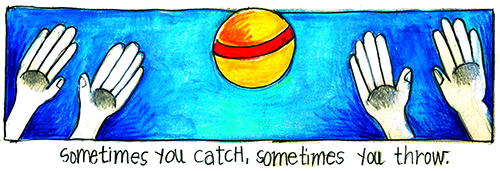
Sometimes You Catch, Sometimes You Throw

Life is not static. It’s about interrelating with yourself, with others, with the world around you. Sometimes you’re the protagonist, sometimes you’re a spectator. In other words, sometimes you catch, sometimes you throw.

It’s how you interrelate with the world around you that determines the quality of your life. You can sit there and whine about what you don’t have. Or, like the inhabitants of the cardboard village, you can paint your life.

 -30-

(from Luz Corazzini’s NOTEBOOKS ©)

Posted in Beauty, Drawings & Paintings, NOTEBOOKS by Luz Corazzini | Tagged , , | Leave a comment

Transitions.

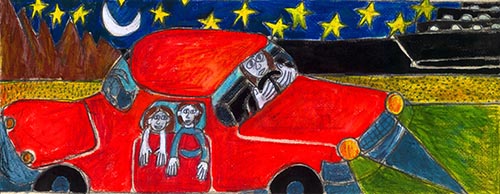
Night Driving

It’s time to move on. Time to prune the bushes and to rearrange the furniture. Time for a new hairdo.

See you in January!

Posted in Drawings & Paintings | Tagged | Leave a comment

The Bluest Eye

Toni Morrison

Toni Morrison’s THE BLUEST EYE, although beautifully written, is a difficult book to read. Its topics of racism, incest, and child molestation keep the stomach in knots. Thus, despite the magnificent prose, there can be nothing poetic about the horrors of growing up as an African-American in a WASP America.

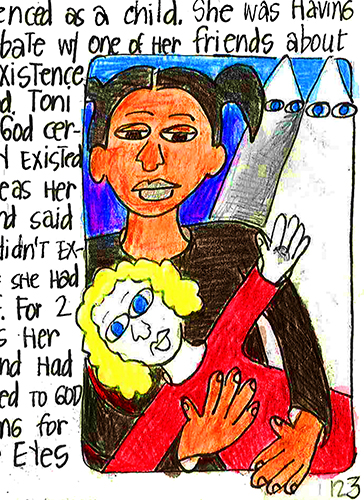
The novel gets its title from a prayer. That of Pecola, a little Black girl forced to live with a foster family because her home was burned down by her depraved and alcoholic father. Pecola considers herself to be ugly because of her dark skin. So she prays to God for blue eyes thinking that they will make her beautiful. For two years she prays but, despite all her prayers, her eyes were still brown. And for Pecola, those brown eyes are proof that God doesn’t exist.

Morrison dramatically illustrates how racism can lead towards self-hatred. And how self-hatred can lead towards insanity.

The message the book gives reminds me of Michael Jackson’s “Heal the World” lyrics. We can make the world a better place by learning to love more and to hate less.

To read THE BLUEST EYE by Toni Morrison on Archive.Org, go HERE.

Related: Lynching Postcards

-30-

P.S. Imagine that you are an American citizen born and raised in the U.S. and don’t have the right to vote. Although the Civil War, in theory, gave Black men the right to vote, it wasn’t until the Voting Rights Act of 1965 that racial discrimination in voting was prohibited.

Posted in Books | Tagged , , , , , | 3 Comments