Klerksdorp spheres

Ooparts, Out of Place Artifacts, are objects seemingly out of historical context. This includes Klerksdorp spheres described below in the articled reblogged from Archaeology Fantasies:

ArchyFantasies's avatarArchaeological Fantasies

I’ve seen this article several times now, and I meant to address it the first time, but then I got distracted by something shinny…er I mean work?

Either way, the biggest reason I let it go was that I wasn’t terribly concerned about it. I mean, these things are so obviously geofacts or frauds, who in their right mind would believe them? Then I saw this same article come across my feed on Linked-In, it kinda made me sad. So, to make myself feel better, I will explain why these 10 ‘puzzling’ artifacts are not so puzzling after all.

Sadly, as with a lot of things, it’s easy to put a lie or misinformation out there, it’s twice as difficult to explain why they are wrong. So we’ll be looking at each of these “artifacts” one at a time. Starting with:

The Grooved Spheres

Grooved Sphere The most common image of the Grooved Spheres

There is a phenomenon in the human brain called Pareidolia. This particular event is what causes us…

View original post 1,083 more words

Posted in Crafts | Tagged , | Leave a comment

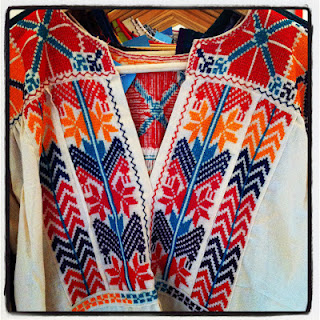
Huipil

Huipiles at Quetzallicastro:

quetzallicastro's avatarquetzallicastro

imageimage

Since the first hands that wove traditional Mexican clothing, a Huipil (pronounced wee-pil) in Nahautl language, is made of soft cotton, (with a linen feel), depicts a story which then trancends to  indigenous textiles; both for females and males. Butterflies, quetzal birds, peacocks, serpents, flowers, temple, and other original designs communicate within bright woven threads of colors. The bright colors represent nature, harmony, and the celebration of life. When laid completely flat, a huipil has a rectangular straight edged structure that resembles the shape of a cross. So, for a women to put her arms through a huipil, and be in full huipil attire, she represents the Mexican indigenous culture with pride, and she becomes in touch with the ritual of dress between both worlds, which has been passed down from generation to generation. Among many parts of Mexico, like Zapopan, Tlaquepaque, Tonala, (Jalisco) & Oaxaca, and especially in Guatemala & Yucatan…

View original post 350 more words

Posted in Fashion | Leave a comment

Photographer Graciela Iturbide: Capturing the Spirit

I am working on a book about huipiles so Frida Kahlo’s constant wearing of them interests me a lot. Graciela Iturbide is a great photographer who documented not only Friday but the women of Tehuantepec…glad to have found the post that follows below.

Broad Strokes's avatarBroad Strokes: The National Museum of Women in the Arts' Blog

graciela-iturbide_fiesta

Mexican artist Graciela Iturbide is considered on of the most important and influential Latin American photographers of the past four decades. Her oeuvre is rich in dramatic and intense imagery that portrays the surreal and spiritual aspects of daily life. Iturbide’s works reveal her compassion for and dedication to her country and its people. We are fortunate to have two of her works in the exhibition Eye Wonder: Photography from the Bank of America Collection as well as one work in NMWA’s collection.

Born in 1942 in Mexico City to a wealthy, conservative Catholic family, Graciela Iturbide was the eldest of 13 children. Despite her ambitions to be a writer, family and societal pressure persuaded her to marry at the age of 20 and have three children.

In 1969, she decided to enroll at the Centro de Estudios Cinematográficos at the Universidad Nacional Autónama de México to become a film…

View original post 386 more words

Posted in People | Tagged , , , , | Leave a comment

“Do not let your adorning be external”…

Below, reblog’d article so interesting….. manuscripts recycled for statue clothing via the blog (Roughly) Daily:

(Roughly) Daily's avatar(Roughly) Daily

In 2011, textile conservators discovered fragments of medieval manuscripts lining the hems of dresses at the Cistercian convent of Wienhausen in Northern Germany. The dresses in question, made by nuns in the late fifteenth century, clothed the convent’s statues.

The medieval dresses were made of patches of different cloth such as linen, velvet and silk, some in the form of lampas, a luxurious material, and sported rabbit fur trim. To achieve drapery-like folds in the fur, the nuns stiffened the hems by lining them with strips of parchment gathered in folds by means of a thread. The parchment… was not brought into the Convent for the purpose of lining. In fact, the manuscript fragments that have been discovered are recycled materials that include liturgical manuscripts and legal texts. Book recycling was common in the late fifteenth century, as evidenced by a manuscript from the Bodleian’s own collection (below). Because this…

View original post 226 more words

Posted in Crafts | Tagged | Leave a comment

Herbal Demon Repellent. No, really!

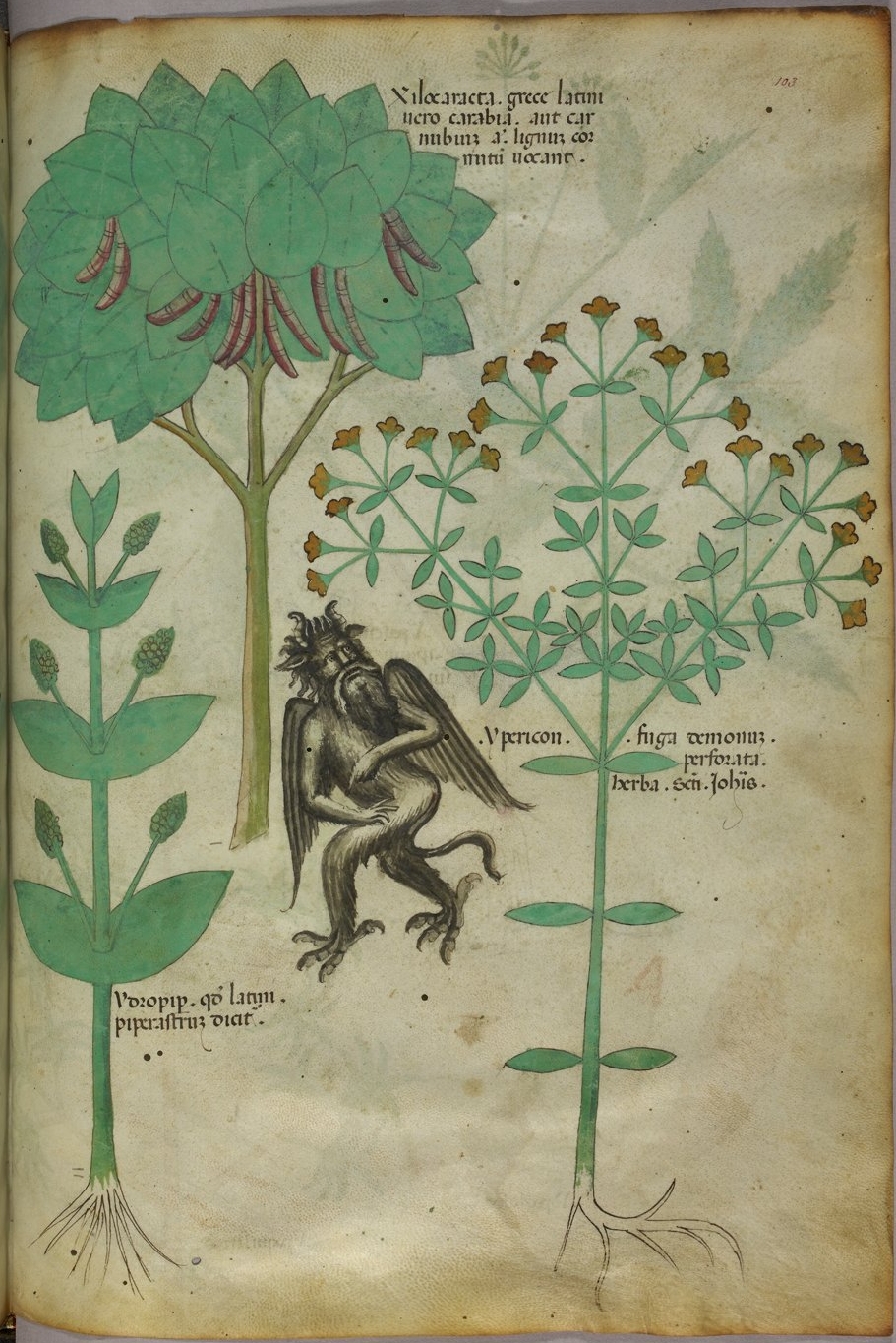
Included in my bedtime tea mix is St. John’s Wort.  It’s also know as Hypericum: The genus name Hypericum is from the Latin word hyper, meaning “above,” and icon, meaning “spirit.” The herb was once hung over doorways to ward off evil spirits or burned to protect and sanctify an area.
Below, a post from Lilith’s Apothecary with relevant info:

lilithsapothecary's avatarLilith's Apothecary Herbal Body Care

Italian 15 c manuscript image of St Johns Wort

A friend recently passed along a fabulous blog called BibliOdyssey, as well as a post with illustrated manuscript belonging to a 15th c. herbal text titled the  Codex Sloane 4016. Like other early manuscripts focusing on herbs, these treatises documented accumulated knowledge about medicinal plants from the oral tradition. In the image above you will immediately recognize St. John’s Wort as the medieval “ypericon”, known now by the latin hypericum perforatum. With the myriad uses for the invaluable St. John’s Wort, SSRI action, anti-viral activity, and vulnerary for nervous system-related symptoms among them, what I did not know was that St John’s Wort was also considered a demon repellent. And what a cute little demon we have here in this medieval illustration, not unlike the many forms of hybrid creatures found on the column lintels that would have surrounded monastic herb gardens of that period. I…

View original post 90 more words

Posted in Plants & Gardening | Leave a comment