Facials

During the Age of Reconfiguration, looking in the mirror can sometimes be a traumatic experience. Some women just shrug their shoulders at the signs of aging whereas others put their face in the hands of a plastic surgeon. But many women seek the help of beauty creams (the best, in my opinion, is aloe vera gel mixed with olive oil).

Face Cream

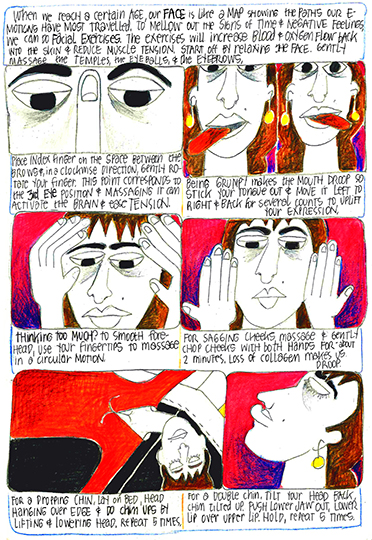
Save for sun bunnies, most wrinkles come from facial expressions. Our emotions trigger involuntary muscles that cause our face to move. Habitual feelings can make paths on our face so wrinkles are like a map showing what emotions we most travel. But facial exercises can help as they increase blood and oxygen flow to the skin as well as reduce muscle tension. Below are a few effective exercises.

Face Exercises

-30-

Posted in Age of Reconfiguration, Art Narratives, Beauty, Drawings & Paintings | Tagged , , , | 2 Comments

Facial Expressions

Facial Expressions

Feelings move your face.

Posted in Age of Reconfiguration, Drawings & Paintings | Tagged , | 1 Comment

Moura Budberg

This blog focuses on women and promotes female solidarity. To better understand our role as women today, it helps to better understand our past.

In a patriarchal society, history is written by men. Thus the way women are remembered and interpreted is generally tainted with male subjectivity. That’s why, for the past few years, I’ve tried to focus on books about women and/or written by them as I’ve been reading books written by men all my life. In middle school, the only required reading written by a female author was “The Diary of Anne Frank”.  As for high school, I don’t remember any female authors at all. On my own I read “Jane Eyre” and “Wuthering Heights”. Maybe because I went to American schools, not even Jane Austin or Virginia Woolf were on the reading list. It wasn’t until, several years ago, I read “The Great Cosmic Mother” that I realized how much my image of myself as a woman had been manipulated by the patriarchal society I was living in.

moura budberg book cover b

Moura Budberg was addicted to intensity and intrigue and was willing to do whatever it took to survive. Even live as a spy. A Russian Mata Hari, Moura (1893-1974) was born an aristocrat. Her wealthy family had connections with the Tzar, Nicholas II, and socialized with the elite. Moura had a British nanny so she grew up speaking English. But she also spoke, aside from Russian, German, French, and Italian. The knowledge of these languages would prove important in the realm of political intrigue as well as provide Moura with an opportunity to earn a living as a translator.

At the age of 18, Moura married an Estonian aristocrat who had a diplomatic post in Berlin. And for a few years, Moura had a privileged and magical lifestyle. Then, in 1914, everything changed. Tzar Nicholas and his cousin Kaiser Wilhelm were now at war on opposing sides. Plus there were uprisings in Russian that would lead to the Bolshevik killing of the Tzar and his family.

The world Moura had grown up in no longer existed. Boundaries were blurred—nobody knew whose side anyone was on anymore. There was nothing stable save for chaos.

Survival, says Darwin, is based on the ability to adapt. So for the next 60 years, Moura transformed herself into a chameleon changing herself in anyway necessary for survival.

As a young woman, Moura was tall, slender, with Slavic cheekbones and feline eyes. Not only was she physically attractive, she had an incredible wit and an ability to hold people’s attention. Moura was a mesmerizer. And she learned how to mesmerize for survival.

It was around this time that she fell in love with Robert Lockhart, a British agent. Although they would eventually go separate ways because of circumstances, it was a love that dominated her heart until her death. But even in love, Moura had numerous lovers and  numerous reason for having them.

Once the Bolsheviks gained power, survival became increasingly difficult. At one point Moura found herself homeless but had the fortune of being taken into the household of Maxim Gorky, Russian writer, founder of social-realist literature, and a political activist. Moura became Gorky’s secretary, translator, mistress, and head of his household. During the 1920s, Gorky’s political views had him exiled so the household moved to Sorrento. When Moura realized that the fascists were following her around, she demanded a meeting with Mussolini. Il Duce explained that the fact that an aristocrat such as herself was living with a socialist made him very suspicious of her. People change, she responded, just like you have. She pointed out that Mussolini himself had been a socialist working for a left-wing newspaper until he invented fascism. Amused by her response, Mussolini said he would mellow out on her surveillance. Nevertheless, Moura was ready to leave Italy and began organizing a move to England.

Via Gorky, Moura met H. G. Wells who fell in love with her. Moura was almost 30 years younger than Wells and came into his life long after he’d become famous for his science fiction novels such as ”The Time Machine”, “The Island of Doctor Moreau”, “The Invisible Man”, and “The War of the Worlds”. But despite his vast imagination, Wells was unable to imagine who the real Moura was. She refused to become his wife but, for about 20 years, she and Wells were lovers and companions.

After Wells’ death, Moura needed additional income. She became a matriarchal hostess always giving parties in her modest Kensington apartment. Her little salon gave her the chance to keep up her contacts as well as make new ones. Moura continued working as a translator but also began working with Sir Alexander Korda, a filmmaker with a dubious reputation. Now with access to the film environment, Moura took on other film related jobs such as that of a researcher, technical advisor, and film script writer. Her friend Peter Ustinov even gave her a small acting role in his comedy “Romanoff and Juliet”.

Moura’s final years were mild-mannered and sad. When, because of poor health she understood she would soon die, Moura left London to stay with her son living in Italy. Here she died a short time afterwards at the age of 82.

Moura’s presence was a bit too baroque for my tastes. However, I do admire her commitment to life and her determination to do whatever necessary to survive. She was courageous and not a quitter. Of course, Moura made some unfortunate compromises which is easy for me to say sitting here at our dining room table surrounded by plants and yellow walls that reflect the sunlight—I have never been without a home or a meal. Or surrounded by Bolsheviks ready to put me in prison. So context redefines compromise. Just as context defines basically everything. Which brings me to the following consideration:

Women need to change the context in which they evaluate themselves. Pity that we live in a patriarchal culture that expects people to adapt instead of changing the context.

Bibliography :A VERY DANGEROUS WOMAN  by Deborah McDonald & Jeremy Dronfield

-30-

Related: Empathy and Ecofeminism + THE COLLECTED SHORT STORIES OF MAXIM GORKY on Archive.org + H. G. WELLS, ANOTHER KIND OF LIFE on Archive.org + TWICE BORN IN RUSSIA (by Natalia Petrova aka Moura) on Archive.org + Agent Moura YOUTUBE + My Secret Agent Auntie        + THE LADIES FROM ST. PETERSBURG
Posted in Art Narratives, Books | Tagged , , , , , , | Leave a comment

Martha and Katherine

The non-stop drumming of the drizzling rain is giving me a headache and making it quite difficult to read Martha Gellhorn’s biography. So I am skimming the pages looking for somewhere to land. Biographies that offer only embellished chronological events nerve me out. I am at an age where I’m no longer willing to spend time on things that don’t interest me.

Martha Gellhorn

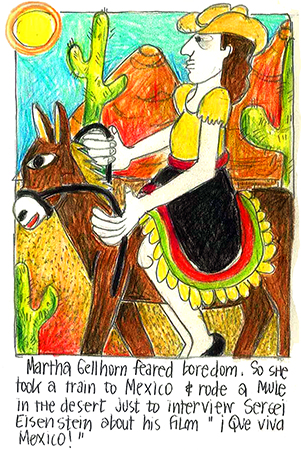
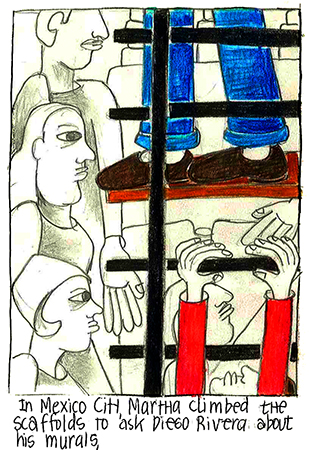
From the biography it seems Martha had a yoyo within that kept her bouncing from the desire to be alone from the desire to be in the company of exciting personalities who wouldn’t bore her. One of her many escapes from boredom found her, without passport, vaccinations, or knowledge of Spanish, on the Missouri Pacific Railroad headed towards Mexico. This terror of boredom made her audacious enough to ride a mule into the desert to interview Sergei Eisenstein about his film. And, in Mexico City, to climb a scaffold to meet Diego Rivera and to ask him about his murals. Martha was impressed that a man of “gargantuan proportions” could have such delicate hands. Being an artist, she wrote, was the “least stuck in the kitchen life” she could think of. Rivera’s blue polka-dotted shirt and his chortle laughter intrigued her. But Martha was not the only American writer who’d been charmed by Rivera.

Martha Gellhorn

For 10 years, Katherine Anne Porter had periodically called Mexico home but had finally called it quits with her second homeland just as Martha was arriving. At the end of the Mexican Revolution, Katherine, with great enthusiasm, wrote about the new Eden. Unfortunately, sometimes we travel hoping to find what’s missing at home and this can lead to expectations impossible to satisfy. Disappointed, Katherine saw the same old thing—who doesn’t have power wants it and who has it wants to keep it.

Katherine Anne Porter

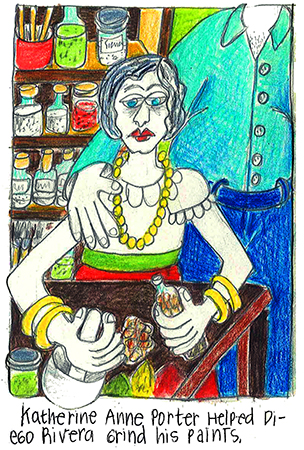
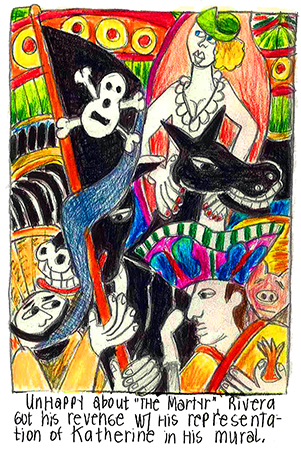
During her period of enthusiasm, Katherine was a kind of art groupie and would help Rivera grind his paints. Rivera, whose ego was as big as his murals, would often say of a woman “she mixes my paints” to indicate that she was his mistress. Once Katherine understood the extent to which Rivera orbited around himself, her enthusiasm waned, and she included him in two of her short stories, “The Lovely Legend” and “The Martyr” (the latter blatantly has Rivera in the role of Ruben who gets dumped by his muse as happened in real life when Lupe Marin left Rivera for Jorge Cuestas, the poet who later castrated himself).

It seems Rivera may have gotten his revenge. In a mural panel known as “Touristic and Folkloristic Mexico”, a blond woman who resembles Katherine is at the top of the panel representing an American tourist. The panel is a criticism of those who come to visit Mexico in search of folklore when they themselves are more folkloristic than anything Mexico has to offer.

Katherine Anne Porter

When Martha met Rivera, she was only 23. Rivera at the time was married to Frida Kahlo, just one year older than Martha. But Martha makes no mention of her. Pity as the two had common fates. Just as Martha would later resent being known only as Hemingway’s wife, Frida already resented being known only as Rivera’s wife.

-30-

related: Martha & Ernie   +  Katherine Anne Porter   +  Eudora Welty (1909-2001)

Posted in Art Narratives, Drawings & Paintings, People | Tagged , , , , | 1 Comment

Mermans and Mermaids

Hans Christian Andersen was an ugly duckling who tried all his life to become a swan. Born in Denmark in 1805, his childhood was dominated by poverty, mismatched parents, and an ambiguous sexual identity. Attracted to both men and women, for a while he focused his emotional attention on Edvard Collin, the son of his benefactor.

“Agnete and the Merman”, a traditional Danish folktale, tells how one day while Agnete is walking by the sea, a merman jumps out of the water and proposes to her.  Impulsively, Agnete accepts and goes to live with him in the sea where the couple have several merbabies. All goes well until Agnete hears the village church bells ringing. Impulsively, she returns on land for a visit but, having her feet back on the ground once again, Agnete decides to stay and not go back to her merfamily.

Andersen rewrote the folktale in the form of a love poem and sent it to Collin. For Andersen, the story of Agnete was that of “the never satisfied longing of the heart, its wondrous yearning for a new, different way of being”. Collin, instead, greatly criticized Andersen’s efforts saying that the poem was trivial, childish and desperately misshapen.

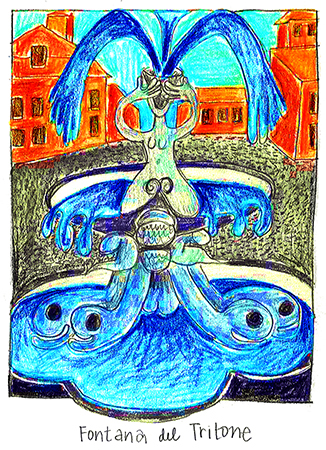
To escape his disappointment and overwhelming feeling of loneliness, Andersen decided to travel. In Rome, from 1833 to 1834, Andersen lived at via Sistine 104, in between the Spanish Steps and the Fountain of Piazza Barberini. Here he began “The Improvisatore”, the novel that would make him famous in Denmark. The novel begins with a description of Bernini’s Fountain with its Triton calming the waters by blowing on his conch shell.

Fontana del Tritone

Triton, Poseidon’s son, is half man, half fish. In other words, a merman like the one in the story of Agnete”. But Rome has mermaids, too, such as that of Piazza Navona’s Fountain of Neptune.

A couple of years after living in Rome and learning of Collin’s wedding engagement, Andersen wrote “The Little Mermaid”. It’s a story about how a mermaid falls in love with a prince after saving his life. In order to be able to follow him on land, she gets a magic potion from a sea witch that will transform her tail into legs. But it will also make her mute.

The prince finds the Little Mermaid and finds her amusing but certainly is not in love with her. Instead he falls in love with and marries a princess from a neighboring kingdom.  The Little Mermaid’s sisters arrive with a magic knife and tell their sister to kill the prince then pour his blood on her human legs so she can become a mermaid again and go back to the sea with her family and live another 300 years. But the Little Mermaid’s love for the prince keeps her from killing him. Instead she throws herself and the knife into the sea. The water starts turning red and the Little Mermaid starts turning into foam. Then suddenly she hears voices telling her that she will be rewarded for having spared the prince’s life. Instead of turning into foam, she’ll turn into air. And this will give her a chance to do good deeds so that one day she can go to the Kingdom of God.

In other words, “The Little Mermaid” is a form of gruesome religious propaganda disguised as child entertainment.  Love is not joy but self-sacrifice to earn your way into Heaven.

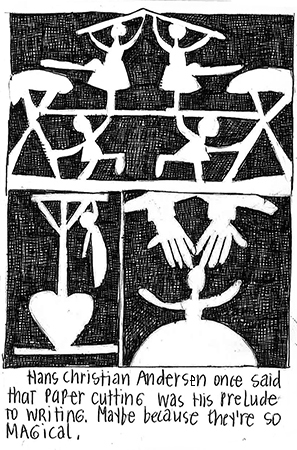
I find Andersen’s fairy tales spooky and disquieting. His paper cut outs are much more entertaining. Before TV and internet, people use to entertain themselves in other ways and one way Andersen kept himself entertained was by making paper cut outs. He would carry a pair of scissors in his pocket. Often invited to social gatherings, he would tell stories while making these silhouettes then give them away.

“Paper cutting is the prelude to writing” he once wrote.

Paper Cutting

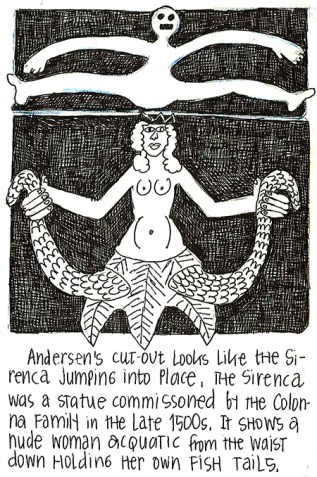
One of Andersen’s paper cuts greatly resembles those sculpted figures of a woman hold her fish tails often found on Romanesque capitals. The important Colonna family of Rome used this figure as their emblem because the siren defied the tempests.

The Sirenca

Andy Warhol was enchanted by Andersen’s paper silhouettes and a year before he died did a series of screen prints based on them.

Anderson & Warhol

Make believe is often a form of survival.

-30-

To read more about Andersen: Hans Christian Andersen : The Life of a Story Teller by Jackie Wullschläger on Archive.org


Posted in Drawings & Paintings, Roman Diary | Tagged , , , , , , , , | 2 Comments