“I have taken a good firm knot and reduced it to a mess of loose ends.” Detective Mike Hoolihan
After Martin Amis’ recent death, I came across his Night Train at our neighbourhood bookstore. It was used and discounted so I bought it.
The book, named after a song, tells the story of Detective Mike Hoolihan’s investigation of the death of Jennifer Rockwell. Was it or was it not a suicide?
Mike Hoolihan is a woman. She knows both Jennifer and her father, Colonel Tom. Both Jennifer and the Colonel were very kind to Mike when she tried to beat her alcohol dependency. So Mike feels much in debt with the Colonel. And he wants her to investigate his daughter’s death hoping that it wasn’t a suicide but, if so, what was the motivation. Why would Jennifer consider ending her life when she was “a kind of embarrassment of perfection”, an exceptionally beautiful and brilliant astrophysicist with plenty of verve and promises of success.
*Semi-spoiler alert here
Felo de se is Latin for “felon of one’s self” meaning that whoever kills themselves commits a crime. And if you commit a crime, you should be punished but how can you be punished if you’re dead? You can’t so who will pay for your gesture will be those you’ve left behind.
Jennifer had “terrific esprit” and “was unfailing cheerful. She got frustrated sometimes. We all do. Because we—we’re permanently on the brink of climax.” Mike finally comes to the conclusion that Jennifer did indeed kill herself probably because she suffered from the Paradise Sundrome. This syndrome is manifested in individuals who, despite having actualized their dreams, feel only dissatisfaction. You know, when too much is not enough.
In the U.S., the profession with the highest suicide rate is among doctors. And the lowest is, apparently, among librarians and teachers.
The county with the highest suicide rate is Lesotho with about 72% suicides per 100,000 people. Once known as Basultoland, Lesotho was a British colony from 1884 until 1966 when it became the Kingdom of Lesotho. Poverty is a leading reason for these suicides.
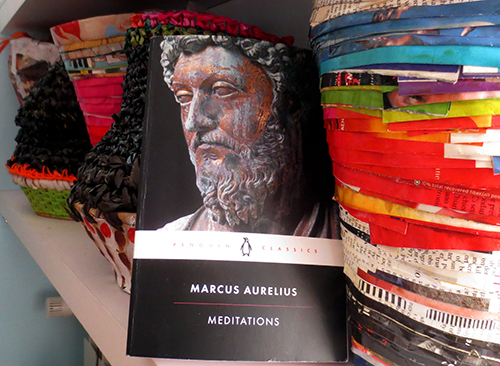
In the center of Piazza del Campidoglio in Rome, there’s a statue of Marcus Aurelius who was once Emperor of Rome. But today he is remembered, in large part, for his journal known as “Meditations” (170-180 AD). These “meditations” were dialogues he had with himself as a means of better understanding his own actions. They were meant for personal and not public use.
Marcus writes “What stands in the way becomes the way” meaning that we should learn to turn obstacles upside down. Sometimes what we see as a barrier can actually become the solution. But it is an art I have yet to master.
The mind, like the body, can become rigid and what is rigid more easily breaks than does something flexible. Like bamboo. To better adapt, maybe we should try stretching both body and mind.
Muscles that are contracted for too long become stiff and difficult to use. The same goes for the mind. A mind that is contracted because it keeps thinking the same thoughts over and over again becomes rigid and difficult to use.
“That all is as thinking makes it so” writes Marcus. Therefore, suggests Marcus, we should learn to control our thoughts. One’s perspective of a situation determines how the situation is affronted and experienced.
Meditations is not a book that can be easily absorbed. A book of reflections, it encourages its readers to reflect as well. Theodore Roosevelt brought a copy with him on his River of Doubt expeditation. The former Prime Minister of China, Wen Jiabao, read Meditations over 100 times whereas collective bargaining creator, Beatrice Webb, referred to Meditations as her Manual of Devotion.
Marcus, like other Stoics, saw journaling as a way of gaining insight into one’s own behavior. Writing about yourself will help you learn about yourself.
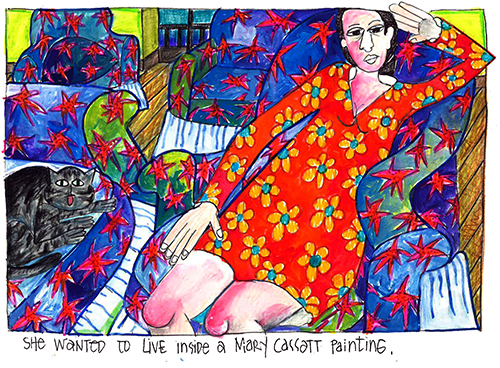
If I could step into a painting, it would be a painting by Berthe Morisot or Mary Cassatt. They are paintings that talk about women and their spaces. Plus they are very pretty.
Mary Cassatt’s parents were not only wealthy, they were also very progressive. They believed that their daughters should get a good education. And, as travel was considered an integral part of education, the family spent five years travelling around Europe. At this time, Mary visited the Paris World’s Fair of 1855 and was thus exposed to French artists such as Ingres, Courbet, Delacroix, and Corot. It was all very exciting, too exciting because, once back in the States, Mary felt restless. She would not be happy until she was back in France. But she would have to wait until the end of the Civil War. Although her father initially objected, Mary returned to Paris in 1866 with her mother acting as chaperone.
Paris may have been avant-garde compared to the U.S.A. but it was still rather retro in terms of women’s access to education. Mary, determined to study, found private tutors and in 1868 one of her paintings was accepted for the Paris Salon. Obviously Mary was pleased but she could already tell that the Salon was stuffy and stuck in the past.
At the beginning of the Franco-Prussian War, Mary was sent back to the States where she lived with her family. Her father was not enthused about Mary’s desire to study art. But Mary did not let her father’s objections diminish her desire to make art. Luckily, fate was her friend. A Roman Catholic bishop from Pittsburg commissioned Mary to make copies of paintings by Correggio. To do so, Mary had to go to Parma.
Sponsored by the bishop, Mary went back to Europe. After finishing her commission, she decided to stay in Europe and, in 1874, Mary moved to Paris with her sister. Degas had seen Mary’s paintings and was impressed. So, in 1877, Degas invited Mary to participate in an exhibition sponsored by the Impressionists.
Mary and Degas developed a somewhat peculiar relationship over the years. Some speculate that maybe there had been intimacy between the two but that is really difficult to believe. Degas was a misogynist with a strong interest in the Petits Rats, young girls studying ballet at the Paris Opera who were generally exploited by older wealthier men with backstage passes. As for Mary, Degas once told friends that he could marry Mary but could not in any way make love to her.
Mary and other female artists were limited in the environments they could frequent. But one place where women dominated was in the home. Impressionists looked towards daily life to find subject matter for their paintings thus giving women painters the possibility to paint scenes not previously considered art worthy.
“The Bath” by Mary Cassatt
Not having children of her own meant Mary had more time to paint. And often she chose to use that extra time to paint the children of others.
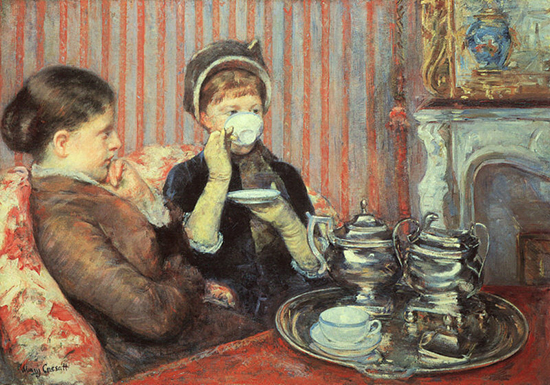
Five O’Clock Tea by Mary Cassatt
Although social constraints of the time did make participating in certain activities impossible for women, afternoon tea was a typical social event for upper middle-class women. Women thus used sociability as a means of empowerment. Mary’s painting Five O’Clock Tea documents this type social engagement. There is a feeling of compressed space and constraint making the mood somewhat ambiguous.
Another American ex-pat in Paris at the time was Abigail May Alcott, one of the Little Women. May was a talented painted but was tremendously overshadowed by her famous sister.
Giuseppe Ungaretti (1888-1970) is considered one of Italy’s great modern poets. Like other Futurists, he supported WWI believing a bit of aggressive agitation could help regenerate and energize Italy. So he enrolled in the infantry serving in the trenches. But war was not as poetic as he thought. While in the trenches he reflected on the existential aspects of the war and began keeping a piece of paper and pencil stub in his pocket and started writing verses. But the trenches are not the easiest place in the world in which to write. You never knew when you’d have to pick up your gun and shoot or be shot at. So Ungaretti developed a style that was minimal and to the point.
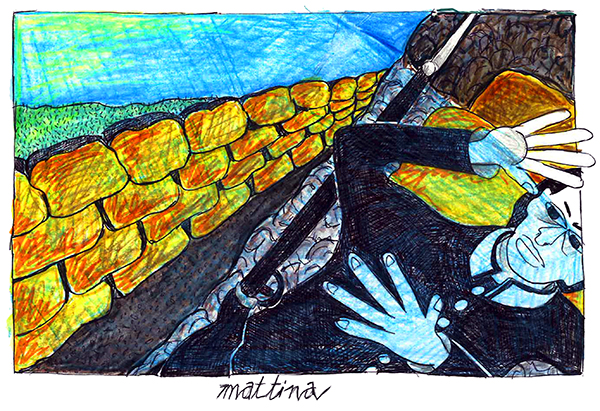
One of Ungaretti’s most famous poems is “Mattina”, that is, “Morning”:
M’illumino d’immenso
These four words are a translator’s nightmare thus many variations exist of this one simple phrase. Examples include:
I illuminate (myself) with immensity
and
Immensity fills
Me with light
The above are two variations but there are others as well. However, the best way to understand this poem is to understand its context.
Imagine yourself, a young man stuffed with radical ideas, forced to live in a trench. Suddenly the big ideas seem so small and the small things so big. After a day of skirmishes, you fall asleep exhausted in the trench in total darkness. Your ideals are losing their glitter but you wake up and above you is this immense sky. The sun is rising and covers you with its light.
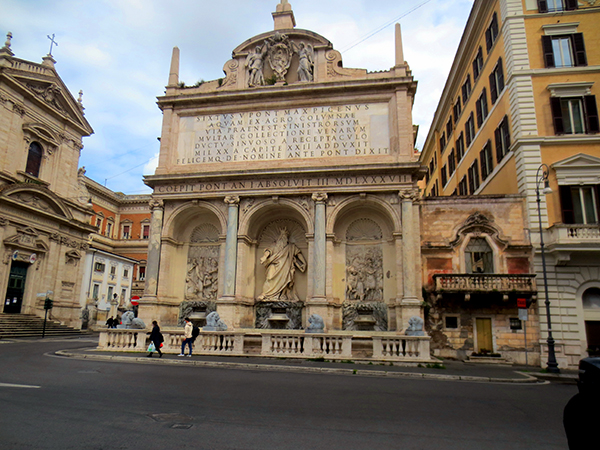
Fontana del Mosè
Around 1585, Roman citizens complained that there was a need for more drinking water. So Pope Sixtus had several of Rome’s ancient aqueducts restored including the Acqua Felice aqueduct. Once the latter was finished, to publicize what he’d done for the citizens, the Pope commissioned the fountain known as Fontana del Mosè. Located just around the corner from Bernini’s Ecstasy of Saint Teresa, the fountain’s sculptural iconography blends many biblical and political motifs. But the focus is on the large central statue of Moses added in 1588.
foto by By Jörg Bittner Unna
If you look closely at Moses, you’ll notice a pair of horns growing out from his head. We can find the same horns on Michelangelo’s Moses found at the Basilica of St. Peter in Chains (so named because it houses the chains used to imprison Peter in Jerusalem).
So why were these horns placed on Moses’ head? Most scholars agree that the horns are a product of a bad translation. In Exodus 34:29 we’re told that when Moses came down from Mount Sinai with the two tablets of the covenant in his hands, he was so happy that his face actually shone. In fact, he was so radiant that two rays of light came out from his forehead.
The Old Testament was written in Hebrew and Aramaic. In Hebrew “karan” or “karnaim” meaning “rays” could have been confused with “keren” meaning “horn”. In other words, Moses has horns thanks to a bad translation.
According to the Wycliffe Global Alliance with its mission of translating the Bible into every possible language, as 2022 the Bible has been translated into 724 languages. Just in English alone the Bible has been translated into over 100 versions. Same language, same book yet, nevertheless, translated in a variety of ways resulting in a variety of meanings.
Catholics have their own version of the Bible whereas Protestants have traditionally used the King James Version. The Old Testament was written in Hebrew and Aramaic whereas the New Testament was written in Greek that was later translated into Latin. Now imagine all these various translations, which existed before the printing press and word processors, being recopied by scribes. It generally took a scribe 15 months to copy just one Bible.
There’s even a New International Version (revised in 2011). And in Britain another version of the Bible came out in 1996 with an “inclusive language” edition but its publication in the U.S. was opposed by conservative evangelical groups who resented the gender-neutral language.
As with the poetry of Ungaretti and the Horns of Moses, translations can be misleading. And wrong.
Now why would anyone want to base their code of ethics on a bad translation?









 The Narrative Within