Dorothy Parker’s Cup of Tea   

During the spring, when sitting outside, I like to watch the bees buzz from one flower to another. Everything is calm and silent save for their humming. So I watch them flit from one flower to another until I’m dizzy and have to look away.

Sometimes my mind acts like a bee. It jumps from one flowered thought to another just buzzing around without a destination. Motion without purpose can be fatiguing so, to convince my wandering mind to stop and focus, I read a short story. It forces me to regroup scattered thoughts and focus on one thing.

“Reading is socially accepted dissociation. You flip a switch and you’re not there anymore. It’s better than heroin.”  Mary Karr

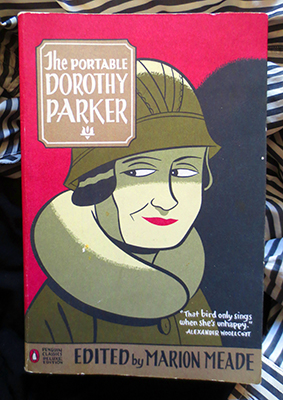
Dorothy Parker, because of her sharp wit, was known as a wisecracker. Her childhood had left her permanently jaded. You can feel her disappointment and chagrin in the stories that she writes. Take, for example, “The Last Tea.”

For 45 minutes a young woman wearing an artificial camellia sits in a tearoom waiting for her date to show up. When he finally arrives, she pretends that she just arrived, too. This Little Lie is the first indication that an emotional and psychological inequality exists between the two.

Initially the man suggests that he’s late due to an indisposition bringing out the material instinct in the woman until she learns that this indisposition has a name: Carol McCall. Humiliated, the woman then proceeds to save face via Wally Dillon, an imaginary suitor invented ad hoc. The man and the woman now initiate a kind of ping pong where they both serve the other with exaggerated compliments about their newly found prospects. The rally comes to a halt when the man tells the woman he needs to call Carol immediately. Hurt, the woman recovers by saying she’s got to run as she’s late for her appointment with Wally. Unfortunately, she then makes the mistake of asking “when will I see you again?” to which the man basically replies “Don’t call me, I’ll call you.”

Why, why, why do women let themselves be humilitated like this?

Dorothy Parker was not only a talented writer, she was a highly vocal advocate of civil liberties and civil rights. The writer collaborated on various screenplays for films that were nominated for an Academy Award (ex. A Star Is Born). But her political beliefs led to her being blacklisted by Sen. Joseph McCarthy & Co. putting an end to her rising career.

Worn out and disappointment, Dorothy began to drink heavily. In 1967, she died of a heart attack at the age of 73. She’d left her entire estate to Martin Luther King Jr. that, upon King’s death, went to the NAACP.

Dorothy was cremated but no one ever came to collect her ashes. So the crematorium eventually sent her urn to her lawyer who simply put the urn in a filing cabinet where it remained for almost 20 years. When the story of Dorothy’s abandoned ashes became public, not only did the NAACP immediately claim them but designed a special memorial garden in their honor. But when the NAACP headquarters moved, the ashes were transferred to a family plot in the Bronx.

So, some 53 years after her death, Dorothy’s ashes finally found a home. No wonder Dorothy suggested as her epitaph “Excuse my dust.”

Here are some Dorothy Parker quotes worth remembering:

“Beauty is only skin deep, but ugly goes clean to the bone.”

“If you want to know what God thinks of money, just look at the people he gave it to.”

“The first thing I do in the morning is brush my teeth and sharpen my tongue.”

“Heterosexuality is not normal, it’s just common.”

“Don’t look at me in that tone of voice.”

“Tell him I was too fucking busy– or vice versa.”

“If you wear a short enough skirt, the party will come to you.”

-30-

Related: Dorothy Parker, An Unwavering Legacy (NAACP) + Dorothy Parker: ‘She was a star, but a dark star’ + Poet-screenwriter Dorothy Parker Was Wisecracking Feminist Accused of Communism + Before Pop Culture Feminism +

Posted in Books, Ecofeminism, female consciousness, politics | Tagged , , , , , , , , , , | Leave a comment

More Recycled Frames

Not too long ago I posted about making frames from old books. But, if you give yourself some time to play, you can make frames from just about anything.

It’s lovely to receive postcards but often they get tossed away or abandoned in a drawer. So I made frames for postcards where the corners are inserted into slits securing the card in place but not compromising the writing on the back. And they would make great frames for kids’ school drawings, too.

Above are frames made using newspaper strips, plastic detergent bottles, egg cartons, cardboard, and shoe box lids.

The above is made from a piece of styrofoam packaging,

These frames were made simply to experiment with different materials. The craftsmanship is therefore “expressionistic” and lacks precision.

-30-

Posted in art, Crafts | Tagged , , , , | Leave a comment

Changes.

My left shoulder is blocked. Maybe I would have continued to ignore it had it not been for the pain. So my doctor sent me to a physiatrist who said heavy duty physical therapy was needed unless I preferred an operation. And that’s how I met Marco the Physical Therapist. At our first encounter we barked at one another. No big deal just establishing territorial domain as most animals do.

Περνούσε τις Τρίτες και τις Πέμπτες με τον Φυσικοθεραπευτή της

My mom told me that when you grow old, no one pays attention to you. So to make sure that I got the attention that I needed, I’d always wear a bright violet gym suit.

Marco and I soon became a team and after a few weeks of therapy, I regained much mobility and felt less pain. When I was finally able to touch my head again with my left hand, I cried—it was the first time I’d been able to do so in months and the joy was immense.

Sometimes you don’t know what you’ve got until you lose it.

Unexpected Change

Last December the British writer Hanif Kureishi and his wife were vacationing in Rome. On the day after Christmas, the couple took a walk around Piazza del Popolo and Villa Borghese. It was a fabulously beautiful day but Kureishi was feeling dizzy so they went home. Here Kureishi blacked out and fell down with a thump. When he came to, Kureishi found himself in a pool of blood, his neck grotesquely twisted and his wife kneeling next to him.

Kureishi was taken to Rome’s Gemelli Hospital where he learned that he couldn’t use his arms and legs. Despite spinal surgery, the British writer was no longer autonomous.

Kureishi was born in London. His dad was Pakistani and his mom English. In his early twenties, he earned a living as a pornography writer (using pseudonyms of course) before writing screenplays. I learned about Kureishi from my friend, Mona who spent much time in London.

The only Kureishi book I’ve read is The Buddha of Suburbia. As with other Kureishi stories, the book focuses on the experience of being Pakistani in London. Constantly dealing with racial discrimination and cultural confusion can make life fatiguing. So “we must find an entirely new way of being alive” writes the author.

Now, despite being unable to physically write on his own, Kureishi uses a dictation machine that allows him to post on Twitter. Here he documents his entirely new way of living. Despite the tragedy, the author writes that he hasn’t “lost the one thing that was most valuable to me, that is my ability to express myself.”

Kureishi is not the first to practice Twitterature using tweets as a literary devise. I follow the author c.c. o’hanlon, an Australian writer married to an American. Using the minimalism of Twitter’s limit of 140 characters, O’Hanlon describes the odyssey he must endure searching for a new home.

Related: A Writer Collapses. As He Recovers, His Dispatches Captivate Readers + Death was chattering to me, says writer Hanif Kureishi + He’s Tweeting for His Life + Hanif Kureishi’s TWITTER + Nurse! My pen! Hanif Kureishi’s hospital musings and the art of sickbed writing + My friend David Bowie by Hanif Kureishi +

Hanif Kureishi: “Che umiliazione dipendere dagli altri. Sogno di andare a comprare dolci a mia moglie e di diventare italiano” + THE KUREISHI CHRONICLES +

Posted in Art Narratives, Books, Health & Healing | Leave a comment

Beauty is Medicine

Patrick Bringley worked at the NEW YORKER magazine. It was a flashy job that stopped shining when his brother became seriously ill and subsequently died.

Grief rearranges one’s priorities. Patrick no longer felt the need for a glamorous job.  He needed something powerful enough to help him absorb his grief. When he was a child, Bringley’s mother used to take him and his brother to visit museums. Remembering the pleasure all that beauty gave him, Bringley abandoned his trendy job to become a museum guard at the Met.

Research shows that appreciating beauty distracts you from your misery thus helping to heal anxiety and depression. Engaging with beauty can help reduce inflammation, diabetes, cardiovascular diseases, as well as other stressed produced illnesses.

Experiencing awe because of beauty is a transcendental experience and sometimes the more we transcend ourselves, the easier it becomes to feel better.

Says Bringley: “I arrived at the Met with no thought of moving forward. My heart is full, my heart is breaking, and I badly have to stand still awhile.”

After 10 years of working as a Met guard, Bringley felt it was time to move on. He is now married and the father of two and providing for his family, his main priority. Despite the Met’s sock allowance for guards, the pay was not enough for a family man.

I, too, like Bringley sought solace in beauty after the death of my mom. Grief distorts your perception and you can feel that that darkness within will never go away. Grief that goes into loop needs to be nipped. And, for myself, the best way to do so is to replace negative thoughts with positive ones. Since when we are sad it is difficult to think about happier times, I’ve created a Pretty Memories catalogue as a reminder that life has been very generous with me.

Paintings are like opened windows waiting for you to jump inside. Some beauty is louder than others and shouts out your name. Some beauty is ignored as not everyone understands its nuances.

In a fairly recent study, researchers found that just 13% of artists featured in museum collections were women. And as women are so severely underrepresented in the art world, I am posting below five works by women that can be found at the Met.

Marie-Josephine Charlotte du Villers by Marie Denise Villers

Marie Denise Villers (1786-1868) was born in Paris just 15 years before the French Revolution. Marie was a trained Neo-classical portraitist. In her mid-20s, Marie began taking painting lessons with Jacques-Louis David. She also married an architecture student who supported his wife’s artistic career and did not expect her to give it up as was the norm at the time.

Although the above portrait is catalogued as the portrait of Charlotte du Val d’Ognes, it’s believed by some to be Villers’ self-portrait. For many years academics believed that the portrait had been painted by David refusing to believe that a woman could be as talented as a man.

 Buffalo Bill by Rosa Bonheur

Rosa Bonheur (1822-1899) loved animals and paintingthem was her passion. She was homosexual and had to get authorization from the Prefecture of Police to wear men’s clothing in public. She wanted to wear men’s clothing because it made it easier for her to get around and she had things to do.

Rosa was taught to paint by her father, an artist and a member of the Saint-Simonian movement that promoted social justice.

When Buffalo Bill took his Wild West Show to Paris in 1889, Rosa went to the grounds so she could sketch the exotic American animals. Here she met Buffalo Bill and invited him to her chateau at Fontainebleau where she painted his portrait (shown above).

Rosa is buried at Pere Lachaise Cemetery in Paris next to her companion Anna Klumpke.

Portrait of Rosa Bonheur by Anna Klumpke

Anna Klumpke (1856-1942) was born in San Francisco into a wealthy family. At three, she fell and broke her femur making it difficult for her to walk. So her mom took her to Europe hoping to find a cure. The geographical distance permanently alienated her parents one from the other so they divorced and Anna’s mother decided to live in Germany with her children.

In 1877 Anna moved to Paris with her family. Here she began studying art at Académie Julian

As a little girl, Anna had played with a “Rosa” doll. That is, a doll modelled after Rosa Bonheur who was very famous at the time. So it must have been a shock when in 1895 Anna met Rosa. Anna wanted to paint Rosa’s portrait. Rosa had a studio set up for Anna in exchange of three portraits of her done by Anna. Anna was also to write Rosa’s biography.

Although there was a c. 35 years difference in age, the two were very compatible and lived together until Rosa’s death. Anna and Rosa are buried together with “Friendship is divine affection” written on their tomb.

The Pink Dress by Berthe Morisot

Berthe Morisot (1844-1895) enchants me. The great-niece of Rococo artist Jean-Honoré Fragonard, she was intrigued by Edouard Manet. Despite her knowledge about what had happened to Victorine Meurent, Manet’s previous model, Berthe became his model, muse, and maybe even his lover. Manet was a real lady’s man. Zola called him “an elegant cavalier” who, it seems, often behaved as a cad. Although Manet was married, he had no problems having lovers.

In all the emotional and social confusion, Berthe married Manet’s brother. Manet might have been an incredible painter but he was not a gentleman. Once Berthe had become an established painter, Manet told a group of friends that “My sister-in-law would not have existed without me.” But by dumping her, he did Berthe a favor. Because of his many lovers, Manet painfully died of syphilis.

Morisot would later state: “I do not think any man would ever treat a woman as his equal, and it is all I ask, because I know my worth.” 

“The Cup of Tea” by Mary Cassatt

Mary Cassatt (1844-1926)

In terms of conditions of possibility, Mary had it better than most as an aspiring female artist of the times. She came from a very wealthy family who could afford to help Mary achieve her goal. When just in her 20s, Mary convinced her parents to let her study in Paris where she initially took private lessons with the well-known artist Jean-Léon Gérôme. In additions to her studies with Gérôme, on most days Mary would go to the Louvre where, along with other “copyists” she studies the masterpieces.

Edgar Degas saw one of Mary’s paintings at an exhibition and later invited her to show her works with the Impressionists. Degas and Mary created a very strong rapport that lasted until his death in 1917.

Mary Cassatt US Postage

-30-

Related:  The Healing Power of Nature and Beauty: Florence Nightingale on Expediting Recovery from Illness and Burnout +

Wild West shows + Buffalo Bill aka William Cody + I butteri maremmani finiscono sul New York Times; this article is about how an Italian cowboy (buttero) defeated Buffalo Bill +

Fragonard and Morisot? + Berthe Morisot and Édouard Manet: Painters in Paris + The Gaze of Victorine Meurent +

The above ladies on Wikipedia: Marie-Denise Villers + Rosa Bonheur + Anna Klumpke + Berthe Morisot + Mary Cassatt +

Sisters, Cancer and the Cathartic Power of Art + Art therapy Brought Her Back,Video on treating dementia with art

Posted in art, Beauty, Books, female consciousness, Paris, PRETTY MEMORIES | Tagged | 2 Comments

Landscape in Motion

Recently I posted about making picture frames from paperback books. And here’s my first experiment.

The book frame is small, c.10.5 X 15 cm. There’s still much retouching to do but it’s a quick and easy project. And I have many outdated manuals that would make great frames.

So now that our dining room table has become my playground, I will try experimenting with cardboard food trays, too. Since covid, there’s much more food packaging to dispose of. And THIS foto is a good example of how these cardboard trays can be used.

For more CARDBOARD FRAMES: see my Pinterest board showing cardboard frames

Posted in art, Books, Crafts | Tagged , , , | Leave a comment